
The consultancy also predicts that the global lithium-ion BESS market will reach a value of $135 billion by 2037, driven, among other factors, by greater integration of renewable energy sources into electricity grids and by new demand associated with the expansion of data centers.
BESS gains ground in battery demand.
Lithium-ion batteries continue to be the dominant technology in the stationary BESS market, according to IDTechEx, which attributes this position to their availability, cost, and evolving performance.
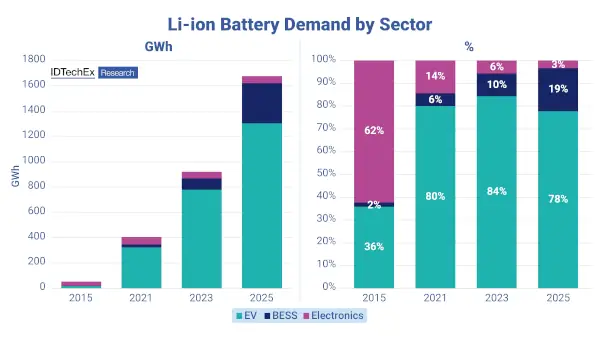
Although electric vehicles still account for the majority of global demand for lithium-ion batteries, their share fell from 84% in 2023 to 78% in 2025. Over the same period, the share for BESS applications increased from 10% to 19%.
IDTechEx links this shift to both the evolution of the electric vehicle market and the faster growth in demand for stationary storage, as grids incorporate more renewable generation and require additional flexibility resources.
China accounted for 58% of
global deployments of lithium-ion BESS in 2025, while the United States accounted for another 18%.
At the same time, markets that previously had a smaller presence have entered the top ten countries by deployed capacity. The report specifically cites the cases of Saudi Arabia and Chile.
Among the mechanisms facilitating new projects, IDTechEx identifies contracting, financing, and revenue support systems. The text mentions Australia's Capacity Investment Scheme (CIS), New South Wales' Long-Term Energy Service Agreements (LTESAs), Italy's MACSE mechanism, Middle Eastern state-backed tenders, and the UK's cap-and-floor model for long-duration storage.
Network connectivity is emerging as a bottleneck.
Market growth is also facing limitations. IDTechEx identifies network connection queues as one of the main bottlenecks for new projects.
This situation can lead to delays and the cancellation of some developments. At the same time, increased competition among developers is raising the barriers for new entrants in network-scale storage projects.
Battery Prices and Regulatory Changes:
Another source of uncertainty stems from raw material prices and trade policies.
The report notes that China's reduction and subsequent elimination of VAT refunds on battery exports could impact future cell and BESS system prices.
IDTechEx also links this process, along with other factors, to the lithium carbonate price increase recorded in early 2026. If these levels persist, they could exert upward pressure on cell and BESS system prices and affect the profitability of certain projects.
Containerized BESS Systems of 6.5 MWh or More:
In the technological sphere, manufacturers are introducing containerized BESS systems that utilize higher-capacity cells. This evolution is increasing the number of solutions with a capacity of 6.5 MWh or higher.
The use of higher-capacity cells can increase system-level energy density by reducing the number of cells, interconnections, and casings required per MWh stored. It can also decrease the number of BESS units needed to achieve a given capacity in an installation.
However, the increased capacity and density introduce new thermal management requirements and can create weight-related restrictions during transport, factors that are influencing the design of these systems.
LFP, Sodium, Flow Batteries, and Long-Life Storage:
The report, Batteries for Stationary Energy Storage 2027–2037, also analyzes the technological evolution of energy storage systems, including lithium-ion batteries (with LFP and NMC chemistries), sodium-ion batteries, redox flow batteries, metal-air batteries, lead-acid batteries, and thermal storage.
The study also addresses long-life energy storage (LDES), the costs of different BESS components, power conversion systems, battery management systems (BMS) and energy management systems (EMS), as well as safety and thermal management strategies using air, liquid, or immersion cooling.