

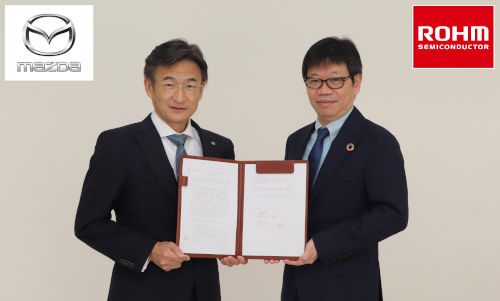
ROHM will undertake the joint development of inverters for the e-Axle by participating in a "cooperative framework for the development and production of electric drive units" with companies such as Imasen, led by Mazda. Simultaneously, ROHM will contribute to the creation of compact, high-efficiency electric drives by developing and supplying advanced SiC power modules that deliver enhanced performance.
Through this collaboration, ROHM will develop even more competitive MOSFETs and SiC modules, working backward from the finished vehicle to understand the performance and optimal drive method required by power semiconductors.
In addition to creating new value through mutual understanding between car and device manufacturers, the three companies also support technical innovation in the automotive field and contribute to a sustainable society by leveraging the extensive knowledge, technologies, and products accumulated globally.
Katsumi Azuma, Director and CEO of ROHM Co Ltd, stated, “We are very pleased to collaborate with Mazda on the development and production of the e-Axle. Mazda is committed to delivering a 'driving pleasure' that expresses the inherent appeal of cars. Through this partnership, we hope that by reflecting genuine demands and requests in our products, we can develop automotive systems that contribute to decarbonization, while also allowing us to better understand Mazda’s goal of creating cars that are sustainable for the earth and society. As the role of semiconductors in the automotive market continues to grow, ROHM will strive to manufacture high-quality products and contribute to the creation of a sustainable mobility society by offering a wide range of solutions.”
 In the case of electric vehicles, more compact, efficient, and lightweight electrical systems are being developed with the goal of achieving carbon neutrality. Especially in electric vehicles, the inverter, which plays a central role in the propulsion system, must be more efficient to extend range and reduce the size of the onboard battery, thus increasing expectations for SiC power devices.
As the world's first supplier to begin mass production of SiC MOSFETs in 2010, followed by the first complete SiC power modules in 2012 and trench-type (3rd generation) SiC MOSFETs in 2015, ROHM continues to develop SiC device technologies ahead of the industry.
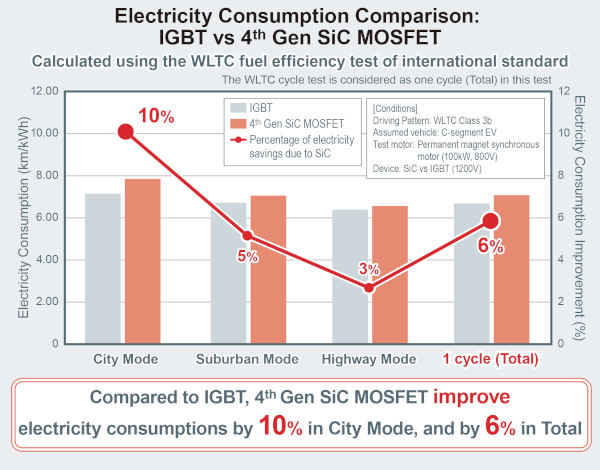
In 2020, ROHM completed the development of its latest 4th generation SiC MOSFETs, which offer the highest short-circuit withstand time and lowest on-resistance in the industry. This enables extended electric vehicle range by reducing energy consumption by 6% compared to IGBTs (based on WLTC fuel efficiency test calculations) when installed in the main inverter. In addition to bare chips, ROHM is currently developing products with discrete packages, and this collaboration will allow us to develop and offer power modules equipped with the latest 4th generation SiC MOSFETs.