

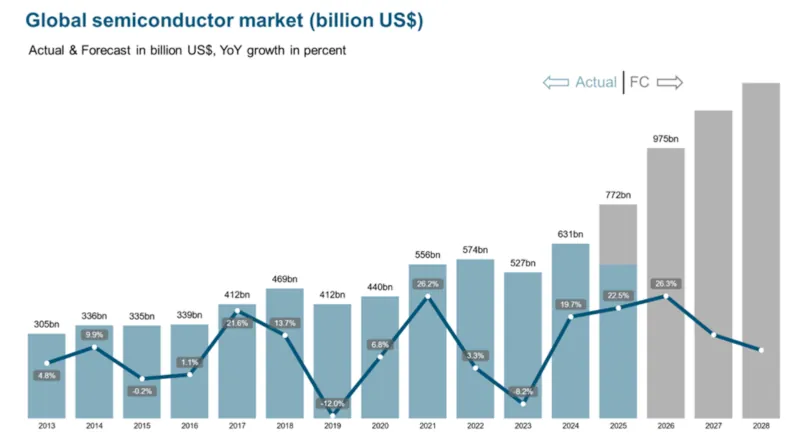
2025: fuerte crecimiento impulsado por la lógica y la memoria; otros segmentos muestran una recuperación gradual Tras un tercer trimestre mejor de lo esperado, se prevé que el mercado mundial de semiconductores crezca un 22,5 % en 2025, hasta alcanzar los 772 200 millones de dólares.
La revisión al alza se debe principalmente a la lógica y la memoria, impulsadas por las aplicaciones relacionadas con la inteligencia artificial y la demanda continua en infraestructura informática y de centros de datos. Ahora se espera que la lógica crezca un 37,1 % (8 puntos porcentuales más) y la memoria un 27,8 % (11 puntos porcentuales más). Otras categorías de productos están mejorando tras el ciclo bajista de 2024, pero la recuperación sigue siendo moderada:
sensores +10,4 %, microprocesadores +7,9 %, analógicos +7,5 % y optoelectrónica +3,7 %.
Se espera que el segmento de productos discretos experimente un ligero descenso, debido principalmente a la continua debilidad de las aplicaciones automovilísticas.
A nivel regional, se espera que Asia-Pacífico y América crezcan entre un 24,9 % y un 29,1 %, lo que refleja la fortaleza de la lógica y la memoria. Se prevé que Europa crezca un 5,6 %, mientras que Japón experimentará un descenso del 4,1 %.
Perspectivas para 2026: crecimiento mundial continuado de los semiconductores hasta alcanzar casi 1 billón de dólares estadounidenses
Para 2026, la WSTS prevé que el mercado mundial de semiconductores crezca más de un 26 %, hasta alcanzar los 975 500 millones de dólares estadounidenses. Se espera un crecimiento en todas las regiones y categorías de productos. Se prevé que la memoria y la lógica vuelvan a liderar el crecimiento, con un aumento interanual superior al 30 % en ambos casos. Se espera que la mayoría de las demás categorías de productos continúen su recuperación gradual, expandiéndose a un ritmo más moderado.
A nivel regional, se espera que todos los principales mercados se expandan. América y Asia-Pacífico siguen siendo los que más contribuyen, mientras que se prevé que Europa y Japón experimenten un crecimiento de dos dígitos bajo.
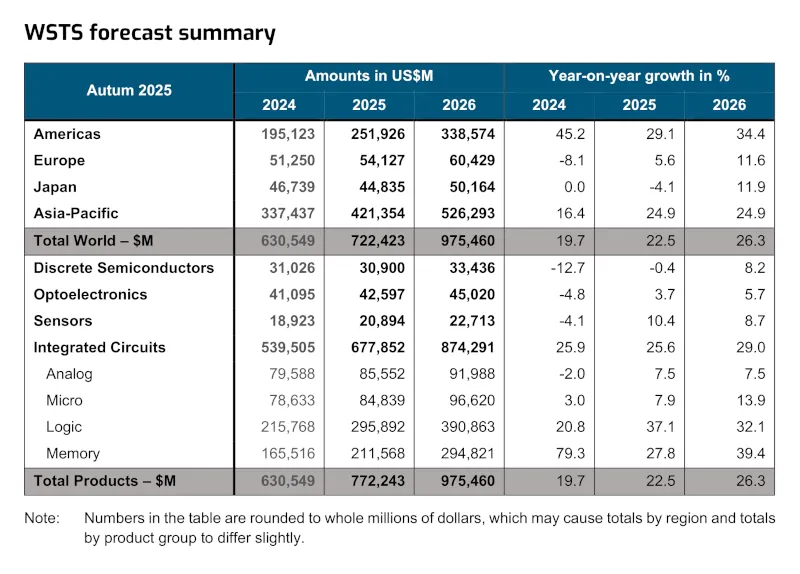
Nota: Las cifras de la tabla se han redondeado a millones de dólares, lo que puede hacer que los totales por región y
por grupo de productos difieran ligeramente.
Acerca de la ESIA: La Asociación Europea de la Industria de Semiconductores (ESIA) es la voz de la industria de semiconductores en Europa. Su misión es representar y promover los intereses comunes de la industria de semiconductores con sede en Europa ante las instituciones europeas y las partes interesadas, con el fin de garantizar un entorno empresarial sostenible y fomentar su competitividad global. Como proveedor de tecnologías facilitadoras clave, la industria crea soluciones innovadoras para el desarrollo industrial, contribuyendo al crecimiento económico y respondiendo a los principales retos sociales. Considerado uno de los sectores más intensivos en I+D por la Comisión Europea, el ecosistema europeo de semiconductores da empleo a aproximadamente 200 000 personas de forma directa y a hasta 1 000 000 de forma indirecta en sistemas, aplicaciones y servicios en Europa.
En general, la micro y nanoelectrónica permite generar al menos el 10 % del PIB en Europa y en el mundo.
Acerca de WSTS: World Semiconductor Trade Statistics (WSTS) se fundó en 1986 como una organización sin ánimo de lucro de empresas de productos semiconductores y es la única fuente del sector que ofrece estadísticas mensuales sobre los envíos de la industria. http://www.wsts.org/