Endoscopic technology is also gaining popularity because it allows surgeons to perform polypectomies immediately, reducing the risk of cancer development. Today, both surgeons and patients are increasingly opting for advanced endoscopic devices that provide high-resolution images and real-time visualization via camera sensors.
Challenges of Modern Endoscopy:
Traditional endoscopy relies on visual analysis and medical diagnosis, but it can be prone to human-related problems such as fatigue and lack of experience. Consequently, there is a high risk of overlooking subtle abnormalities, resulting in missed treatment opportunities in early stages.
To avoid this situation, some endoscope equipment developers are looking to improve screen resolution and incorporate AI recognition by selecting large integrated systems with PCIe GPUs. However, endoscope manufacturers can reap greater benefits by adopting a smaller, more versatile solution. A compact single-board computer (SBC) with an expansion module, for example, offers a much better option for medical imaging in endoscopic analysis applications.
Performance and Compactness:
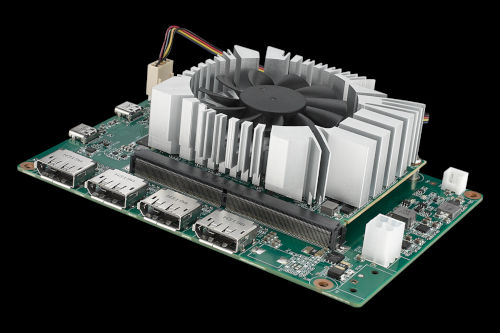
Compact embedded boards (SBCs) are playing an increasingly important role in endoscopy equipment, where size is a critical factor. The latest SBCs enable the development of more optimized endoscopes that occupy less space, typically in a 3.5" format. This advancement has resulted in a substantial improvement in mobility and control for surgeons.
The latest generation of mobile processors are at the heart of modern single-board computers (SBCs) and offer impressively high execution unit (EU) capacity for graphics. Some have three times the EU capacity of desktop processors of the same generation.
Greater processing power is a vital asset in the field of endoscopy, as it facilitates demanding tasks such as image enhancement and real-time image stitching. Furthermore, processors with this capacity consume little energy thanks to a quiet thermal design and no forced ventilation. These attributes translate into a significant improvement in diagnoses and treatments.
Furthermore, the latest SBC features take productivity a step further by supporting four simultaneous displays with resolutions up to 4K. Thanks to this impressive innovation, surgeons can examine patients with exceptional clarity and precision, significantly enhancing the diagnostic capabilities of endoscopy systems. Another tip for endoscopy system designers is to look for an SBC that integrates USB Type-C, simplifying camera connectivity and enabling better illumination and the use of thinner lenses.
High-Performance GPU Expansion to Enhance Imaging and AI Capabilities:
In the field of medical imaging, endoscopy demands high graphics performance. However, many current embedded boards are deliberately large to accommodate PCIe or MXM expansion. In contrast, the latest GPU expansion modules easily connect to single-board computers (SBCs) via a USB Type-C connector. Some expansion boards can support MXM GPU modules with power ratings of up to 115W, resulting in a remarkable 460% increase in graphics performance.
By incorporating this same type of expansion module with an MXM GPU, the display quality is upgraded from DP1.4 at 3840×2160 and 60Hz to DP1.4a, with the same resolution but a faster 120Hz refresh rate. This improvement provides sharper and smoother images to increase accuracy, facilitate the visualization of internal structures, and improve the efficiency of medical procedures.
A GPU upgrade can also enhance machine learning (ML) algorithms, further strengthening the endoscope's AI capabilities. It helps medical professionals quickly identify abnormalities, injuries, and potential problems in real time, improving both the accuracy and speed of diagnosis. Furthermore, an enhanced GPU can accelerate image processing, enabling real-time rendering of 3D medical images and volumetric data. This capability is indispensable for tasks such as surgical planning and examinations, as it allows surgeons to gain a comprehensive understanding of the patient's anatomy.
Leveraging AI Deployment with Design Services:
Of course, when AI and ML algorithms consume significant amounts of energy, finding hardware with an optimal price-performance ratio can be challenging. Even if all the datasets, algorithms, training, and UI/UX work, how can you facilitate the deployment of an AI application? There is a clear need to efficiently manage AI models, as well as all the remote hardware devices, such as sensors.
Fortunately, edge orchestration and end-to-end device management software solutions are now available to help power and scale AI/ML applications. As an added bonus, some vendors, such as Advantech, offer this tool for free. Capable of improving CPU and GPU performance, the software makes object identification and AI performance evaluation even more efficient. With a single click, users can test the AI capabilities of their edge devices using pre-trained models, saving time and reducing the cost of AI deployment.
Conclusion:
Advances in endoscopy technology play a vital role in cancer prevention and diagnosis. Today, common challenges such as bulky systems, high latency, and reliance on human analysis can be addressed by adopting Advantech's MIO-5377R SBC and MIOe-UMXM expansion module. These compact yet powerful devices, equipped with 13th Gen Intel® Mobile processors, enhance diagnostic accuracy, mobility, and efficiency for medical professionals. Furthermore, the optional GPU boosts graphics capabilities, enabling real-time imaging and improving artificial intelligence applications. Advantech's commitment to optimized design and cutting-edge technology, along with the company's free Edge AI Suite software tool, underscores its dedication to pushing the boundaries of medical imaging to improve healthcare outcomes.
Author: By Christoph Kühn, EU Sales Manager - Medical Equipment Builder
About Advantech:
Founded in 1983, Advantech is a leader in providing innovative and trusted products, services, and solutions. Advantech offers complete systems integration, hardware, software, customer-centric design services, embedded systems, automation products, and global logistics support. We collaborate closely with our partners to help deliver comprehensive solutions for a wide range of applications across diverse industries. Our mission is to enable a smarter planet with embedded computing and automation products and solutions that empower smarter living and working. With Advantech, there are no limits to the applications and innovations our products make possible. (Corporate website: www.advantech.com)