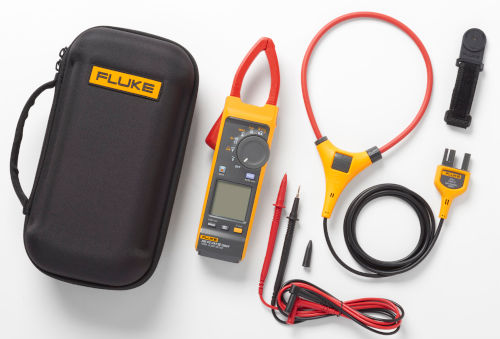
• IP54 protection, ideal for outdoor work such as solar panels and wind turbines
• DC measurements with readings expressed in kVA
• An audible polarity indicator to prevent accidental wiring errors
• The Visual Continuity feature displays a bright green light on the screen to help technicians work in dark and noisy environments
• Recording and reporting of test results via Fluke Connect software.
Hans-Dieter Schuessele, Fluke's Applications and Technology Expert in the EMEA region, notes: “The transition to renewable energy is accelerating, and it is essential that installers and maintenance personnel have the right tools, not only to get solar farms connected to the grid quickly but also to ensure they continue to operate at peak performance. As the world's first solar clamp meter to offer CAT III rating up to 1500 V, the Fluke 393 FC enables technicians to work safely and ensures that the use of solar energy has a bright future.”
 Distributed solar systems and loads are becoming increasingly large and complex, making technician safety even more critical. For technicians, understanding the protection level of an instrument and how to use it for maintenance and troubleshooting is paramount. According to Fluke, troubleshooting a photovoltaic system typically focuses on four parts of the system: photovoltaic panels, load, inverter, and combiner boxes.
1. Troubleshooting Photovoltaic Panels:
The technician should first check the output of the entire system at the meter or inverter. Before troubleshooting, they should also check and record the input voltage at the inverter and the current level at the solar panel array.
The combiner box can be an ideal place to troubleshoot the system, as it is connected to each cable from the modules. Each module may have a fuse that should be checked with the Fluke 393 FC.
Wiring problems and loose connections can cause a module to generate too low a voltage. This can be measured with the Fluke 393 FC to check the wiring connections in the junction boxes.
The Fluke 393 FC provides an audible polarity warning when checking Voc. If the polarity is reversed, it may mean that other circuits in the combiner box are unintentionally connected in series, resulting in voltages higher than the inverter's maximum input voltage.
2. Troubleshooting Photovoltaic Loads
Begin by checking the load's switches, fuses, and circuit breakers with the Fluke 393 FC to verify the correct voltage at the load connection. Next, check the fuses and circuit breakers in the circuit. Locate and replace any blown fuses or tripped circuit breakers. If the load is a motor, an internal circuit breaker may have tripped, or there may be an open winding in the motor. To test this, connect another load and observe if it operates correctly.
As with any electrical system, check for broken wires and loose connections. Clean dirty connections and replace any damaged wiring. Once the power is disconnected, check and repair any faulty grounding. If a fuse blows again or a circuit breaker trips, a short circuit will occur, which must be located and repaired.
If the load still isn't working correctly, use the Fluke 393 FC to check the system voltage at the load connection. The wire size may be too small and needs to be increased. This will manifest as low voltage at the load; to resolve this, reduce the load on the circuit or install a larger wire.
3. Troubleshooting Photovoltaic Inverters
The inverter converts the DC from the photovoltaic system into AC that can be used in buildings. To troubleshoot the AC side, use the Fluke 393 FC to check the voltage and current levels at the inverter output. Many of these systems have a display that shows the current performance of the inverter and the system. Because the Fluke 393 FC provides a true RMS reading, you can use the voltage and current to measure and record the output power in kilowatts (kW). If possible, use the inverter's display to show the total energy consumption in kilowatt-hours (kWh) and compare it to the value recorded during the last inspection. When troubleshooting the DC side, use the Fluke 393 FC to check the DC power and save the reading to the Fluke Connect™ app on your phone.
If the inverter is not supplying the correct power, there may be a blown fuse, a tripped circuit breaker, or broken wires. All of this can be easily verified with the Fluke 393 FC.
4. Troubleshooting Combiner Boxes
When troubleshooting combiner boxes, current measurements and calculations are essential to determine if photovoltaic panel arrays are functioning correctly. Measuring the current in each panel array or combining current measurements will help determine if a module is malfunctioning.
The Fluke 393 FC clamp meter's fine jaws allow for the use of multiple leads in the jaws to obtain combined current measurements, even in confined or crowded spaces such as inverters or combiner boxes.