
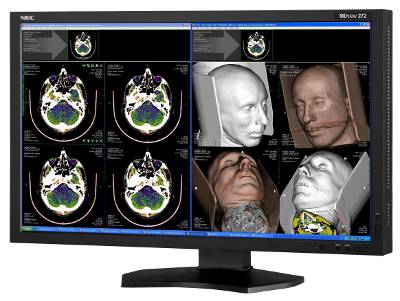
 “Whether used to display X-rays or as an information monitor in a hospital, access to the best displays is essential for physicians’ diagnostic review,” says Shinji Nohara, Director of Medical Solutions at NEC Display Solutions Europe. “Color accuracy, image stability, standards compliance, and ease of use and maintenance combine to make this display NEC’s flagship device today. The MDview272 meets all the specific quality requirements for displaying CT, MRI, nuclear medicine/PET, and cardiology images, as well as for PACS-derived patient testing.” This
device also incorporates built-in firmware features not available on standard desktop monitors or those included with the system. These features help optimize image quality and integrate the navigation display with the Picture Archiving and Communication System (PACS) to expand the range of solutions available in hospitals.
User productivity is further enhanced by ergonomic height adjustment and features such as programmable USB, picture-by-picture viewing, and DisplayPort and Mini-DisplayPort connectivity options, ready for future innovations.
The MDview272 is the ultimate clinical review display, as its manufacturing characteristics comply with the DICOM color or grayscale standard, ensuring it is ready for immediate use. Digital Uniformity Control and Backlight Correction with Aging guarantee ensure consistent image quality and white point monitoring. The accompanying GammaCompMD client software simplifies maintenance, calibration, and reliability.
Availability and Warranty:
The new NEC MDview272 medical display will be available through authorized distributors across Europe starting in January. Each unit includes the display, power cable, quick reference guide, GammaCompMD QA software on DVD, DVI-D to DVI-D cable, and DisplayPort cable. NEC Display Solutions Europe offers a three-year warranty, including feedback.
How can engineers improve pulse resolution and cell type discrimination in modern flow cytometry systems?
Flow cytometry is a technology that analyzes cells based on the scattering and fluorescence they produce when passing through lasers of different wavelengths of light. These signals are detected by optical sensors that produce small electrical pulses of current that...