
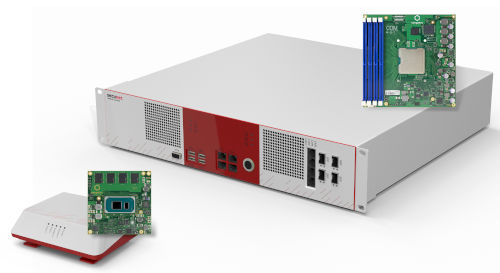
The joint offering targets medical device manufacturers and infrastructure solution providers that require patient, data, and cybersecurity to digitize healthcare. The first proof-of-concept demonstrations of the co-creation services from congatec and SIE will have their world premiere at the congatec booth even before their official market launch: two new medical edge computing systems, called secunet medical connect Carna and Athene, developed and manufactured in collaboration with the OEM customer secunet.
The two Secunet systems are perfect examples of the most demanding system design challenges currently facing medical device manufacturers: Edge computing platforms for healthcare digitalization must fully comply with ITSEC or Common Criteria data and cybersecurity specifications and/or be ready for B3S KRITIS and ISO/IEC 80001 certification. For point-of-care (POC) operation, their medical computing platforms must also comply with EN 60601-1/EN 60601-2 and be MDR/FDA certifiable. All of this requires 100% reliable and traceable components, complete documentation, and trusted sources throughout the supply chain and the entire lifecycle of medical devices. As application-ready platforms that meet these cutting-edge requirements for patient, data, and cybersecurity, secunet medical connect Carna and Athene address virtually all needs for digitizing point-of-concept (POC) medical devices and securely processing patient data in hospital networks, such as backend systems for medical image processing in CT, MRI, X-ray, and ultrasound machines.
The secunet Carna platform, for example, can connect to any medical device and is therefore ideal for digitizing existing platforms, whether driven by OEMs or hospitals themselves. Original equipment manufacturers seeking a dedicated solution for digitizing their medical systems can use these platforms as a proof of concept and are invited to request customization of existing platforms or even explore the creation of entirely new platforms in collaboration with congatec, SIE, and, of course, secunet.
In addition to these edge computing platforms focused on digitization, the co-creation team is also addressing any other medical panel or PC box needs that OEMs may have, including functional security on x86, enabled by Intel's initiatives based on the Intel Atom x6000E processors for functional security and planned future support for more cores. Engineers of mixed mission-critical deployments can also leverage support for the new security hypervisor technology from congatec subsidiary Real-Time Systems, also announced today, and congatec's value proposition for application-ready security COM modules. Within the congatec and SIE co-creation offering, OEMs receive an unprecedented value proposition with total system responsibility—from the compute core to certification, mass production, and lifecycle management. This is especially valuable if customers in regulated markets want to focus on their core competencies and are looking for a reliable source with Central European roots.
In addition to critical healthcare infrastructure and OEM medical equipment, the two companies also intend to enter other embedded systems and edge computing markets for critical infrastructure, such as the financial and insurance sector, water and energy supplies, information technology and telecommunications, and even transport and traffic, all of which rely on cyber-secure systems for their IT infrastructures.
How can engineers improve pulse resolution and cell type discrimination in modern flow cytometry systems?
Flow cytometry is a technology that analyzes cells based on the scattering and fluorescence they produce when passing through lasers of different wavelengths of light. These signals are detected by optical sensors that produce small electrical pulses of current that...