
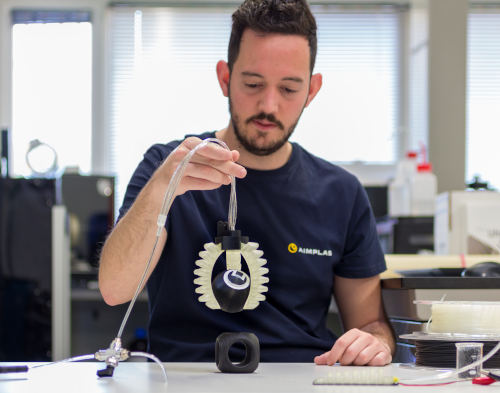
In this context, AIMPLAS, the Technological Institute of Plastics, is developing a smart 'claw' that facilitates the rehabilitation of patients with musculoskeletal injuries and reduced mobility through motion guidance and integrated pressure sensors that monitor and regulate the pressure applied to the limb being treated. Specifically, it is a flexible, claw-shaped pneumatic demonstrator being developed in collaboration with the SOFTRONIC project, funded by the Valencian Institute of Business Competitiveness (IVACE).
When evaluating and studying a person's movements during rehabilitation, as explained by the head of the research, Roberto Dart, "the integration of flexible sensors that respond to physical variations in the proposed technology allows for monitoring parameters such as deformation, temperature, and pressure, among others. Furthermore, the processing of soft robotics using additive manufacturing technologies allows for the customization of orthotics and prosthetics according to each patient's needs."
Thus, the institute is creating, in collaboration with leading companies in the health, industrial robotics and additive manufacturing sectors, such as Robotnik, Sinfiny, Tequir, IT3D or the Valencia Orthopedic Center, a solution that integrates the various emerging technologies of the plastics sector to develop intelligent polymeric devices focused on the industrial robotics and health sectors, with a hybrid and modular additive manufacturing test bench with which it will be possible to process elastomeric and/or plastomeric materials, as well as deposit conductive inks on the part.
The combination of hybrid 3D printing technologies, in the words of Roberto Dart, “is an innovative element, since it involves the integration of a network of actuators, sensors, controls, and power systems into soft robots through a single on-demand digital manufacturing process, resulting in a fully customized product. Furthermore, multi-material conformal printing allows for the incorporation of electronics and sensors into the soft robot's structure, facilitating self-learning and greater interaction between the robot and its environment.”
Increasingly personalized medicine
Also contributing to increasingly personalized medicine, AIMPLAS is working on the NUTRAFARM project, together with Asacpharma, Korott, Tequir R&D, and IT3D, on pharmaceutical and nutraceutical formulations to obtain novel and customized products through 3D printing. The technology used, compounding or hot melt extrusion, is very versatile and allows for the development and processing of highly complex formulations in a single step, resulting in energy savings, greater reproducibility and bioavailability of the drug, as well as avoiding the consumption of solvents.
“In addition to enabling more precise drug dosages for each patient, the technology used allows us to obtain orodispersible films in a single step, as well as filaments that can later be used in FDM (fused deposition modeling) printing or the pellets for direct printing with printers designed to work with this format. The project reduces processing steps and saves materials, with all the associated advantages, and enhances the effectiveness of the active ingredients and their release thanks to the type of technology used,” highlights Raquel Llorens-Chiralt, principal investigator of the NUTRAFARM project.
These projects are financed by the Valencian Regional Government's Ministry of Sustainable Economy, Productive Sectors, Trade and Employment through IVACE grants with co-financing from the EU's ERDF funds, within the ERDF Operational Programme of the Valencian Community 2014-2020. These grants are aimed at technology centres in the Valencian Community for the development of non-economic R&D projects carried out in cooperation with companies for the 2021 financial year.