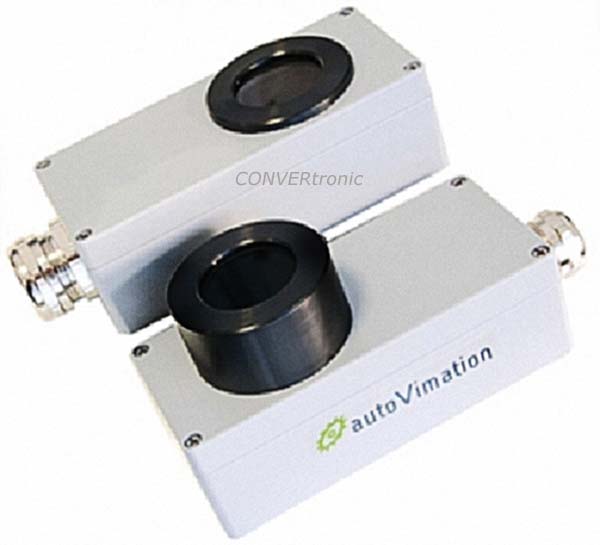
The barcode reader is capable of reading currently used barcode symbologies and is available in two versions. The OPC120W design is available at an attractive price and can be used for numerous standard tasks with normal read speed requirements. In contrast, the OPC120P is a "high-end" design that achieves high read speeds of up to 100 reads/s and tape speeds of up to 10 m/s.
A common weakness of optical sensors is their susceptibility to harmful reflections, which can be caused by external light or the camera's own light source. Under normal circumstances, it is rarely possible to completely avoid reflections, as they depend on multiple factors, including the reading angle of the code reader, the angle of the light source, and the orientation and structure of the surface on which the code is detected and located. Codes located on rounded, curved, or cylindrical objects made of reflective materials—such as ball bearings or metal tubes—are particularly challenging to handle, as multiple reading angles may coincide in a single scan.
The OPC120P features a unique polarization filter technology that prevents readings under these and other conditions. This technology eliminates harmful reflections and allows for more reliable readings, even if the codes are on reflective surfaces such as metals, plastics, printed circuit boards, or film.
The exceptionally wide reading distance range of 70 to 180 mm significantly contributes to the efficiency and flexibility of the vision sensor. The OPC120P can read codes on reflective surfaces at varying distances without needing to refocus or adjust settings. Auxiliary side illumination or adjustable lenses, typically required by other scanners in challenging environments, are unnecessary.
In addition to detecting 1D and 2D codes, the barcode readers can check for the presence of variable textures and static graphics. The presence detection function ensures that variable structures—such as best-before and best-before dates—are actually located at a predefined point, such as on food packaging. Logo detection allows for the detection and verification of unchanging elements, such as company logos. The reader can decode long codes by capturing multiple images if it encounters codes that don't fit in a single image. The device automatically combines up to six consecutive images, enabling it to easily decode extremely long codes or codes on rounded objects.
The OPC120 can read up to four codes in a single image capture. The device can not only read codes but also process up to four tasks, such as presence and logo detection, in a single image capture.
The OPC120 comes with the main interfaces, facilitating its integration into plants and machinery. These interfaces include RS232, digital I/O, a connectivity option for a rotary encoder or trigger sensor, Ethernet TCP/IP, and the latest addition: PROFINET. Industrial Ethernet achieves a transmission speed of 100 Mbit/s and meets the real-time requirements of PROFINET IO Real-Time Class A. The developers have integrated a two-port switch as an ideal solution, enabling direct connection to the next PROFINET device. This allows for network deployment in a linear topology without the need for additional couplings or switches. All vision sensor configuration settings are accessible via PROFINET, while the Vision Configurator Windows software serves as the input stage for parameterization. Other options offered by the code reader include access to the error pattern memory, code quality output, and manipulation and formatting of the resulting strings.