



RSS feed

- Details
- Category: Electromechanical
The ESCON2 control electronics utilize the latest semiconductor and PCB technology in their manufacturing. As a result, they achieve unprecedented power density and control performance in terms of torque and speed. The modular design allows for seamless integration into any application.

- Details
- Category: Batteries
To address the urgent need for solutions to support high-performance computing (HPC) in increasingly congested data center environments, Vertiv has introduced the Vertiv™ EnergyCore battery cabinets. Factory-assembled with LFP (Lithium-Iron-Phosphate) battery modules and Vertiv’s internally powered battery management system, the Vertiv EnergyCore cabinets are available globally and are compatible with most current and legacy Vertiv™ three-phase uninterruptible power supply (UPS) systems, including the Vertiv™ Trinergy™ range.
- Details
- Category: Other Equipment
Artificial intelligence (AI) is renowned for its image recognition and classification capabilities, suggesting a strong suitability for the goals of automated optical inspection. How is this technology applied, and how does it improve performance?
Equipment suppliers are rushing to integrate AI into their solutions. Similarly, manufacturers are rushing to integrate the technology into their processes. Since the assembly of surface-mount electronic components is already highly automated, AI offers the opportunity to extend machine speed and repeatability to complex tasks that require learning, judgment, and adaptability. Automated optical inspection (AOI) is a good example.
- Details
- Category: Design
Analog Devices, Inc. has launched a suite of developer-focused offerings that unite hardware, software, and services across all devices and markets to help customers deliver Intelligent Edge innovations faster and more securely. A central element of this launch is CodeFusion Studio™, an embedded software development environment based on Microsoft Visual Studio Code.
- Details
- Category: Current Affairs
Lynred today announced the acquisition of New Imaging Technologies, a Paris-based supplier of short-wave infrared (SWIR) imaging modules and sensors. Lynred's product portfolio will be expanded to include large-format, high-definition SWIR sensors with a small pixel pitch, strengthening its product offering across all wavelength bands
- Details
- Category: Batteries
In this four-part blog series, we'll discuss sustainable living and how it will be possible to save more energy in the future thanks to new energy generation methods, new materials technologies, and the latest design techniques.
The drive for renewables to achieve productivity and efficiency
How to Achieve Demand for Real Sustainability:
Electrification is an essential element in the global goal of abandoning fossil fuels for activities such as heating and transportation; moreover, the latter is expected to increase electricity demand in the coming years. The utilities sector is trying to phase out conventional, fossil fuel-based power plants and replace them with renewable energy generators, typically wind or solar farms. Wave energy (Figure 1) can add capacity to the energy mix, although more research is needed to determine its effect on tidal flow.
Environmental energy sources are less predictable than those derived from fossil fuels. To achieve true sustainability, energy must be extracted more efficiently and inefficiencies in conversion and transmission must be minimized.
Efficient Production:
Some studies aimed at increasing the efficiency of photovoltaic cells have included the use of advanced materials, such as gallium arsenide (GaAs), and efficient structures, such as multi-junction cells. Multi-junction structures enhance efficiency because they capture energy from a greater proportion of absorbed photons, including low-energy photons that single-junction structures cannot utilize. They are composed of layers of single-junction cells, each with a distinct band gap. These cells are stacked in descending order according to this band gap, so that low-energy photons create electron-hole pairs in the cells at the lower levels.
According to the Best Research-Cell Efficiency Chart, published by the US National Renewable Energy Laboratory (NREL), the most efficient photovoltaic cell currently available is a four-junction concentrator that achieved 47.3% efficiency in June 2022. This level is 20% higher than that of the crystalline silicon and single-junction cells commonly used in photovoltaic panels.
The difference between commercially available cells and those used in research highlights the potential for improvement in solar technology, but it also underscores the importance of cost. Newer, more complex photovoltaic cell technologies must offer a competitive price per watt to attract industry adoption.
In general terms, all stages of solar conversion need to improve efficiency, including DC-DC conversion, DC-AC inverters, and even electrical interconnections (Figure 2). These interconnections must be robust, capable of withstanding demanding handling and weather conditions, such as corrosion, without experiencing an excessive increase in ohmic resistance.

Image: Interconnections in solar converters, such as TE Connectivity's (TE) SOLARLOK 2.0 connectors, must be robust to ensure durability and prevent deterioration that could reduce energy generation (source: TE Connectivity)
If commercially available cells achieve an efficiency greater than 40%, they would reach the maximum theoretical efficiency of wind turbines (Figure 3). According to Betz's law, this maximum level is 59.3%, although some argue that this figure should be understood as an energy coefficient, not an efficiency coefficient. However, Betz's research and similar work were conducted before 1920. 21st-century research, which has considered factors such as airflow and pressure distribution and applied computational fluid dynamics, suggests a limit between 30% and 59.3% (this excludes other loss mechanisms, such as bearing friction).

Image: The Betz limit describes the maximum proportion that can be obtained from wind energy (source: Mouser Electronics)
Clearly, increasing total installed capacity will generate more electricity, since we can access wind and sunlight from virtually anywhere. In the UK, wind turbines have recently made headlines, supplying a record 21.6 GW and meeting over 50% of the country's evening energy demand.
Efficient Conversion:
The power output generated by turbines and solar cells is not very high, so minimizing energy loss in associated conditioning systems is crucial. One common technique is to increase the main bus voltage (e.g., from 1000 to 1500 V), which offers several advantages: it allows for larger strings of solar panels, reducing the number of junction boxes and wiring; in solar and wind generators, switching to higher bus voltages helps reduce resistance losses (I²R).
Wide-bandgap semiconductor technologies, such as silicon carbide (SiC), are important for implementing these improvements. SiC MOSFETs can have a much higher breakdown voltage relative to their physical size compared to conventional silicon devices. Furthermore, SiC's superior switching performance means that smaller passive components can be used to stabilize power flow within the system. This helps to reduce costs, minimize circuit size, and lower losses due to parasitic effects of components, such as unwanted ohmic resistances.
If we switch to more efficient conversion topologies, we have more options for improvement. Synchronous rectification increases the efficiency of the power supply by eliminating the loss associated with the forward bias diode; instead, a MOSFET with similar characteristics is used, but with much lower RDS(on) losses.
On the other hand, the use of resonant switching topologies is becoming increasingly common. In addition to eliminating the losses associated with conventional forced commutation circuits, resonant commutation also improves reliability. The potential savings in maintenance and equipment replacements contribute to reducing the overall cost per watt of green electricity.
Competition Accelerates Progress.
Achieving a sustainable and affordable source of electricity is a global imperative. However, competition fosters innovation, and that's exactly what happened between 2014 and 2016 when Google launched its Little Box Challenge, aiming to shrink a 2 kW power inverter by 90%, from the size of a picnic cooler to that of a laptop. Having such small inverters opens the door to various improvements, such as microgrids and affordable, consumer-ready photovoltaic energy. Google's challenge required a maximum size of 40 cubic inches and an efficiency greater than 95%. Some teams met the target, and the one that achieved the best results, such as a power density of 145 watts per cubic centimeter, received a $1 million prize. Is now the time to launch another similar challenge to achieve further breakthroughs?
Conclusion: We're not so far off.
The cumulative effect of all these improvements—greater photovoltaic efficiency, advanced power conversion topologies, and widebandgap semiconductors with higher bus voltages and greater power density—is significantly increasing global ambient energy production. According to the World Economic Forum, renewable energy could meet all our needs by 2050, although this forecast is subject to many conditions, such as interregional cooperation and grid interconnections. To get to that point from where we are now and overcome all the practical and weather-related challenges, we will need to continue developing technology to improve productivity, efficiency, and affordability.
Connected storage: a pillar of the green grid
When we think of an electricity grid powered by renewable energy, what likely comes to mind is a wind farm (image 1) and a solar farm. In these cases, unlike conventional power plants, the availability of supply cannot be controlled or predicted. To manage the uncertainty related to when and how much electricity will be available, grid-connected energy storage is necessary to balance the temporal and quantitative factors of supply and demand. This storage should be able to hold excess energy when conditions are favorable, as well as cover shortfalls during less ideal conditions, especially at night when there is no solar energy. It must be able to handle short peak demand periods and high loads, such as fast chargers for electric vehicles. To meet consumer expectations, this massive, grid-connected storage must be installed at generating facilities and at other points throughout the infrastructure.

Image: Energy storage with a volume suitable for public supply will need to include battery installations at generating facilities (source: Mouser Electronics)
On the other side, we find what we could call "prosumers" (a combination of producer and consumer), who have private generators for local loads and who feed the excess into the grid; these also need storage within their own facilities or homes to balance the available supply and demand.
Location, Size, and Technology:
To be effective, grid-attached storage must offer a large capacity; it must also be reliable, affordable, and have a long lifecycle. Grid-attached storage planning is a relatively new discipline. Determining the location and size to achieve adequate storage in the right places will depend on demand patterns, nearby loads, and battery performance (Figure 2). Effective load cubic capacity (ELCC) assessment has been proposed as a useful method for calculating the level of storage a given grid will need.
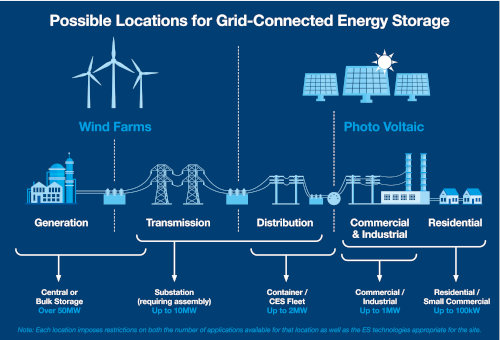
Image: Battery energy storage will be connected to many locations throughout the network (source: Mouser Electronics)
When it comes to battery performance, cutting-edge research has identified improvements in materials, structure, and the design of internal components, such as electrodes. One example of this is the emergence of high-capacity lithium-sulfur batteries, which leverage the abundance of sulfur to offset global demand for lithium. These batteries promise greater energy storage than traditional lithium-ion (Li-ion) batteries.
Nanotechnologies can also help solve energy storage problems. Researchers have demonstrated that carbon nanotubes can stop the growth of dendrites—unwanted conductive strands that form inside the battery and cause short circuits, ultimately leading to failure—and thus improve reliability and longevity.
Solid-state battery technology offers higher energy density than lithium-ion batteries and increases safety by eliminating liquid electrolytes. While its development has been slowed by its limited durability, recent research on electrodes constructed from a combination of lithium titanate and lithium vanadium dioxide could offer a solution for expanding the commercial use of solid-state batteries.
Prosumers typically use lithium-ion or lead-acid batteries for energy storage in their homes. Lead-acid battery technology is proven and reliable, but it is not as compact or lightweight as lithium-ion batteries and requires more maintenance. However, they are more affordable, so they will continue to be a popular choice for residential prosumer installations. In addition to the economic factor, ease of use also plays an important role in encouraging homeowners to support the green energy grid.
"Prosumers" need to know that their investment will be sufficiently profitable without having to become energy experts or spend countless hours managing their own generating station. Sophisticated yet user-friendly system management software is essential to ensure that the household always uses the most cost-effective energy source and guarantees reliability and stability. For example, the local microgenerator could be used to charge the battery bank, power household loads, or feed energy back into the grid, so that energy is drawn from the grid only when needed. Ideally, all of this would happen at the best possible rate.
Storage for Integrated Systems:
If we want electrification to contribute to sustainability, better storage is needed everywhere, from utility supply to printed circuit boards such as connection points or IoT gateways. Small, solid-state batteries manufactured using thin-film processes promise higher energy density and reliability than traditional lithium-ion technologies. Another important factor is recycling capacity, in order to ease the demand on our planet's mineral resources and enhance our future.
Conclusion:
We will need large amounts of battery storage to ensure energy stability and availability, meet the demands of modern life, and contribute to a green grid that can sustain electrification. To achieve this, the technology must improve. There are many promising research projects underway, but we still face the same obstacle: the manufacturability and price of battery technology. Battery technologies for electric vehicles (EVs) may point the way forward: their mass production economics and performance demands are perhaps higher than those of any other technology. If batteries work well in an EV, they can work anywhere; in fact, used EV batteries appear to be an effective and cost-efficient solution for grid-connected applications. Management software can help manage different energy sources and tariffs to achieve the best possible balance of value and stability.
Produce more, consume less
Electronic engineers have long sought ways to reduce energy consumption through product design, long before the current climate crisis. Lower power consumption means less heat, smaller heat sinks, smaller power supply components, less space for the battery, and a longer battery lifespan. Generally speaking, this results in a more attractive and marketable product that can perform better in the market compared to a less sophisticated design alternative.
The improved design in the nominal capacity of the battery is motivated by a desire to help clean up the planet, but it is also a very important selling point for consumers who care about the environment.
It is necessary to promote innovation in energy saving, from power conversion circuits to the integrated systems that run the application.
Low-Power Design for Adapters:
Eco-design codes have very ambitious power and efficiency targets, especially for equipment such as chargers and adapters. Recently, the US, the EU, and China have expanded the applicable requirements for this type of equipment. Currently, the US Department of Energy (DOE) Level VI regulations and the EU Eco-design Regulation 2019/1782 mandate similar requirements for average efficiency and no-load power. To meet these requirements, major distributors are switching to wide-bandgap semiconductor technology (Figure 1), particularly gallium nitride (GaN). GaN transistors are an attractive option for the power levels specified in eco-design codes, below 250 W. Some of the advantages compared to traditional silicon transistors include low conduction losses relative to the rated voltage, low switching losses at high frequencies, high thermal conductivity, and reliability at high operating temperatures. Furthermore, they offer a more favorable combination of device voltage rating and RDS(ON) than current silicon carbide MOSFETs. With these transistors, power supply designers are achieving peak efficiency levels exceeding 96%, all with units that are lighter and 30% smaller than previous models of the same rating.

Image: Semiconductor manufacturers have commercialized widebandgap technologies and are encouraging their use with reference designs and evaluation boards (source: Texas Instruments)
Energy Savings in Computing:
Integrated microcontrollers (MCUs) have long been at the heart of ultra-low power technologies and component design techniques aimed at enabling the smallest elements of the Internet of Things (IoT) to perform better and operate for longer periods. These factors have become essential in recent years, as a massive number of remotely connected sensors and actuators have been deployed for various control and monitoring applications in smart buildings, cities, infrastructure, and factories. Replacing these batteries in the field is often impractical, so the only option is to design these components to operate their entire lifespan on a small battery or to incorporate the necessary circuitry to draw power from ambient sources. Working with such a limited power source demands very careful management of the entire budget allocated to powering the equipment.
Processor and MCU vendors have developed power-saving features to help application designers meet these performance and power targets. Dynamic voltage scaling allows the device to adjust its operating frequency and voltage to handle rapid spikes in computational demand while still operating at a low voltage and frequency, thus minimizing power consumption when demand is low. Today's ultra-low-power MCUs offer various power-saving modes that provide the flexibility to disable subsystems and peripherals, stop unnecessary clocks, maintain or reduce dynamic memory usage, and optimize the time required to resume operation after exiting any of these modes. Thanks to this flexibility, a low-power application can quickly activate only the subsystems needed for a given task, complete the corresponding processing at high speed, and return the circuitry to standby mode as quickly as possible. Other innovations, such as memory access accelerators for graphics and real-time execution, save the power that is normally lost when a process must wait for a complete access cycle to finish. There are also standalone modes that allow peripherals to operate while the core is off, as well as low-power timers, which allow some simple tasks to continue running while most of the device and clock signals are turned off.
The AI Effect:
By definition, doing more work in less time requires more energy; to reverse this trend, we need to change how we do that work. Artificial intelligence (AI) is leading the way in this regard, handling tasks such as pattern analysis for image recognition and anomaly detection more efficiently than conventional computing techniques. MCU vendors are helping developers use tiny neural networks and other machine learning frameworks (such as decision trees) in deeply embedded systems, aiming to provide advanced capabilities and contextual awareness at extremely low power levels, often with real-time response. This has spawned a new branch of embedded design: tiny machine learning, which uses lightweight frameworks such as TensorFlow Lite and TinyML. Similar frameworks are being integrated with devices such as inertial sensors so they can independently perform tasks like basic activity recognition, allowing the system to remain offline and conserve power.
In conclusion
, electrification, coupled with the natural human desire to create better machines—machines that can do more, faster—is increasing the demand for electricity for appliances and for charging the batteries of mobile or wireless devices. Designing ultra-low power systems can foster the next generation of machines, devices with greater control over our lives and our environment; however, this design must also strike the right balance between performance and energy consumption.
Author: Mark Patrick
Mouser Electronics
Authorized Distributor
www.mouser.com
- Details
- Category: Current Affairs
According to the report "Labor Market Outlook in Catalonia 2025-2030" prepared by the Catenon Consulting firm, the region is in a favorable position to become a leading technology center in areas such as biotechnology, semiconductors, renewable energies and advanced manufacturing.

- Details
- Category: Other Components
Toshiba Electronics Europe GmbH (“Toshiba”) enhances its silicon carbide (SiC) diode portfolio with ten new 1200V Schottky barrier diodes (SBDs). The TRSxxx120Hx series, comprising five products in TO-247-2L packages and five in TO-247 packages, helps designers improve the efficiency of industrial equipment, including photovoltaic (PV) inverters, electric vehicle (EV) charging stations, and switched-mode power supplies.
- Details
- Category: Seminars
Mouser Electronics, Inc. explores life-saving technologies that are revolutionizing the medical and healthcare industries through its dynamic medical resource center. With the latest and most prolific digital transformations, healthcare systems have experienced groundbreaking advancements, enabling faster and more accurate diagnoses, reduced wait times, and the adoption of cutting-edge digital treatments.

- Details
- Category: Current Affairs
Murata Manufacturing Ltd (hereinafter "Murata") has expanded the scope of its Integrated Passive Solutions offering with the opening of a new production line at its plant in Caen, France.
Following the initial announcement in 2023, Murata has fulfilled its commitment to establish a new 200 mm series production line to bolster its silicon capacitor manufacturing capabilities. The Caen facility has been managed by Murata since its acquisition of the start-up IPDiA in 2016.

- Details
- Category: Design
Steliau Technology Iberia presents two innovative motherboards from Giada: the IB2-281 and IBC-386. Designed to optimize performance in industrial and embedded environments, these boards offer an unmatched combination of power, efficiency, and versatility.
- Details
- Category: Seminars
Advanced Rework Technology Ltd (ART), the IPC-certified and bespoke training service provider for the electronics assembly industry, has published a new guide detailing best practices for assembling and soldering plated through-hole (PTH) mounting components

Spanish electronics magazine. Printed for over 25 years.
Spain - Madrid - All rights reserved © Convertronic Professional Spanish Electronics Magazine.