



Energy as a Service (EAaS) is the latest in the “as-a-service” business model, and it’s redefining how companies think about their relationship with energy.
Currently, energy is seen as a difficult-to-control cost, a necessary expense for the business to operate. In the new EaS model, companies are changing their relationship with energy in two significant ways:
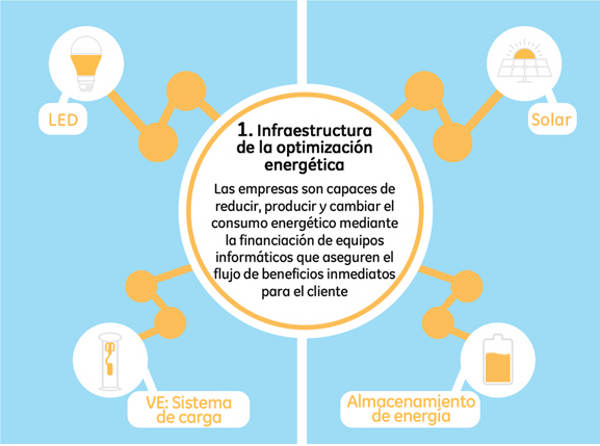
1. Companies are realizing their ability to reduce, produce, and control energy use through the use of financed equipment, which ensures immediate cash flow benefits.
2. Companies are using sensors in smart lighting systems to align their energy spending with business metrics, such as dollars per square meter for a small retail business.
These two changes transform energy from a cost into a business enabler, leveraging the company’s fixed assets as a growth asset.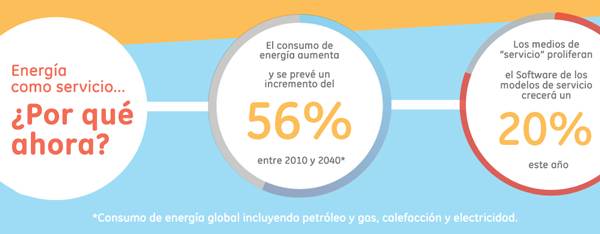 Why now?
Globally, increasing energy consumption is continuously straining not only the supply grid but also business costs. Global energy consumption is expected to grow by 56% between 2010 and 2040, and energy prices are rising by around 3-5% annually. The convergence of these factors favors the use of energy distribution models (including solar and combined cycle) where technology reduces implementation costs. The adoption of energy-efficient solutions that reduce consumption is also increasing, as is the use of energy management software, which improves productivity at a lower cost.
At the same time, the Internet of Things (IoT), or as we say in the industrial world, the Industrial Internet, is advancing rapidly. It is expected that 50 billion machines will be online by 2020, constantly pumping operational and environmental data in real time. As this expands, companies are expected to transition from on-premises solutions to cloud-based solutions to adapt to and capitalize on these changes.
The convergence of these trends—the growth of "as-a-service" models, the maturation of the Industrial Internet, the influx of new operational and environmental data, and the rising cost of energy—is setting the stage for companies to redefine their mindset regarding energy use. They need to manage all this complexity with holistic and scalable solutions that allow them to adapt to the speed of change while becoming more efficient, agile, and environmentally friendly. And they need to do so without breaking the bank.
There is only one way to access these benefits: "energy as a service."
A world where energy improves results.
“Energy as a service” makes sense on many levels. When done right—and by right we mean working with a partner capable of delivering solutions (hardware and software), service expertise, objectivity, and the financial stability to ensure their long-term presence—it reduces complexity and costs, scales easily, and ensures innovators have access to the best and latest solutions. We should think of “Energy as a service” as a way to simplify things—it shifts responsibility (management, implementation of updates, and the evaluation and selection of the latest technology) to the provider, makes the business run more efficiently, and allows for cost savings with little to no capital expenditure.
A smart store could leverage energy-saving infrastructure with sensors to “talk” to shoppers’ smartphones and send a personalized greeting or a special offer based on past purchases. What if that same infrastructure could help scan store shelves, measure checkout and shipping times, or locate missing merchandise? What kind of efficiencies could that generate?
Now imagine the same scenario in a hospital, where sensors could track medical equipment, monitor staff hygiene practices, and send personalized information or prescriptions to patients.
Or imagine a city where LEDs not only save energy but also direct drivers to available parking spaces, offering cities a way to increase parking revenue. And that same energy infrastructure could help control traffic or measure air quality to aid in city planning, or even report car accidents to emergency services the moment they happen.
We are at a pivotal moment in energy management, where all the pieces are coming together to transform its role in business, driving new efficiencies, business models, and value chains. At the same time, spending on Internet of Things hardware is expected to exceed $2.5 million per minute. We need a way to manage that. We need a way to capitalize on it. Why not do both in a way that truly drives business? The time has come for "energy as a service."
Article provided by GE
