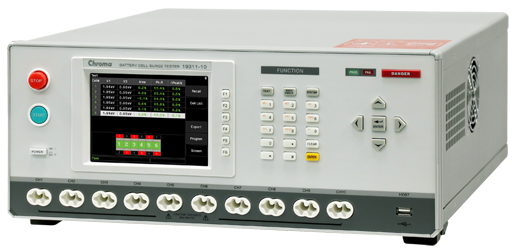
This is achieved by applying a high-voltage overload/impulse before electrolyte injection. Its output voltage can reach up to 6kV. It also features four measurement terminals and a 200MHz sampling rate. The Chroma 19311 series includes a single-channel (19311) and a multi-channel (19311-10) tester.
The 19311-10 has 10 channels, which can test up to 9 battery cells via scan testing with a single unit. It can support up to 25 channels to test up to 24 cells sequentially by connecting to an external scanner (A190362). The multi-cell scan testing speed of the 19311-10 is extremely efficient, saving testing time and reducing labor costs. It also increases production line capacity.
The lead-acid battery cell test, which involves a high voltage increase before electrolyte injection, checks the insulation distance and insulation quality between the positive and negative plates. It determines the separator between these plates and identifies whether they are shorted together. This overcharge test can decrease the defect rate in lead-acid battery production and improve the insulation quality of the lead-acid battery cells.
The Chroma 19311 series analyzes insulation quality differences in the resonant waveform using eight analytical parameters: Area, Diff-Area, Flutter, Laplacian, V1, V3, Peak Ratio, and ΔPeak%.





- Details
- Category: Electrical Analyzers
Chroma 19311 Battery Analyzer
Instrumentos de Medida, SL presents the Chroma 19311 series battery cell overload meter. It is designed to test the insulation quality between the positive and negative plates of the lead-acid battery cell.




Print Magazine

Annual subscription price:
You will receive all 10 editions that are published each year.
social networks
Popular News Electronics


Spanish electronics magazine. Printed for over 25 years.
Spain - Madrid - All rights reserved © Convertronic Professional Spanish Electronics Magazine.