




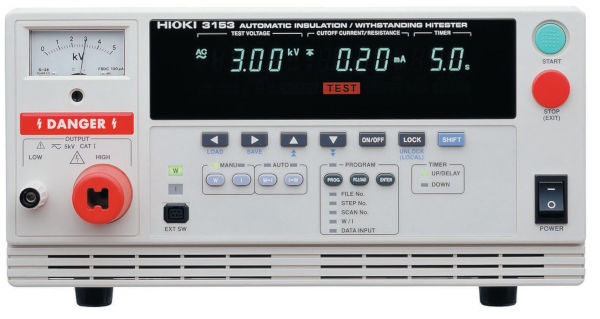
The 3153 model is an automatic AC/DC voltage and insulation tester that fully supports automated testing.
Features:
• Programmable insulation (50 to 1,200 V DC) and dielectric strength (AC/DC) testing
• Program up to 32 test type files, test points (50 steps), and measurement settings
• Optional scanner for automatic multi-point testing
• Generates precise test voltages independent of the supply voltage using the PWM method
• Ramp timer function to increase or decrease the applied voltage during dielectric strength testing at user-specified times.
Automation features include test modes, EXT I/O, RS-232C, GP-IB,
connection scanning, and data management functions.
It stores up to 10 sets of test mode conditions for voltage and insulation resistance, allowing for quick switching between test conditions. (Save/Load)
To ensure safety during automated testing, the output can be interrupted to inhibit testing.
Any electrical charge on the test object is discharged by the test instrument, leaving it with no residual charge after the test.
The test voltage's on/off switching can be forced to occur only at zero crossings of the sine wave. (AC Voltage Resistance Test)
Improved accuracy is achieved by preventing variations in the supply voltage (PWM switching technique) from affecting the test voltage.
Optional 5kV High Voltage Scanner.
5kV AC/DC high voltage scanner supports automatic multi-point testing.
The 3930 is a high-voltage scanner that accepts high-voltage inputs from any channel.
A single unit is equipped with 8 channels (using common mode), and up to four units can be interconnected for a total of 32 channels.
Additionally, the 3930 can be used in conjunction with the Automatic Insulation Tester, demonstrating its capabilities as an automatic multi-point test device.
https://www.hioki.com/file/cmw/hdCatalog/4461/pdf/?action=browser&log=1&lang=en
Introduction to safety standards, description of test methods, and appropriate test instruments for electrical medical equipment.
Electronic equipment must be designed to prevent accidental electric shock. Electric shock accidents can be severe enough to cause death, fire, or explosion.






