




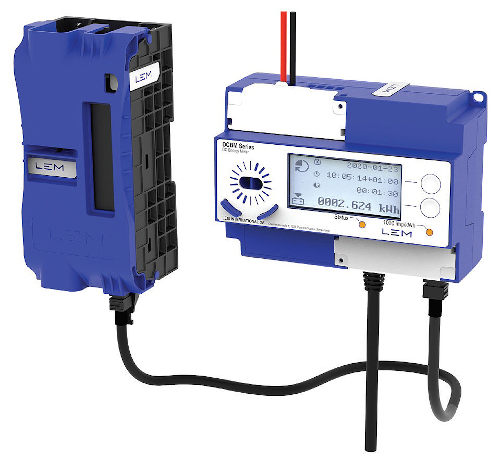
In 2019, there were approximately 2.5 million plug-in electric vehicles, making charging infrastructure crucial for global mobility. Current public charging infrastructure primarily supplies alternating current (AC). Consequently, charging times are relatively long, averaging around eight hours, due to the low available power output of approximately 44 kW. To reduce this charging time to just a few minutes, charger manufacturers convert AC to direct current (DC) outside the vehicle by bypassing the on-board charger (OBC) and directly powering the electric vehicle's battery pack. This method can increase charging power to up to 400 kW, but this conversion stage generates power losses that should not be borne by the end user, i.e., the electric vehicle owner. Therefore, the electricity meter is placed after the conversion stage to monitor and bill for the precise amount of energy transferred to the electric vehicle.
DCBM complies with German “Eichrecht” regulations.
German “Eichrecht” regulations stipulate that consumers should only be charged for the electricity supplied. Standards are also being established not only in Europe but also internationally, specifically in the state of California (USA).
The DCBM solution has been developed to meet market demands for interoperability and data security, as well as simple and rapid adaptation of existing charging stations and the capacity to supply up to 600A/1000V. The DCBM solution's design anticipates future connectivity needs and offers Ethernet communications compatible with the HTTPS/REST protocol to streamline integration and installation at charging stations.
The DCBM solution also integrates signed billing data compliant with the SAFE OCMF protocol to enable the transmission of billing data with an extremely high level of security and with full interoperability to cloud service providers.
The DCBM project is already a success thanks to the exceptional cooperation between LEM customers, standards committees, certification bodies, and LEM's global teams. The DCBM solution was developed in record time by LEM's R&D center in Lyon, France, and the Geneva team working in the industrial segment. This project is an excellent example of LEM's innovation, talent, technical expertise, and leadership. The main challenge was to define and design a DC counter that met the relevant standards as well as the numerous requirements of charger manufacturers.
Key technical advantages:
Standardized DC billing meter compliant with VDE-AR-E-2418-3-100.
Adjusts meter accuracy based on the charging cable used.
LCD screen displays measurements, energy consumption, alarms, and legal data at all times.
Ethernet communication enables quick integration and installation at charging stations.
Signed billing data offers extremely high security and full interoperability for cloud service providers.






