
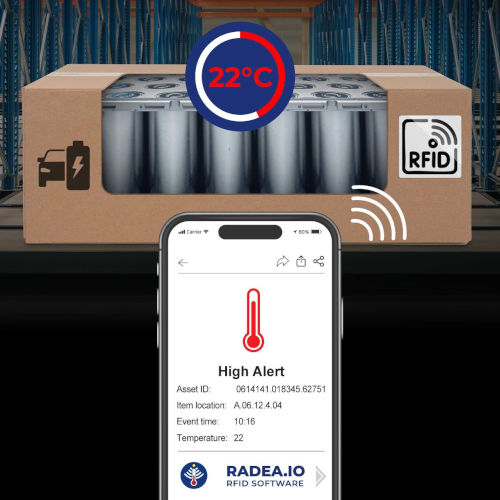
Self-adhesive UHF RFID labels can be applied to the inside of battery storage boxes to quickly detect any temperature variations. Each battery can also include a Brady UHF RFID tag, suitable for metallic surfaces and printable, providing additional benefits for Li-Ion battery supply chains.
RFID antennas and readers automatically send a signal every second to all tags and sensors within range, collecting temperature readings with an accuracy of 0.5°C. The RFID software platform collects all temperature readings and the location of each battery. When certain defined temperature thresholds are reached, the software platform activates third-party devices via a standard API.
Warehouse managers will have near-continuous, automated, and accurate temperature monitoring, enabling them to receive early alerts via SMS, email, or even visual warning indicators on the shelves themselves. This way, you can reach the precise location of the unstable Li-Ion battery in the warehouse and isolate it. Additionally, the software platform's API can also send a command to an autonomous vehicle to automatically remove an unstable battery.
The UHF RFID tags and their temperature sensors are wirelessly powered via RFID antennas and readers within range and require no maintenance. Brady can connect up to 16 antennas to a single RFID reader, providing temperature monitoring for all storage locations in racks up to 12 meters wide and 4 meters high. If an RFID reader is installed at the warehouse exits, the Brady solution can also provide automated, real-time warehouse inventory. Brady RFID readers read RFID-tagged items as soon as they enter their reading range. If there is an RFID reader at the exit, the RFID software platform can easily remove these items from the inventory as they pass through the door.
Teradyne introduces Iris 100 for optical testing of microLED devices
Teradyne has introduced Iris 100, an optical testing platform for microLED devices designed for use in manufacturing processes. The system allows for the individual measurement of emitters within a microLED array and can be integrated with the UltraFLEXplus platform...