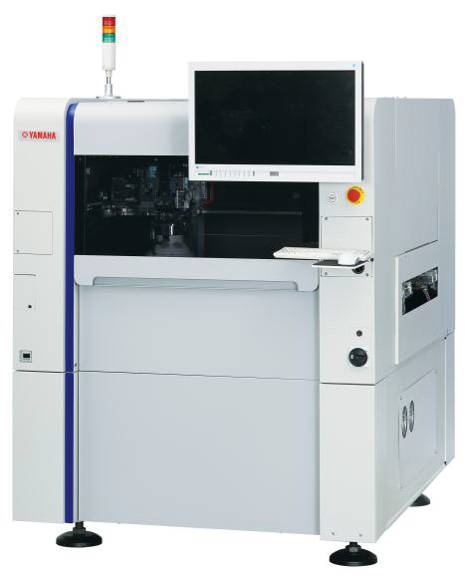
The new YSi-V Optical Online Inspection (AOI) system, unveiled at the trade show and equipped with a new 5-megapixel camera, brings sophisticated quality control to small producers or those working in budget-conscious project environments. Yamaha offers a range of configurations, from 2D to 2D/3D, with 5- or 12-megapixel cameras, allowing customers to select the configuration best suited to their needs. All configurations feature a wide field of view and benefit from the same signal processing and control system, as well as multiple inspection modes. The 12-megapixel version even offers a dual-lane option. The new 5-megapixel camera with 18-micron resolution enables these systems to deliver high-performance defect detection and capture detailed images from four different angles, which can be used as a reference by the operator for rework.
Also making its debut at Productronica was Yamaha's new ZS feeder with automatic loading, which eliminates the need for laborious roll splicing and the errors caused by roll termination, thus taking line efficiency to the next level. The component roll is changed quickly and easily without removing the feeder; simply insert the new roll into the back. Furthermore, the integrated self-calibration ensures correct belt positioning for consistent and stable cutting accuracy, guaranteeing no component waste. Moreover, by cutting the top plastic instead of separating it from the roll, the ZS feeder minimizes the effects of electrostatic charging and ensures that the components are perfectly positioned in the roll pocket. Once empty of components, the roll is cut into small strips for easy waste disposal. These new feeders are compatible with all Yamaha YS and Yamaha YSM assembly machines, and are suitable not only for high-volume production, but also for simplifying small series or prototypes where components are presented in component strips.
Furthermore, Yamaha has further expanded its range of mobile tools designed to boost productivity and provide critical information to operators regardless of their location within the production area. The new “Mobile Parts-Remaining Counter” allows users to check the number of components remaining in a given feeder at a glance, using a Windows® 7 handheld computer.
Visitors facing high-volume/low-mix production challenges were also able to see the latest Sigma assembly machines, which now incorporate all of Yamaha's engineering since the brand's acquisition from Hitachi in early 2015. Sigma machines are fully integrated into Yamaha's Complete Line Solutions and achieve high speeds, up to 75,000 cph for the Sigma G5S model equipped with two axes and two sets of heads. The Sigma F8 model, with four axes and four heads, can reach speeds of up to 150,000 cph. With their direct-drive heads, Sigma machines can assemble a wide range of components from 0.3015 mm up to 72 mm x 72 mm or 150 mm x 26 mm and 35 mm in height. Furthermore, support for advanced feeding solutions and options such as odd-form component heads maximize the machine's flexibility to meet diverse production needs.