This update was developed following an extensive study involving Fluke customers worldwide, in which specialists and maintenance technicians indicated that the most important thing is to identify problems as early as possible in the potential failure curve.
After examining various types of conveyor systems, the study revealed that uncontrolled bearings are often the cause of many mechanical failures. Since these systems are part of the overall production processes, extended downtime can negatively impact the entire plant and lead to serious problems throughout the supply chain. This holds true for food and beverage production as well as for the logistics, electronics, automotive, and mining/raw materials sectors.
Never inspected.
Despite the fact that a downtime line represents a serious problem (and a cost of up to €130,000 per hour), Fluke observed that 59% of conveyor belt systems are never inspected, while another 11% are checked manually. The study showed that the least effective way to detect a problem was through human sensitivity, followed by contact temperature and thermography. Checking by contact vibration or ultrasound was also complicated – in particular, ease of use is a major issue with ultrasound – while acoustic cameras offer the most effective method of all.
Customers not only said that the ability to pinpoint problems was vital for achieving substantial cost savings, but also that a scalable solution was needed that could help those using extensive conveyor systems (a large warehouse can have up to 80 km of conveyor belts) or where accessibility is a problem (perhaps due to conveyor guards).
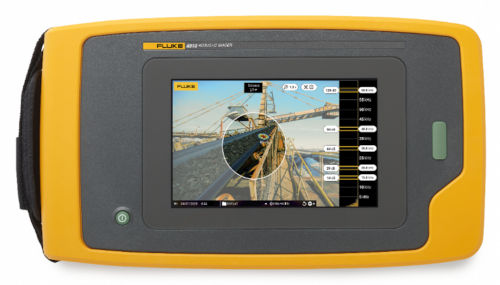
Thanks to the Fluke ii910 acoustic camera with MecQ, the non-contact inspection process for conveyor systems is significantly simplified. The instrument immediately identifies the location of a mechanical area of interest by comparing sound patterns. After viewing the problem on the screen, the maintenance professional can take note of it, share it with their team, and add it to their maintenance plan.
User-selectable frequencies:
MecQ was developed to add another layer of detection to the ii910, in addition to taking a photo, recording a video, detecting leaks with LeakQ, and detecting partial discharges in PDQ mode. Although the most common frequency for ultrasonic measurements is 30 kHz, the ii910 with MecQ now offers user-selectable frequencies from 2 kHz to 100 kHz and fixed multimode frequency bands of 15 kHz, 20 kHz, 30 kHz, 40 kHz, and 60 kHz for checking various stages of bearing deterioration. Depending on the environment, the user can choose whether or not to activate these preset frequency bands.
Tako Feron of Fluke stated, “All maintenance personnel will love the ease of use of the new version of MecQ, thanks to its intuitive interface and seamless integration with existing leak and partial discharge detection instruments. They will also appreciate its ability to increase efficiency, maximize uptime (by reducing mean time to repair), and decrease costs, all while ensuring high levels of safety through non-contact inspection and the elimination of hazardous situations. With MecQ, the ii910 now allows maintenance engineers to pinpoint a problem, take a screenshot, share it with the team, and schedule repairs during the anticipated downtime. Having all these workflow-streamlining solutions in a single instrument is not only unique to Fluke, but the Firmware 5.0 update also simplifies what is typically a complex and time-consuming inspection and maintenance task.”
Feron adds: “It is important to remember that the ii910 with MecQ is designed to offer a top-of-the-line inspection solution that identifies an area of interest for further analysis.”