The electrification of the automotive industry is an established trend that continues to accelerate as automakers seek to differentiate their products in the market and meet increasingly stringent regulatory demands for greater safety and reduced environmental impact. Advanced technologies such as artificial intelligence and millimeter-wave radar, previously used primarily in the aerospace industry and cutting-edge research, are now on the road and within reach of consumers. According to a Statista market study, the global automotive electronics market is worth more than $270 billion.
This relentless electrification presents a huge opportunity for the automotive and electronics sectors, but it also poses significant challenges. Consumer expectations for this technology are sky-high—they always demand something new and exciting—while, on the other hand, the industry's well-established focus on reliability and safety means that proven standards and technologies tend to change slowly.
 Flexibility and Efficiency
On the production line, large components and connectors that conform to legacy standards must be handled alongside the latest SMD chips, application processors, and power semiconductors in advanced surface-mount packages.
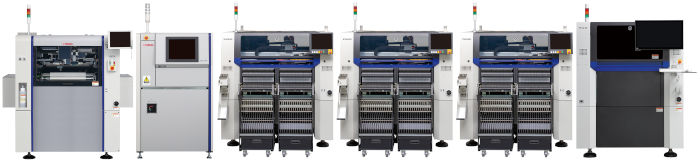
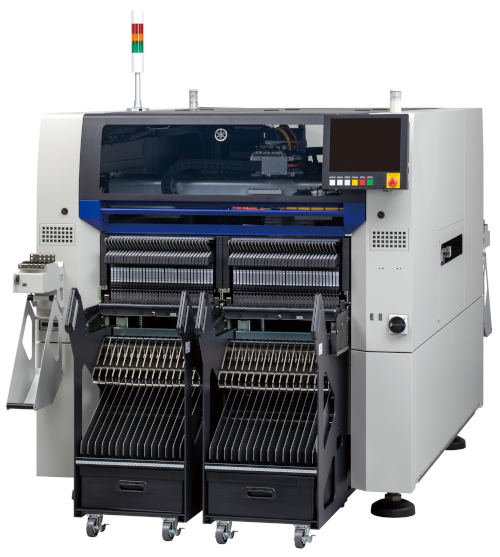
Yamaha Robotics' SMT division enables the industry to meet this challenge with its next-generation YR-series assembly solutions. The YRM20 flexible assembler can handle large mixes and high volumes, supporting the broader trend toward smart manufacturing.
Early customers have appreciated the YRM20's significant new features, such as its high-mix (HM) assembly head, which can handle components ranging from 0201-sized chip resistors to components up to 55 mm x 100 mm. This greatly simplifies the challenge of assembling large components, such as automotive circuit board edge connectors and tall capacitors, into high-power assemblies like electric power steering (EPS) controllers. Previously, a dedicated machine had to be set up to assemble these types of components. The YRM20 can handle almost anything without stopping the line and changing the head. Furthermore, its increased feed capacity minimizes changeover workload, while the compact feed carriages increase efficiency on the production floor.
Traceability is
another defining challenge in the automotive electronics sector, driven by the industry's high expectations for quality, reliability, and safety. With traditional SMT equipment, manufacturers can struggle to trace the root causes of defects encountered during post-reflow or downstream inspections. Yamaha's proven and integrated M2M communications, featured on the YRM20 and across all machines in the company's 1 STOP SMART SOLUTION, enable traceability and N-point verification, virtually eliminating the effort required to identify the causes of defects. When a defect is detected, supervisors can go directly to the root cause and resolve it quickly before it affects other assemblies. This increases productivity and improves quality by preventing defective units from leaving the factory after they leave the SMT line.
Yamaha's YSUP smart factory software supports machine-to-machine communication and offers time-saving features such as automatic assembly program generation and assembly simulations, and includes flexible packages for monitoring, analysis, and traceability. "The YSUP environment connects all machines on the line and helps users quickly create and optimize their programs," explains Daisuke Yoshihara, Yamaha's General Manager of Sales. "The smart factory tools enhance control and connect with enterprise-level software to assist with resource management and scheduling. The traceability package captures real-time data to pinpoint defects and their root causes and can be extended with All Image Tracer to analyze component assembly quality."
With these advantages in their surface mount production facilities, electronic component manufacturers serving automakers and Tier 1 automotive suppliers can handle the wide variety of product types typical of this market, while maintaining fast cycle times and minimizing line stops and changeovers. The result is a significant increase in productivity, even when dealing with tall or irregularly shaped components. Reducing format changes increases equipment utilization and reduces operational errors.
The traceability function allows for locating defective points and identifying the causes of defects in much less time than sequential ordering. "Traceability is an issue that extends throughout the entire automotive electronics supply chain," adds Yoshihara. "YSUP Traceability helps manufacturing companies capture all the information they need quickly and efficiently."
As advanced electronic systems continue to expand throughout the next generations of vehicles, managing functions ranging from infotainment, comfort and lighting, to transmission and autonomous driving, Yamaha's advanced mounting solutions provide flexibility and control for manufacturers to deliver cost-effective, high-quality solutions.