




As the EU Cyber Resilience Act (CRA) enters its implementation phase, with the European Commission's draft guidelines due in March 2026 and vulnerability notification obligations coming into effect on September 11, 2026, engineering teams are facing increasing pressure to address cybersecurity earlier in the design cycle. Even organizations based outside the EU must adapt to these requirements if they want to market connected products in the European market and maintain access to EU customers. This challenge becomes even more critical as industrial systems become more connected and data-driven, and as network roadmaps begin to look beyond 5G toward more resilient next-generation communications.
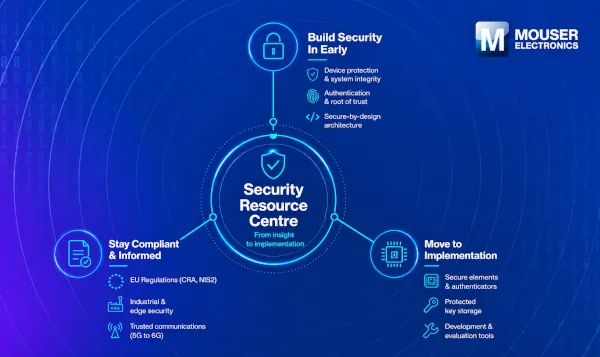
Because Mouser's security resource center is regularly updated with new articles, ebooks, and product examples, engineers can use it as a constant reference point as standards, threats, and best practices evolve. This platform provides developers with a practical starting point for understanding current risks, reviewing expert guidance, and identifying hardware technologies that can help create more resilient designs. Engineers can use the resource center in three particularly helpful ways.
First, it helps design teams strengthen security fundamentals during the design phase. Mouser's security content allows for early consideration of device protection, authentication, and system integrity, helping engineers integrate security into connected systems from the ground up, rather than treating it as an add-on in later stages.
Second, it helps engineers stay current with the constantly evolving cybersecurity requirements across all sectors, standards, and government regulations. It provides guidance on how to secure distributed devices that emulate control systems in increasingly connected environments, supports industrial and people-centric automation, and prepares operators for cybersecurity and information security incidents. Developers can also leverage the broader content from NIST and the Industrial Automation Security Resource Center to evaluate next-generation connected systems.
Third, it helps bridge the gap between guidance and implementation. Along with training resources, Mouser guides engineers toward relevant hardware security technologies, such as secure elements, secure authenticators, and related components that support root of trust, secure key storage, and authenticated operation in IoT, edge, and industrial designs.
Mouser's recent vendor-focused resources address edge security risks, industrial regulatory compliance, and cyber-physical development, helping engineers connect policy and architecture to practical implementation. The resources provide guidance on authentication, credential protection, and supply chain trust, along with content from NIST and Texas Instruments on next-generation industrial designs.
Because the content focuses on real-world design and implementation problems, the security resource center can help engineers compare approaches, identify gaps, and evaluate security/authentication tools, as well as prepare for evolving cybersecurity expectations driven by connected devices, AI, industrial digitization, and future EU regulations.
While security by design is now a requirement for many connected products, most embedded systems teams are still coordinating engineering, regulatory compliance, and product delivery. The Security Resource Center helps engineers by simplifying complex requirements, highlighting risks and solutions, and helping teams integrate security earlier and more consistently into their designs.
Mouser's broader focus on providing trusted support to engineers is also reflected in its own information security credentials, such as SOC 2 Type II, ISO 27001, and Cyber Essentials certifications.




