

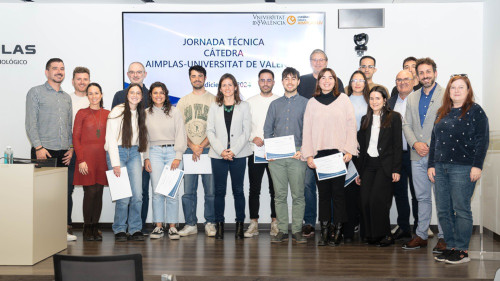
This is an award promoted by the Chair established this year by AIMPLAS, Technological Institute of Plastics, and the University of Valencia (UV) to reward academic excellence in final degree projects (TFG) and final master's projects (TFM) related to the circular economy in the plastics sector.
This first edition has featured fifteen applications that highlight the effort and innovation of students with a high commitment to developing sustainable solutions to address current challenges in the plastics sector.
Young talent alongside AI
The first prize went to Alex Planas Martínez, a student from Cuenca, who completed a Master's degree in Chemical Engineering at the University of Valencia (UV). His final project focused on 'The implementation of NIR-based techniques and artificial intelligence in the polyethylene packaging waste sorting process'. Planas explained: “I implemented optical techniques, as well as machine vision cameras, to differentiate between food contact and non-food contact packaging and recycle the waste so it can be reused for its original purpose.” As a result, the young man confirmed that this project “will allow for the recycling of a large amount of waste generated in the packaging sector.”
The second prize went to Gorka Marco Velasco, a student from Villareal, for his final project in the Master's program in Chemical Engineering at the University of Valencia (UV) on 'Use of ionic liquids and deep eutectic solvents for the preparation of polymer-based membranes for decarbonisation technologies', which focuses on the development of polymer membranes for CO2 capture.Marco explained that "if this technology is made available to industry, it can be possible to recover this greenhouse gas and therefore prevent its emission into the atmosphere."
Finally, the third prize went to Paula Gómez García, a student from Valencia, for her final project in the Master's Degree in Chemistry at the University of Valencia on 'Polymeric Coatings with Latent Heat Storage Capacity'. Gómez explained that "these coatings increase in temperature and absorb energy when they melt, but when they solidify, they decrease in temperature, thus emitting the energy they have absorbed."
Along these lines, he highlighted that “one of the problems we have globally is the use of fossil fuels; thanks to them we obtain a large part of our energy, and especially thermal energy for homes. So, with these polymer coatings, what we can create are alternatives to heat homes without needing to use these natural resources, which are limited and not properly treated, and which pollute when used by us.”
In addition, seven honorable mentions have been awarded to highlight the quality of as many applications: 'Integració de materials de canvi de fase en recobriments de sistemes tèxtils' (Eric Fuster Navarro), 'Preparación de membranas hidrofóbicas de PVDF con solvents verdes y agregar de polyethylene glycol y glicerol como formadores de poro' (Alejandro Gálvez Subiela), 'Computational modeling of the enzymatic mechanism of polyethylene terephthalate degradation' (Laura Granero Parejo), 'Encapsulación de complejos agroquímicos en lignina mediante métodos colloides' (José Huerta Recasens), 'Desarrollo de materiales funcional a partir de residuos de biomasa' (Lucía López Lucas), 'Diseño de una planta de reciclaje de terephtalate de polyethylene' (PET) (Lucía Mora Fernández) and 'Reciclaje química de residuos textil mediante líquidos ionices' (Javier Gonzalo Young).
A high-level jury
The evaluation of the projects was carried out by a jury composed of four specialists in the academic and technological fields: Marina Patricia Arrieta Dillón, PhD, Assistant Professor I3 at the Polytechnic University of Madrid; Luis Cabedo Mas, Professor at the Universitat Jaume I; Vicent Fombuena Borrás, Associate Professor at the Polytechnic University of Valencia; and Laura Santonja Blasco, Researcher at Polymer Char: Laboratory Instruments and Analytical Services. All of them highlighted the high technical and scientific quality of the applications, as well as their focus on critical areas such as recycling, sustainability, and innovation in polymeric materials.
At the awards ceremony, following presentations by AIMPLAS and the Chair, Adrián Morales, lead researcher of Mechanical Recycling at AIMPLAS, gave a lecture on the valorization of plastic waste.
It focuses on talent and sustainability
With these awards, AIMPLAS and the University of Valencia reinforce their commitment to training and promoting young talent. According to José Badia, director of the AIMPLAS-UV Chair, "these awards are not only a recognition of the students' efforts, but also a contribution to the advancement of the circular economy, a key aspect for the sustainability of the plastics sector."
The AIMPLAS-UV Chair aims to strengthen the connection between academia and industrial needs in the areas of sustainability, innovation, and the circular economy. Through initiatives such as these awards, it seeks to foster knowledge generation and the search for innovative solutions to the sector's challenges.