Evolution of Batteries for Electric Vehicles:
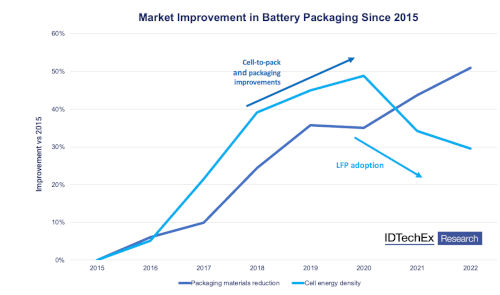
The electric vehicle (EV) market has continued its trend toward higher energy density battery designs. Although the average energy density of the market has decreased slightly since 2020 due to the resurgence of LFP batteries, the percentage of the battery occupied by the cells has been increasing, somewhat mitigating the impact of adopting the lower energy density cell chemistry.
The increasing proportion of LFPs has reduced the average energy density of the cells, but packaging efficiency has continued to increase rapidly, helping to offset this at the pack level. Source: IDTechEx (Figure 1)
The trend toward increased packaging efficiency is due in part to incremental improvements, but also to the increased adoption of cell-to-cell and cell-to-body designs seen in 2022. BYD's Blade battery saw a significant increase in its rollout in 2022, with BYD's market share in the Chinese electric vehicle market expected to reach approximately 25% in the first half of the year. This cell-to-cell design means that each prismatic cell occupies the entire width of the pack. In 2022, Tesla also rolled out its first vehicles using the highly effective 4680 battery cells and a structural pack design in which the cells are fixed directly to the battery lid. These design changes greatly improve energy density by eliminating auxiliary materials that do not directly contribute to the battery's performance. Several original equipment manufacturers (OEMs) have announced plans to implement cell-to-pack or cell-to-body designs in the coming years, including groups such as VW, Stellantis, and others.
Fire Protection in Future Battery Designs
Despite the elimination and reduction of materials in EV batteries, several materials will always be necessary in the design of an EV battery for optimal performance. These include the thermal management strategy (cold plates, coolants, etc.) and, especially in 2022, fire protection materials. As in 2021, EV fires have been prominent in the news, but now more than ever they are a driver for materials innovation. Although fires are infrequent and less likely than in a combustion engine vehicle, lithium-ion batteries, regardless of the chemical composition or cell format, present a non-zero risk of thermal runaway and subsequent fire. In 2021, several recalls related to the risk of battery fires were issued by major original equipment manufacturers (OEMs), such as GM, Hyundai, VW, and others. In 2022, India has witnessed a surge of attention to battery fires in electric two-wheelers, prompting the adoption of specific safety standards relating to various battery design factors.
With increased public attention and the imminent implementation of thermal runaway safety regulations in several regions, original equipment manufacturers (OEMs) are being compelled to take a more careful look at the materials used for fire protection. The previously mentioned trend toward cell-to-stack and higher energy-density packs presents a challenge in fire protection. As energy density increases, there is less room for additive materials, leading suppliers to focus on multifunctional materials. For example, aerogels are gaining market share due to their thermal insulation, fire protection, and compressibility capabilities. In 2022, Aspen Aerogels was named a supplier for GM's Ultium platform, and its PyroThin material generated $18.4 million in revenue in the first half of 2022, up from $6.7 million for all of 2021. Rogers Corporation, a major player in the supply of compression foam pads for pouch cell battery packs, announced its EV ProCell Firewall materials in 2022, which provide both fire protection and compression management (critical for pouch cell battery packs). In late 2021, DuPont's acquisition of Rogers was announced as one of the largest acquisitions in the materials sector in recent history. However, this acquisition was canceled in late 2022 after DuPont failed to obtain approval from all the necessary regulatory bodies.
Other material options may be used depending on the cell format and whether an inter-cell and/or pack-level solution is required. Starting in 2023, with the rapid expansion of the electric vehicle market, several of these materials will experience rapid demand growth, and IDTechEx forecasts that demand for fire protection materials will increase thirteenfold by 2033. IDTechEx’s latest report, “Fire Protection Materials for Electric Vehicle Batteries 2023–2033,” analyzes trends in battery design, safety regulations, and how these will affect fire protection materials. The report compares materials directly with each other and for applications within battery packs. The materials analyzed include ceramic blankets and sheets (and other nonwoven materials), mica, aerogels, coatings (intumescent and others), encapsulants, encapsulating foams, compression pads, phase-change materials, and many others. Ten-year market forecasts are included for each material and vehicle category.
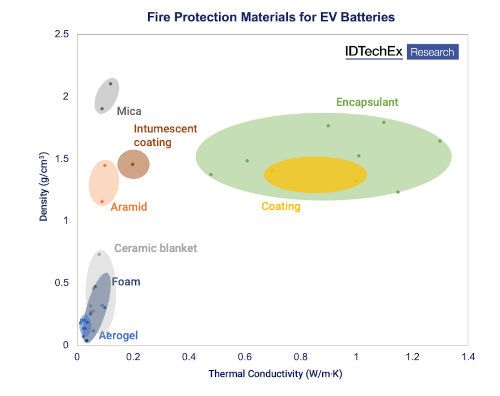 There are many materials applicable to fire protection, each with its pros and cons depending on the battery design.
Evolution of thermal interface materials in electric vehicle batteries
Thermal interface materials (TIMs) are a fundamental component in the vast majority of modern electric vehicle battery designs. They help dissipate heat from the cells to the cooling structure (module housings, cooling system, cold plates/channels). Currently, the most common applications have battery cells seated on a gap-fill TIM within a module; then, several of these modules are seated on another gap-fill TIM to make contact with the liquid-cooled cold plate below. This approach has changed in some more recent designs, particularly in cell-to-pack designs.
The concept involves cells making direct contact with the cold plate via a single thermal interface material (TIM), reducing the number of interfaces and improving heat transfer. With fewer interfaces, the thermal conductivity of the TIM can be reduced, requiring less TIM. Initially, this could lower the weight and cost of the TIM and facilitate its distribution. However, with the elimination of module housings (or similar structures), the TIM must now provide a structural component. This presents a significant opportunity for thermally conductive adhesives.
While (as mentioned earlier) the materials surrounding the battery cells are being eliminated from the pack to allow for higher energy density, the thermal interface material (TIM) is one of the materials that will largely remain and provide multifunctional properties to aid in both thermal management and the battery pack structure. With larger cells, the application area of TIM may narrow somewhat in some designs, but IDTechEx forecasts more than 2 TWh of liquid-cooled or coolant-cooled batteries by 2031, which will represent enormous growth for TIM, along with other thermal management components and materials.
Combination of thermal management and electromagnetic shielding in 5G and ADAS
Several industries are moving toward higher frequencies. Two key examples of this are 5G telecommunications for higher data transfer speeds and automotive radar to enable higher-resolution detection. At higher frequencies, shielding against electromagnetic interference (EMI) becomes more difficult with traditional methods. When this is combined with the increasing density and power of components, materials that can provide both thermal management and EMI shielding become an increasingly attractive proposition.
The rollout of 5G is well underway, but the higher-frequency infrastructure, mmWave (>24GHz), is still in its infancy. The vast majority of 5G infrastructure in 2022 remains in the lower frequency bands, below 6 GHz. However, IDTechEx predicts a 70-fold increase in mmWave small cell deployment by 2033. mmWave infrastructure presents several challenges related to signal propagation, but also, the higher frequency leads to smaller, more densely packed antennas where both thermal management and EMI shielding pose a challenge.
Automotive radar is a key component of advanced driver assistance systems (ADAS) and a key enabler of future autonomous vehicles. Previous automotive radars primarily operated at 24 GHz. Since then, the market has largely shifted to >77 GHz. This increases resolution but also necessitates a more compact antenna and, consequently, a smaller radar unit. These high-frequency radars are expected to be the dominant technology in the future. IDTechEx estimates that over 90% of automotive radars will operate in the 77 GHz region by 2030. In these designs, the compact nature of the device with higher frequency signals again presents challenges for both thermal management and EMI shielding.
Traditional EMI shielding typically consists of a metal board-level shield (BLS) placed over the component, with a thermal interface material (TIM) used between the component and the shield, and another between the shield and a heatsink. These shields often have holes to aid heat dissipation, but at higher frequencies (shorter wavelengths), this greatly reduces the shield's EMI effectiveness. Furthermore, with multiple interfaces between the component and the heatsink, heat transfer is significantly less efficient. Several materials companies have introduced a solution to these problems, providing a TIM that also has EMI shielding properties.
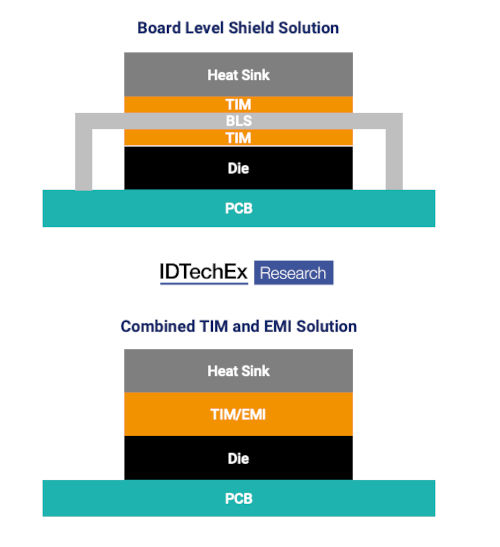 A combined EMI shield and TIM can replace several TIMs and a plate-level shield (BLS). Source: IDTechEx
Several manufacturers, such as Henkel, Kitagawa, and Schlegel, have released TIMs that also function as EMI shields. One option that stands out in 2022 is the announcement of Laird's CoolZorb D. Like others, it's a combination of EMI shield and TIM, but it differs in that it comes in the form of a single-piece, expendable material. The material offers a thermal conductivity of 3.5 W/mK and high attenuation, especially above 20 GHz. Its expendable nature makes it potentially more suitable for high-volume manufacturing, which can help automate the production process. While these combined EMI/TIM options are more expensive than a similar TIM, the ability to remove the EMI-absorbing material can reduce the overall cost of the device, as well as simplify the manufacturing process.
Both 5G and automotive radar are rapidly growing markets transitioning to higher frequencies. IDTechEx forecasts over 12 million 5G base stations by 2032 that will require thermal management, and that the annual market value of TIMs in ADAS will increase elevenfold over the next ten years.