Thanks to seamless integration with high-density, liquid-cooled environments, the Vertiv CoolLoop Trim Cooler enhances operational efficiency and aligns with the evolving needs of the industry, which demands highly energy-efficient and compact cooling solutions. This technology delivers up to a 70% reduction in annual cooling energy consumption by leveraging free cooling and mechanical operation, while requiring 40% less space than traditional systems. Designed to meet the challenges of today's AI factories, the system supports water supply temperature fluctuations of up to 40°C and cold plate functionality at 45°C.
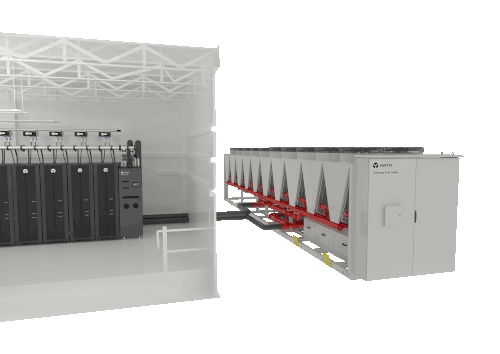
Water connections facilitate seamless and direct integration of the Vertiv CoolLoop Trim Cooler system and Vertiv™ CoolChip CDU coolant distribution units for direct-to-chip cooling. The Vertiv CoolLoop Trim Cooler can also be directly connected to immersion cooling systems. This simplifies installation and reduces operational complexity, facilitating compatibility with a wide range of high-density cooling environments, resulting in time and cost savings for customers.
“AI is completely changing data center cooling profiles, requiring an innovative approach to managing the cooling challenges inherent in racks exceeding 100kW,” explained Sam Bainborough, Vice President of Vertiv’s Cooling business in the EMEA region. “Today’s announcement and the continued expansion of Vertiv’s industry-leading high-density cooling portfolio enable us to offer pioneering liquid and chilled water cooling solutions capable of meeting the increased demand driven by the growing use of AI.”
The Vertiv™ CoolLoop Trim Cooler system uses a low-GWP (global warming potential) refrigerant and offers scalable cooling capacity up to nearly 3 MW in the air-cooled configuration. With a free-cooling system optimized for high ambient temperatures, the system has been designed to operate in free-cooling mode under a wide range of environmental conditions, reducing electricity consumption and CO2 emissions. The system complies with European regulations that include a ban on fluorinated gases by 2027, thus avoiding the need for costly redesigns and infrastructure upgrades to adapt to this future regulatory requirement.





- Details
- Category: Thermal control
Vertiv™ CoolLoop Trim Cooler Flexible Rejection System #industrialcooling
Vertiv has added a new solution to its cooling portfolio. The Vertiv™ CoolLoop Trim Cooler system supports air and liquid cooling applications for AI (artificial intelligence) and HPC (high-performance computing). This comprehensive solution will facilitate the operation of data centers and AI factories with hybrid or liquid cooling in a wide variety of climates.


Print Magazine

Annual subscription price:
You will receive all 10 editions that are published each year.
social networks
Popular News Electronics


Spanish electronics magazine. Printed for over 25 years.
Spain - Madrid - All rights reserved © Convertronic Professional Spanish Electronics Magazine.