
Rehm Thermal Systems offers the right solution for every application: with the sophisticated drying systems from the Blaubeuren-based company, it's possible not only to process any common adhesive and varnish, dielectric pastes, fillers, casting resins, and filler materials, but also to dry and harden them energy-efficiently in a very small space. The Rehm Thermal Systems product portfolio includes no fewer than four specialized, space-saving drying systems.
Alteco Vertical Dryer,
specially designed for flat components up to approximately 70 mm in total height, is the preferred compact system for achieving maximum throughput in long curing processes while using minimal space. This is achieved by using printed circuit boards loaded onto product carriers that pass through two processing towers, each with up to four heating zones stacked vertically one on top of the other. At just under 4 meters long, the Alteco replaces a comparable 40-meter-long horizontal oven without compromising the quality of the drying and curing processes. “Thanks to its alternating heat supply, uniform and reproducible heating is achieved even in a vertical position, even with heavy components,” says the head of mechanical design at Rehm Thermal Systems, highlighting the advantages of the vertical dryer. Another advantage of the system: it consumes less energy than a traditional design. Its compact, vertical structure has only a small radiating surface, so heat loss is minimal.
Thanks to its loading options, the Alteco is highly flexible. For example, not only does an automatic product holder adjustment allow for the simultaneous drying of two different varnished boards in one system, but since the product holder width automatically adjusts to the product width, the oven can be loaded with subsequent batches of different sizes without wasting time on preparation. An optional cooling section can also be integrated in a segmented form or implemented in the heating tower. In the latter case, the system is taller but offers the same performance.
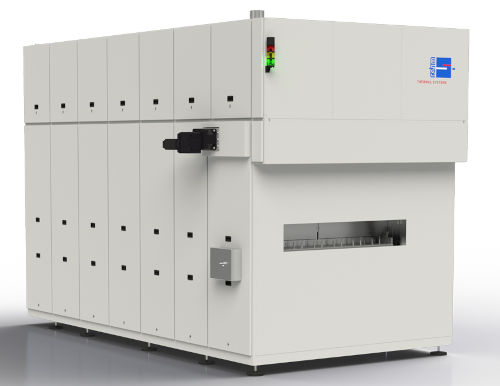 Pramo Drying System:
Unlike the Alteco, the Pramo continuous dryer processes components using a looped conveyor system. Product carriers with "nave" receptacles pass through several zones where they are heated and then held at the preset temperature for the drying or hardening process. Its design offers numerous advantages: in addition to requiring little space, the looped conveyor not only enables high throughput with variable cycle times but also reliably guarantees optimal and flexible drying and hardening results, even for special shapes and taller components. For process verification, appropriately prepared measuring gondolas can be easily inserted using a quick-release mechanism.
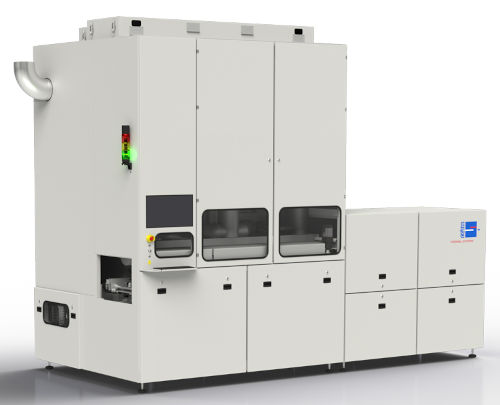
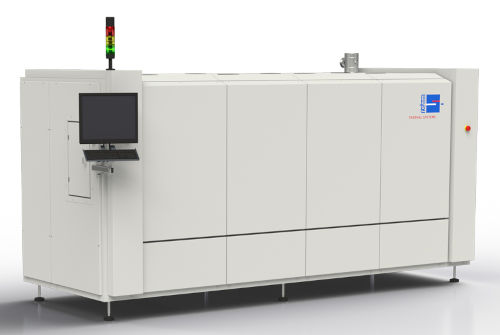 RDS compartment dryer
from Rehm Thermal Systems also saves space. Unlike a vertical dryer with a loop conveyor, the system is loaded—either manually or via a handling system—with multiple compartments, which then enter the heating zones. There, the system reaches temperatures up to 300 °C and residual oxygen levels below 5000 ppm O2. Optimal thermal insulation ensures a stable temperature profile throughout the process. This makes the compartment dryer particularly suitable for high-performance modules and high-temperature applications, or for the heat treatment of semiconductors, hybrid assemblies, and electronic modules such as those used in wind turbines, electric vehicles, or the solar energy sector.
Meander Dryer:
The meander-shaped design of this special dryer from the Rehm range allows a large number of parts to be fed through the processing chamber in a precise position within a very small space. The loading position is outside the chamber; the actual loading is carried out manually or with the help of a robot. Designed as a special system, the final design of the meander dryer can be individually adapted to the customer's requirements.
One for the other: the right system for every need.
The Alteco and Pramo drying and hardening systems, the RDS compartment dryer, and the Rehm Thermal Systems meander dryer are specifically designed to process different modules. What they all have in common is that they require little space while offering high throughput and long drying times compared to conventional ovens. Added to this is an attractive price-performance ratio and relatively low energy consumption.