It is possible to experiment with the behavior of sound waves in different layers of water and their reflections off various materials on the ocean floor, such as rocks, sand, and mud. Miniaturization means that the highest possible precision of the measuring equipment is required, as the experimental results are then scaled to indicate what would occur in the real world.
The laboratory's new water tank is rectangular, measuring 3.6 m long by 1.2 m wide, with a maximum water depth of 0.91 m. The research involves using a hydrophone to record the signals, or chirps, generated by an arbitrary waveform generator (AWG), the Spectrum M2p.6546-x4 model. This PC board generates signals with 24 V output oscillations, which are then amplified before being emitted by a hydrophone. After traveling through the tank, the signals are detected by another hydrophone and processed by a Spectrum M2p.5932-x4 digitizing board. The transmitter and receiver are held by a robotic arm that positions and orients them within the water, so that the source and receiver can be positioned as needed.
 The tank allows for experiments to be conducted on how the seabed affects sound waves that bounce off it. A pure rock bottom will have a different effect compared to sand, mud, or layers of different materials.
"It's even more complicated," explains Dr. Traci Neilsen, the professor in charge of the project, "because water isn't homogeneous. Changes in temperature and salinity alter the speed of sound and cause the waves to bend, similar to how a mirage occurs. We plan to examine the impact of water temperature changes on machine learning for locating sound sources. These tank studies are more repeatable, efficient, and cost-effective than open-ocean experiments and will allow us to develop techniques that can then be tested with ocean data."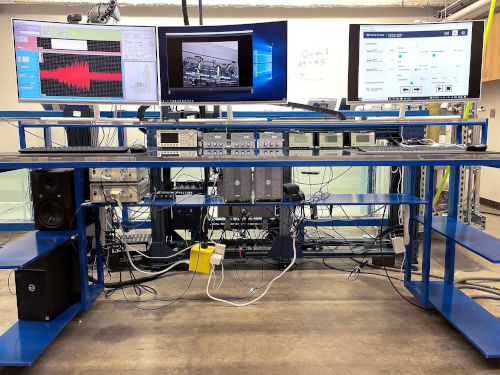
Adam Kingsley, the PhD student responsible for the acquisition software, says: "We chose Spectrum products because they have proven capable of delivering the high level of accuracy and timing we need. Since this tank is actually a miniaturized version of a huge body of water, accurate timing is vital for the results to be meaningful when scaled up."
Spectrum's pair of PCIe cards are housed in an external PCIe chassis on the main control console, precisely synchronized by a Spectrum Star-Hub module. The setup includes a second pair of identical cards in a second chassis that can be activated by the first.
This scaled-down experiment requires much higher frequencies, in the kilohertz range, than would be used in the ocean. The digitizers and AWG cards have a high 16-bit resolution and can sample and output at rates of up to 40 megasamples per second, while the channel-to-channel deviation is less than 100 picoseconds. This provides the high accuracy required for the experiments. The two UR10e robotic arms, along with signal generation and data acquisition, are controlled by a custom LabVIEW software program created by Adam Kingsley called "Easy Spectrum Acoustics Underwater" (ESAU).
 A key part of the experimental setup is modeling the open ocean, so special anechoic panels from Precision Acoustics, positioned on the sides of the tank, reduce reflections. A significant innovation was the design of a filtration and circulation pump by John Ellsworth, supervisor of the research laboratories in BYU's Department of Physics and Astronomy. This pump keeps the water clean without creating bubbles in the tank, which are a major source of noise. With all these preparations in place, impulse responses could be measured, making it easier to remove noise from readings during an experiment. The precision of Spectrum PC cards, with a signal-to-noise ratio (SNR) of over 71 dB, ensures that impulse response removal yields accurate experimental results.

Dr. Neilsen added, "This new lab was built so that research students could design and conduct their own experiments as part of their undergraduate studies. My first postgraduate student, Cameron Vongsawad, and I carefully considered the equipment we needed to purchase because it was important that everything be robust and easy to use, as this equipment will be in operation for many years. Like many other labs, we value Spectrum Instrumentation's unique five-year warranty, as it means we can rely on their products for years to come."