Driving Continuous Improvement
: To increase production, a Japanese automotive component manufacturer sought to reduce the cycle time of critical processes while simultaneously increasing conveyor belt speed to minimize the travel time of each part between processes. The company's production team discovered that increasing speed beyond a certain level resulted in diminishing returns. When fast-moving items are stopped by a conventional pneumatic stop cylinder, a significant settling time is required before the part can be retrieved from the conveyor and loaded into the process. They also found that increasing the speed of process machinery to achieve a faster cycle time began to cause more frequent line stoppages for troubleshooting.
Another manufacturer, producing small electric motors, was looking to build orders for small runs of specific product variants more efficiently by reducing line changeover time. Optimizing changeover procedures allowed them to reduce this time by 50%, from 10 to 5 minutes. However, the cumulative effect of these 5-minute changeovers, which are typically performed several times a day, equates to approximately 16 hours of lost production each month. Therefore, the team had to manage production carefully, prioritizing higher-volume products to optimize productivity.
To save these lost hours, the company sought to develop a special jig to produce multiple product variants without reconfiguring the line. This custom jig, designed to hold three different components in small, medium, and large sizes, allowed the line to handle up to nine different product variants without requiring line changes. However, the two-axis robot used to remove the selected part from its position in the jig required adjusting the conveyor's stop position depending on the product variant being manufactured (Figure 1). Alternatively, replacing the two-axis robot with a three-axis robot would allow the robot to move along the jig to pick up the desired part. Either approach would involve additional expense but would result in significant production time savings.
Conveyor System Design and Support:
As the main artery running through the production line, a well-designed conveyor system can help maximize production output, eliminate manual handling, and ensure the best use of factory space. Configuring a conveyor system to optimize facility operations is a skill that often involves customizing off-the-shelf standard units or developing individual solutions for specific challenges within the factory environment, such as extreme space limitations or elevation changes. Compensating units are often needed to accommodate differences in machine capabilities on the line and enable the entire line to operate consistently and in a coordinated manner. Conveyor belt suppliers offer a wide variety of options and configurations, and even proprietary specialty products that can be tailored to meet individual customer needs.
Because the system is typically designed by specialists according to specifications, the result is well-suited to the factory's requirements as expressed at the beginning of the project. As those requirements change and evolve, making the necessary adjustments to the conveyor system can become challenging. Changing the stop positions implemented with pneumatic cylinders and their associated sensors and solenoid valves, for example, can involve extensive software development, wiring, and mechanical adjustments.
Two companies that manufacture automotive components and small engines encountered these limitations when trying to increase production throughput with conventional conveyors. In each case, the project team was unable to achieve 100% of the desired improvement.
Linear Module Part Transport:
Compared to conventional conveyors, Yamaha's LCMR200 linear transport module offers significantly greater flexibility for adapting and improving line performance. Parameters such as acceleration, deceleration, speed, and stop positions are electronically set and easily adjusted by writing the desired values to the controller. Furthermore, the linear motor allows for bidirectional movement.
The associated YHX controller eliminates the need to write ladder logic code and allows the user to specify direct values and simple point-to-point movements. A single controller can coordinate multiple interconnected LCMR200 modules as part of a complete production cell.
Since no additional sensors are required to add extra stop positions, users can easily reconfigure their production line without compromising reliability. The linear motor accelerates and stops quickly and smoothly, and the settling time after reaching the desired position can be very short. In fact, the settling time can be optimized by adjusting the positioning tolerance: a larger tolerance allows for a reduction in settling time. Furthermore, users can increase the conveyor speed without inserting additional stops, as each module can be stopped, restarted, and reversed independently, as needed, to deliver each part at the optimal time.
The LCMR200 slider can be programmed to stop at any desired point, with a positional repeatability of ±5µm (maximum). Moreover, the transfer speed is electronically adjustable up to 2500 mm/s. The table below compares the typical times required to transfer parts, depending on the payload.
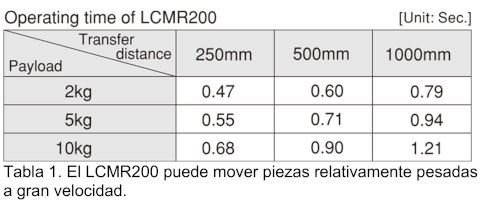 Table 1. The LCMR200 can move relatively heavy parts at high speed.
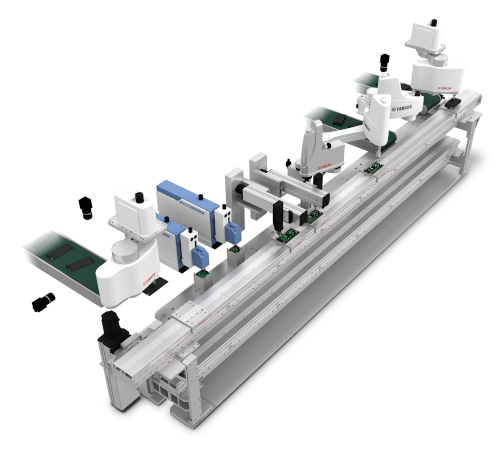
The slider can support loads of up to 15 kg, and the module's rigidity allows processes to be carried out without removing the workpiece from the slider (Figure 2). This ensures a fast cycle time and also saves the effort and engineering cost of developing a mechanism to transfer the workpiece to and from a different jig for each process.
 Figure 2. The linear transport modules present the workpieces directly to each process in a sequence.
The automotive component manufacturer mentioned earlier quickly saw how the LCMR200 could help achieve 100% of the desired productivity improvement. As a pilot project, redesigning a production line to replace conventional conveyors with LCMR200 modules resulted in a substantial reduction in transfer time. This time saving, in turn, eased the pressure to shorten the cycle times of the various processes on the line. As a result, production volume has exceeded the team's original target, and the number of errors causing downtime has been reduced to the point that this assembly line has become a model line in the plant.
Similarly, the electric motor manufacturer used the LCMR200 to improve production by increasing the flexibility of the production line. The ability to change the stop positions of the modules through reprogramming saved a significant amount of manual setup work. Subsequently, the team introduced a QR code reader to identify each unit type at the start of production and allow all LCMR200 modules to automatically reconfigure their settings. This eliminated any need for human interaction with the machines or equipment via the touch panel, resulting in complete end-to-end automation of product assembly. This significantly increased operating speed and eliminated the need for operator intervention to change product models. The company can now manage small production runs as efficiently as large orders.
Conclusion:
Manufacturing companies constantly face the challenge of increasing productivity through measures such as increasing line speed and reducing changeover time. Conventional conveyors can be an obstacle to progress, offering only limited flexibility and requiring significant engineering effort for reconfiguration. Simple changes often fail to achieve the necessary improvements. Furthermore, making major changes typically requires substantial support from the supplier partner.
Bidirectional linear conveyor modules allow for extensive reconfiguration of parameters such as speed and stop positions. Moreover, equipment owners can usually make these changes independently. Other advantages include the ability to perform processes such as mechanical assembly directly on the module, saving both processing time and the engineering overhead associated with removing and replacing parts on a conventional conveyor.