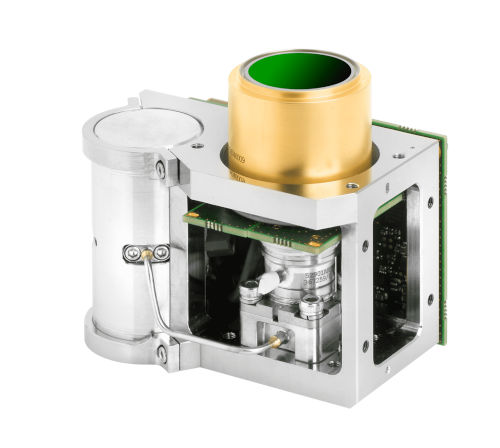
EOLE, a high-performance, VGA-resolution, low-power IR detector, is the first product Lynred is launching in its new line of IR detectors targeting methane and other OGI (Optical Gas Imaging) applications. It has been developed to meet new regulatory requirements and designed for easy integration into imaging systems.
Lynred's lowest-cost solution, the broadband PICO640S, enables 24/7 monitoring of high-risk areas to detect anomalies outside of quarterly inspection operations. It will be available for sampling in 2025.
Both IR detector models cover a wide range of OGI applications, including manual and UAV (unmanned aerial vehicle) inspections and continuous monitoring systems. Thanks to their compact size, both models are compatible with handheld and fixed cameras, including drone cameras. By providing solutions that help operators detect, locate, and quantify leaks, such as gas formation, EOLE enables the identification of even minor leaks, thus triggering rapid repairs.
“Lynred is proud to introduce EOLE and PICO640S Broad Band as new offerings in the gas detection market for monitoring greenhouse gas emissions and other environmental inspection operations,” stated Herve Bouaziz, CEO of Lynred. “Customers seeking new gas detection solutions will benefit from EOLE’s high image quality, sensitivity, compact packaging, and low power consumption thanks to HOT (High Operating Temperature) technology, as well as its special architecture: PLUGUP, a standardized interface for easy design or upgrades of any product application.”.
Lynred will conduct a live demonstration of EOLE at booth number 1 of the Methane Mitigation Tech & Innovation Summit, which will be held from June 11-13, 2024 in Austin, Texas, where it will show how its optimized design, with a very low noise cryogenic refrigerator, outperforms other architectures.
In May 2024, the U.S. Environmental Protection Agency (EPA) issued final regulations to reduce methane emissions and strengthen greenhouse gas emissions reporting. These regulations require operators to adopt a proactive approach to emissions control by improving leak detection and repair practices and increasing the frequency of inspections.
Methane is the second largest contributor to global warming after CO2. In 2023, methane emissions from the energy sector remained near record highs, accounting for approximately 120 million metric tons. More than 20% of methane emissions come from fossil fuels. The total length of major oil and gas pipelines is 2.15 million kilometers, with projected growth of over 5% by 2027.