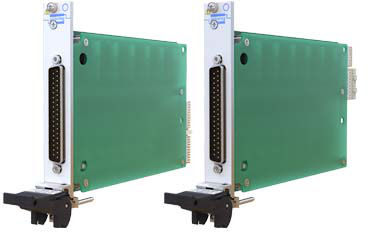
Designed for electric vehicles, electric aircraft, and other automotive, aerospace, and energy storage applications, these battery simulator modules occupy only one PXI or PXIe slot. The 41-752A-111 (PXI) and 43-752A-111 (PXIe) are 2-, 4-, or 6-channel battery simulators capable of supplying up to 7 V and 300 mA per channel. The channels are fully isolated from ground and from each other, allowing for series connection to simulate batteries in a stacked architecture. The 1 kV isolation barrier allows the module to be used as a lower-power version of a battery bank, representative of those used for vehicle propulsion.
Each channel of the modules can absorb up to 300 mA to simulate a battery under load and provides independent power and sensing connections, enabling the simulator to detect a remote load and correct for wiring losses. Designed to respond to dynamic loads, the battery simulator minimizes the need for local decoupling capacitors at the load. The module can also independently read the voltage across the load and current for each channel, either programmatically or via a manual soft front panel.
The modules can be combined with other Pickering PXI switching and simulation modules, including high-voltage switching, fault insertion, thermocouple simulation, and RTD simulation, as well as with third-party PXI modules, such as a CANbus interface, to create a fully flexible BMS (Battery Management System) test system. The 41/43-752A can also be used as a fully isolated 6-channel power supply with independent sensing lines on each channel.
Pickering's Simulation Product Director, Paul Bovingdon, comments: "With most of the EV industry expected to switch from 400V to 800V architectures by 2025, unlocking significantly faster charging speeds and helping to address range anxiety, the 41/43-752A-111's increased voltage isolation will be vital to support BMS testing with battery stacks up to 1kV."
Pickering offers comprehensive software support for all its products, enabling users to design their applications with their preferred operating system and programming languages (C/C++, .NET, Python, LabVIEW/LabWindows, MATLAB, etc.), ensuring seamless system integration. Users can choose from all Microsoft-compatible Windows versions, popular Linux distributions, and real-time hardware-in-the-loop (HIL) tools such as VeriStand, LabVIEW RT, and QNX.
All modules are covered by Pickering's standard three-year warranty.