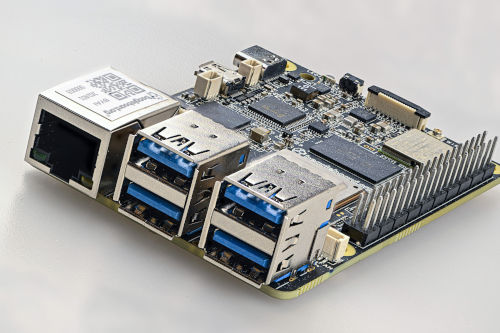
BeagleY®-AI is designed to help users maximize AI performance in robotics, factory and building automation, test and measurement, medical technology, human-machine interfaces (HMIs), and intelligent vision. BeagleY®-AI delivers the computing power needed to perform tasks such as image classification, object detection, semantic segmentation, and many others.
BeagleY®-AI features a powerful 64-bit quad-core A53 processor, multiple powerful AI accelerators coupled with a C7x DSP, an integrated 50 GFLOPS GPU supporting up to three simultaneous display outputs, and modern connectivity including USB 3.1, PCIe Gen 3, WiFi 6, and BLE 5.4. The board is compatible with a wide range of existing accessories that expand system functionality, such as Power over Ethernet (PoE), NVMe storage, and 5G connectivity.

The full range of new features in the BeagleY®-AI single-board computer includes:
Texas Instruments AM67A SoC: Quad-core 64-bit Arm Cortex-A53 CPU, dual general-purpose DSPs, Arm Cortex-R5 subsystem, GPU, and video and vision accelerators.
Memory: 4GB LPDDR4; microSD card slot; EEPROM board identifier.
Three simultaneous displays: microHDMI, OLDI (LVDS) with touchscreen support; MIPI-DSI with touchscreen support (mixed with MIPI-CSI).
Debugging: 3-pin JST-SH console UART; 10-pin TAG-CONNECT JTAG header.
Full I/O: PCI-Express® Gen3; USB-C device port; 40-pin expansion header
Romain Soreau, Head of Single Board Computing at Farnell, comments: “This is excellent news for all developers. With its competitive price and user-friendly design, the BeagleY®-AI offers a positive development experience using BeagleBoard’s proven custom Debian Linux image.”
Christine Long, CEO of BeagleBoard.org, states: “We are delighted to announce the release of the Beagle®Y-AI as an open-source board. This is an exciting step forward in BeagleBoard’s mission to expand the open-source hardware ecosystem. By providing a platform that fosters collaboration and learning, the BeagleY®-AI has the potential to empower individuals and professionals to develop open designs and contribute to the wider community.”