
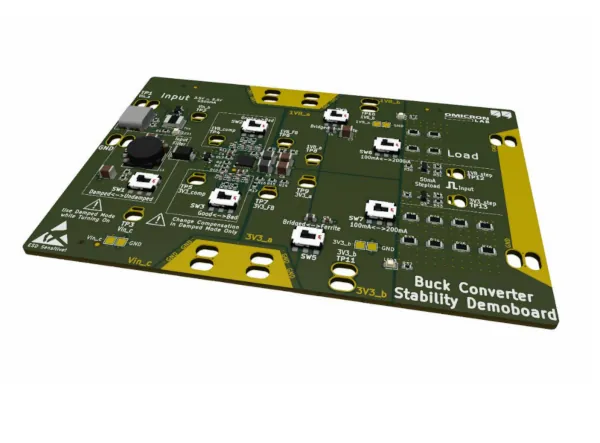
To address this problem in both the educational and applied engineering fields, OMICRON Lab has developed the Buck Converter Stability Demoboard (model DGN1DEMO-2): a didactic and measurement platform that allows visualization, comparison and quantification of the dynamic behavior of a dual buck converter under different configurations.
System description
The DGN1DEMO-2 is a compact demo board that implements a dual buck converter, generating two regulated output voltages—1.8 V and 3.3 V—from an input voltage in the range of 3.5 V to 5.5 V. Power can be supplied directly from a USB-C connector or via a conventional lab power supply, greatly simplifying setup.
The integrated status LEDs visually confirm the correct regulation of the outputs from the very first moment, eliminating additional verification steps and allowing the user to concentrate on the analysis.
Configurability: the core of the design
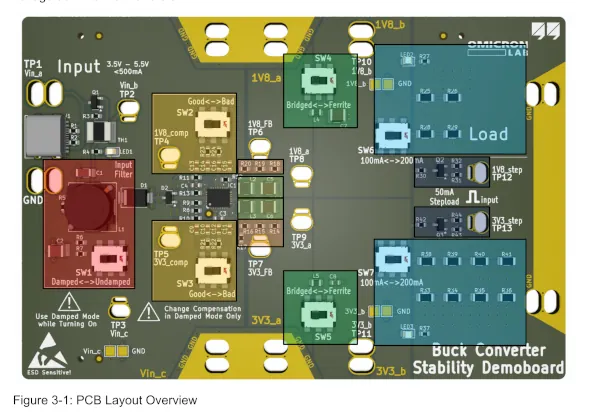
One of the most outstanding features of the DGN1DEMO-2 is its high degree of configurability. The card incorporates:
Switchable input filter damping allows for the study of the impact of input filter resonance on control loop stability, a phenomenon known as input filter stability interaction.
Selectable compensation networks facilitate direct comparison between properly designed and inadequate compensation, observing the effect on phase margin and crossover frequency.
Optional ferrite filter stages at the output have well-defined resonant frequencies: ~170 kHz for the 1.8 V output and ~730 kHz for the 3.3 V output.
Static and dynamic loads, with currents between 100 mA and 300 mA, plus a 50 mA load step for transient response analysis.
This combination of options makes the DGN1DEMO-2 an ideal tool for comparing "good" and "bad" stability scenarios in a reproducible and controlled manner.
Notable frequencies of the system
The design of the DGN1DEMO-2 has been carefully planned to expose the user to relevant dynamic phenomena at well-differentiated frequencies:
PhenomenonApproximate FrequencyInput Filter Resonance~10 kHzControl Loop Crossover~20 kHzFerrite Filter Resonance (1.8 V Output)~170 kHzFerrite Filter Resonance (3.3 V Output)~730 kHzConverter Switching Frequency~1 MHz
This arrangement allows frequency sweeps to be performed that cover everything from the low-frequency behavior of the loop to parasitic interactions in the megahertz band.
Available measurements
Access to multiple test points along the circuit enables a complete set of characterization measurements:
Open-loop gain: a fundamental measurement for evaluating gain margin and phase margin.
NISM (Non-Invasive Stability Measurement): a non-invasive stability measurement technique that does not require opening the feedback loop.
Output impedance: a key parameter for evaluating the source's response to load variations.
Input impedance: relevant for analyzing the interaction with input filters and other system stages.
Input filter impedance: characterizes the input stage filter.
PSRR (Power Supply Rejection Ratio): the power supply's ripple rejection ratio.
Step-load response: evaluates the transient behavior in response to abrupt current changes.
Integration with frequency response analyzers
The DGN1DEMO-2 has been optimized for use with OMICRON Lab's Bode 100 and Bode 500 frequency response analyzers, although its design with standard injection and measurement points makes it compatible with any conventional vector network or frequency response analyzer.
The converter's feedback path includes a signal injection point for loop measurement, following the disturbance injection methodology described by Middlebrook and widely adopted in the industry.
Applications and target audience
The DGN1DEMO-2 is particularly suitable for:
University and technical training environments, where it allows students to experiment practically with the concepts of small-signal stability, control theory applied to converters, and the effects of parasitic components.
Design engineers who need to become familiar with stability measurement techniques before applying them to their own designs.
R&D departments that require a documented and repeatable reference for validating measurement procedures.
Each unit is supplied in a pack of two DGN1DEMO-2 cards, which facilitates simultaneous comparison of configurations or working in groups in laboratory environments.
Conclusion
The OMICRON Lab DGN1DEMO-2 Buck Converter Stability Demoboard is a well-designed solution for bridging the gap between converter control theory and experimental verification. Its configurability, the variety of measurements it supports, and its low entry threshold—USB-C power and immediate startup—make it a valuable resource for both trainers and power engineers seeking a reliable dynamic characterization platform.
For more technical information, the complete user manual is available on the OMICRON Lab website, along with application notes and additional training resources.
Source: OMICRON Lab — https://www.omicron-lab.com/products/educational-material/buck-converter-stability-demoboard