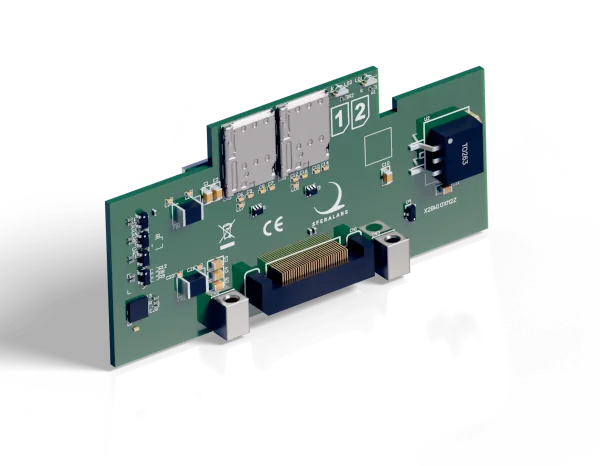
The M.2 LTE module is designed for applications that define the IIoT challenge: where wired Ethernet is impractical, Wi-Fi is unreliable, and continuous connectivity is essential. Typical deployment scenarios include: remote monitoring stations and smart infrastructure in locations without fixed broadband; fleet telematics and vehicle gateway applications requiring cellular availability and GPS location awareness; asset tracking and georeferenced edge computing where GNSS positioning is critical; and unattended industrial nodes where cellular connectivity serves as the primary connection or as a backup to an existing wired link
Key technical features
Dual SIM: Two Nano SIM slots allow for multi-operator configurations or automatic SIM failover, ensuring continuity even when the primary operator has no coverage.
Telit LN920A Compatibility: Fully compatible with the Telit LN920A M.2 LTE data card family, a widely adopted and industry-certified modem platform.
Permanent connectivity: The LN920A supports user-developed applications that run directly on the modem, allowing it to work in conjunction with the Strato Pi Max's integrated RP2040 microcontroller. This enables cellular connectivity and I/O management to remain active even when the compute module is powered off.
GNSS Positioning: The LN920A's integrated GNSS receiver provides location data for asset tracking, geofencing, and logging of georeferenced data without the need for additional hardware.
Granular software control: Dedicated control lines for modem power, reset, RF disable (airplane mode), and GNSS disable give developers precise control over power consumption and operating states.
Visual diagnostics: Front panel LEDs provide instant feedback on power status and network registration, simplifying field commissioning and reducing on-site troubleshooting time.