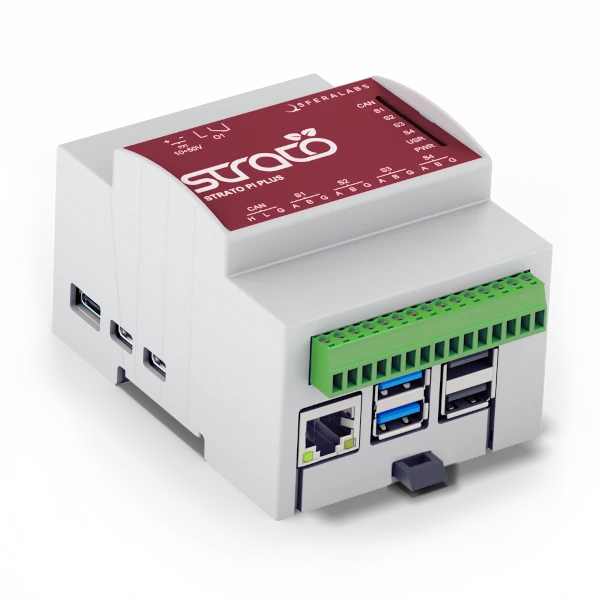
The RP2354 coprocessor operates independently of the Raspberry Pi, managing the hardware watchdog timer, power-up cycle logic, RS-485 transmission enable, CAN communication, relay output, fan control, and input power monitoring. If the Raspberry Pi's operating system becomes unresponsive, the RP2354 automatically detects and recovers it, without requiring any software installation on the Raspberry Pi. Over-the-air (OTA) firmware updates for the RP2354 are delivered via the Raspberry Pi's GPIO pins, allowing for updates to field-deployed fleets without requiring physical access.
The Strato Pi Plus variant A offers four individually isolated RS-485 interfaces, each based on the Analog Devices ADM2861E transceiver with ESD protection and programmable termination. For engineers managing Modbus RTU multibus networks, this completely eliminates the need for external RS-485 gateways.
Both variants A and B support CAN 2.0B and CAN FD with data rates up to 8 Mbps, galvanic isolation, and ESD protection, making the Strato Pi Plus ideal for machine networks as well as vehicle or fleet telemetry applications.
The power supply accepts 10 to 50 V DC, covering 12 V, 24 V, and 48 V industrial rails without the need for an external converter. An NXP PCF2131 real-time clock with a temperature-compensated oscillator (±3 ppm) maintains accurate time even during power outages, while the Microchip ATECC608 secure element provides hardware key storage and other standard cryptographic functions for device authentication and secure communications.
An optional 3-axis accelerometer enables tamper detection and vibration monitoring. An optional internal fan, controlled by the RP2354, activates upon reaching user-configurable temperature thresholds.
Strato Pi Plus is available in variants A (4 × RS-485, CAN FD, relay), B (1 × RS-485, CAN FD, relay), and C (1 × RS-485). All variants are compatible with Raspberry Pi 4B or 5, with memory configurations from 1 GB to 16 GB, an optional internal fan, and CE, FCC, and IC certifications. The Linux drivers expose all parameters managed by the RP2354 through the sysfs filesystem, enabling integration from any language or framework.
The Raspberry Pi 5 models will incorporate optional support for M.2 SSD storage in late 2026, making the Strato Pi Plus one of the few industrial DIN-rail Raspberry Pi platforms to offer this capability, along with Sfera Labs' Strato Pi Max. For deployments requiring fast local storage, large-scale data logging, or local AI model inference, support for integrated SSDs removes a significant limitation that has historically forced engineers to opt for more expensive or proprietary solutions.