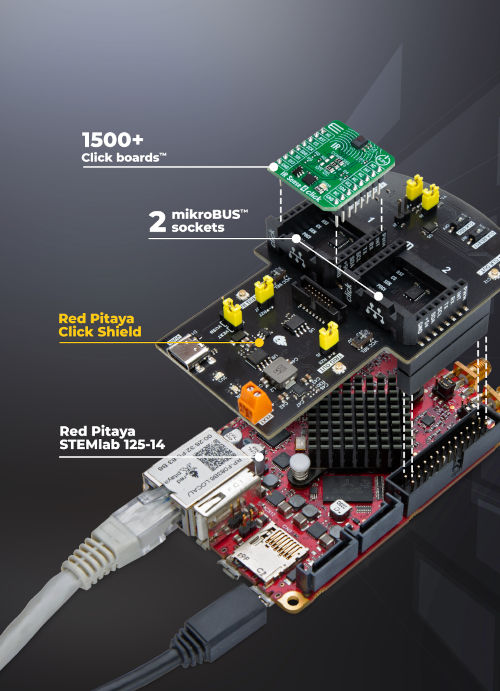
About the size of a credit card, Red Pitaya combines the functionalities of several laboratory instruments—oscilloscope, signal generator, and spectrum analyzer—with extensive programming capabilities and open-source software to power any project. Click Shields are adapters that bring Click board™ connectivity to popular development platforms such as Arduino, Raspberry Pi, STM32 Nucleo, and now, Red Pitaya.
Nebojsa Matic, CEO of MIKROE, comments: “This Click Shield is the ideal companion for Red Pitaya, designed to unlock even more possibilities for engineering and programming projects. It facilitates seamless integration of Click boards with the Red Pitaya host board, expanding its capabilities and versatility. Once the Red Pitaya host board is connected to our Red Pitaya Click Shield, designers can access over 1,550 Click boards, as well as a library containing functions and sample code for MIKROE compilers.”
With two mikroBUS™ sockets, the Red Pitaya Click Shield can be powered via an external power supply, compatible with a wide voltage range of 12V to 24V, or via a USB Type-C connector, ensuring configuration flexibility. Furthermore, users can utilize any Click board with the help of existing bidirectional level-shift voltage translators, regardless of whether the Click board operates at a selected logic voltage level of 3.3V or 5V.
A distinguishing feature of the Click Shield is its shuttle connector, specifically designed for connecting logic analyzers. This connector is your gateway for easily monitoring and analyzing SPI, UART, or I2C signals, providing valuable insights into your projects. Another notable feature is the integration of the ZL40213, an LVDS clock buffer with two identical output clock drivers. This component is designed to distribute low-jitter reference clocks from external or internal sources, depending on your needs. Whether for wired or optical communication applications, Click Shield ensures minimal jitter, maintaining signal integrity. Furthermore, it extends its utility beyond clock signals with a dedicated section for distributing and synchronizing trigger signals.