To facilitate real-time, lag-free communication with client systems, data is typically processed at the edge of communication networks in edge computing server environments, rather than in central cloud environments. Unfortunately, this poses a challenge for server, networking, and storage technology manufacturers. To date, they have consistently produced rack-based solutions for their systems, where rack thermal management and server room climate control were managed through active ventilation and powerful air conditioning technology. However, these methods are no longer adequate for cutting-edge server technology.
ASHRAE, the American Society of Heating, Refrigerating, and Air-Conditioning Engineers, has considerable experience in the practical deployment of edge servers in harsh environments. The Society has also offered reasonable proposals to ensure that edge data centers remain compatible with high-performance air conditioning and the best available insulation so they can be protected from heat and cold.
 Freeing Edge Servers from Climate Control Limitations.
That said, ASHRAE advises that, for optimal performance, edge data centers should only experience a maximum temperature change of 20 degrees Celsius in one hour and a maximum temperature change of 5 degrees Celsius in 15 minutes. Unfortunately, this is difficult to achieve, as it would require advanced air conditioning technology. Furthermore, these guidelines are even more challenging to meet when performing maintenance on edge data centers that happen to be, for example, smaller than a phone booth, since manufacturers would need to be able to work on these solutions during the maintenance phase and at any ambient temperature. Obviously, it would be impractical to quickly access these systems with a control lock and then rush to close the door again to perform maintenance in the fully climate-controlled edge server room.
Therefore, in harsh environments, edge servers and data centers require system designs that are equipped to manage temperature variations more effectively and that can also operate over a much wider temperature range than the 0-40 degrees Celsius range typically recommended for indoor computing equipment. Instead, it is imperative to aim for embedded system designs that can function in ambient temperatures ranging from the -40°C of the Arctic to the 85°C of the heat more common in industrial environments. Therefore, each component must be evaluated accordingly.
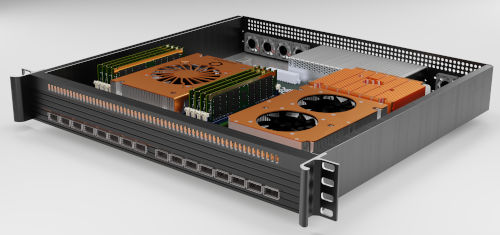 Next-generation designs can help reduce cooling costs.
Processor technology is the most critical aspect of designing next-generation server, networking, and storage technologies. Whether ASHRAE directives must be met—and therefore whether significant investment in cooling and insulation technology, as well as the operating costs associated with secondary energy consumption, must be allocated—depends entirely on this technology. Alternatively, manufacturers can choose to focus on other types of systems that do not require such efforts to operate effectively in extreme temperatures and can be deployed more cost-effectively in harsh environments. Examples of such systems include factory installations, outdoor equipment for communications, video surveillance, and other critical infrastructure, and servers in mobile systems ranging from trains and airplanes to autonomous shuttle buses in smart cities.
Since the introduction of Xeon D processors, a robust server technology has emerged that can operate across a wide temperature range from -40°C to 85°C. Therefore, high-performance server designs can also break free from the rigid thermal limitations of air-conditioned server rooms and be deployed anywhere massive, latency-free data throughput is needed at the edge of the Internet of Things and Industry 4.0 factories.
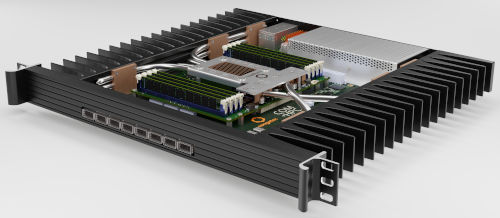 Multiple Specific Requirements for System Design.
However, a robust edge server is not defined solely by its server processor. In fact, extensive technological knowledge is also essential to meet the needs of system designs built for harsh environments. Each unit must be evaluated accordingly, and special attention must be paid to the circuit board and card design, as well as to specific coatings that protect against condensation and other environmental influences. Furthermore, additional stringent measures are needed to safeguard against external electromagnetic and high-frequency signals that could affect device performance.
Regarding embedded computing technologies, manufacturers like Congatec have considerable experience in designing these systems, as they often incorporate core PC technologies, such as Intel Core processors, into embedded systems in a way that is compatible with industrial use. Developers are highly aware of the certification requirements and standards established in various sectors and are accustomed to creating durable systems that meet industry requirements and can offer OEM solutions with identical board configurations for 7-15 years. Regarding industrial applications, they understand that the models are quite different from typical office system designs, as industrial applications often require a certain level of scalability, making modular designs with COM modules the ideal way to develop boards. Finally, developers recognize the importance of standardization, and therefore, international standards have been largely developed for these modules.
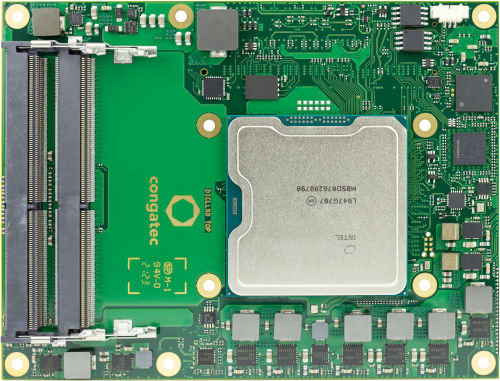 Achieving goals more efficiently with the standard:
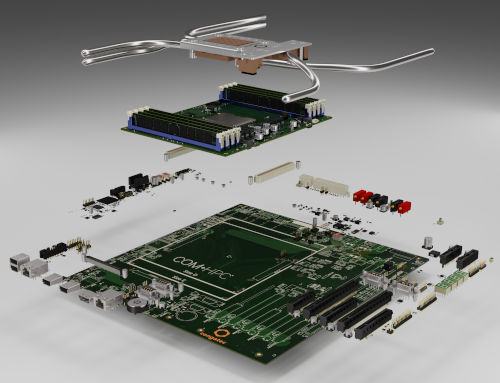
This rich experience has now been put into practice in the application area of industry-ready edge server designs with the COM-HPC server specification, and developers now have unprecedented access to real-world products with the advent of Intel Xeon D processors. Within the context of the COM-HPC server standard, the new server modules are highly beneficial for developers, who can incorporate the modules as application-ready embedded computing logic on their individual motherboards. This way, they don't have to worry about the underlying processor technology and can instead focus on specifications relating to component placement and the implementation of interfaces in the correct locations on the motherboard. For this very reason, the PICMG standardization committee recently adopted the COM-HPC Carrier Design Guide. Ultimately, it is fundamental for creating interactive and optimizable embedded computing platforms, specific to each client, based on the new standard, and for facilitating the learning process for developers trying to familiarize themselves with the logic of the standard.
 Simplified Robust Edge Server Designs
To further simplify matters, congatec is supporting developers by offering a comprehensive introduction to design principles through its newly established online and in-person training academy for COM-HPC server and client designs. This opportunity allows developers to participate in expert-led lessons on high-end embedded and edge system designs based on the new Computer-on-Module (COM) standard. During the training, instructors review required and suggested design fundamentals, as well as best practice schemes for COM-HPC motherboards and accessories, such as high-end forced-air cooling solutions, for server designs that reach and even exceed 100 watts. Evaluation motherboards for COM-HPC server modules serve as a benchmark for training on the implementation of the Intel Xeon D processor.  They provide the full set of features that developers can use for prototyping platforms when further application development is required.
The primary goal of the congatec training academy is to introduce developers to the essential fundamentals of COM-HPC design, including but not limited to PCB layer principles, power management rules and signal integrity requirements, and component selection. Dedicated sessions on communication interfaces shed light on the most common errors and difficulties encountered in the challenging design of high-speed serial communications, ranging from PCIe Gen 4 and 5 to USB 3.2 Gen 2 and USB 4 with Thunderbolt over USB-C, to 100 Gigabit Ethernet, as well as the management of sideband signals for 10G/25G/40G/100G KR Ethernet interfaces that must be deserialized on the motherboard in COM-HPC. Finally, these sessions also highlight how best-practice designs utilize interface standards such as eSPI, I²C, and GPIOs.
Demonstrations of the x86 module firmware implementation with embedded BIOS, board management controller, and module management controller functions conclude the design training. Finally, the training also includes presentations on verification and testing strategies to highlight various challenges encountered, such as issues with verifying the initial motherboard design and mass production testing. As a result of the comprehensive learning opportunity offered by the congatec Academy, congatec helps simplify the design of rugged edge server technology. Furthermore, congatec and its extensive partner network can provide OEM customers with complete system designs based on the new COM-HPC server modules.
 Break through barriers with accelerated edge server workloads
. The new COM-HPC Size E and Size D server modules with Intel Xeon D BGA processors, initially known as Ice Lake D, not only support extended temperatures from -40°C to 85°C, but also free previous edge servers from many limitations, significantly accelerating next-generation real-time microserver workloads in harsh environments and across extended temperature ranges. The upgrade includes up to 20 cores, up to 1TB of memory across up to 8 DRAM sockets at 2933MT/s, up to 47 PCIe lanes across the module with 32 PCIe Gen 4 lanes offering double the throughput per lane, and up to 100GbE connectivity, as well as TCC/TSN support. Video storage and analytics servers also benefit from support for Intel AVX-512, VNNI, and OpenVINO for AI-based data analysis.
A turning point for real-time edge server designs.
In this regard, the launch of the Ice Lake D-based COM-HPC server modules represents a major advance due to three key aspects: (1) as a result of support for the extended temperature range, Intel Xeon D server modules can now serve outdoor and automotive applications, in addition to typical industrial environments; (2) the first-of-its-kind COM-HPC server modules now allow the number of cores to reach an unprecedented 20 cores and, together with up to 8 DRAM sockets, support vastly greater memory bandwidth than was previously possible with server modules of other PICMG specifications; (3) these server modules provide real-time capabilities with respect to processor cores and TCC/TSN-enabled real-time Ethernet, which is fundamental for digitalization in IIoT and Industry 4.0 projects. 0.
To successfully achieve server balancing and consolidation services for deterministic real-time server installations at the edge, which can run multiple real-time applications separately on a single edge server, platforms must support real-time-capable virtual machines, such as those provided by the Real-Time Systems RTS hypervisor, for example. This would give Industry 4.0 factories at the edge of their private 5G networks the ability to deploy diverse real-time applications on a single server platform and allocate system resources strictly to dedicated processes. The server modules offered by congatec are already prepared to support these services. congatec also adds such capabilities, along with all the necessary configurations, to the already extensive list of typical services it offers for the new COM-HPC modules.
The modules also impress with their server-grade features: For business-critical designs, they offer robust hardware security features such as Intel Boot Guard, Intel Total Memory Encryption-Multi-Tenant (Intel TME-MT), and Intel Software Guard Extensions (Intel SGX). For optimal reliability, accessibility, and serviceability (RAS) performance, the processor modules incorporate the Intel ME Manageability Engine and are compatible with remote hardware management applications such as IPMI and Redfish, as defined by the PICMG. This helps ensure interoperability and is another topic covered in the congatec Academy training sessions.
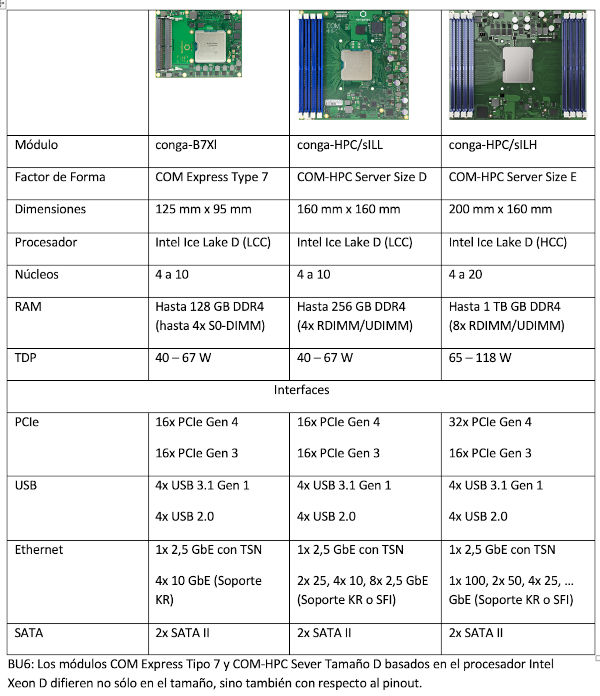 Server Module Options for Intel Xeon D:
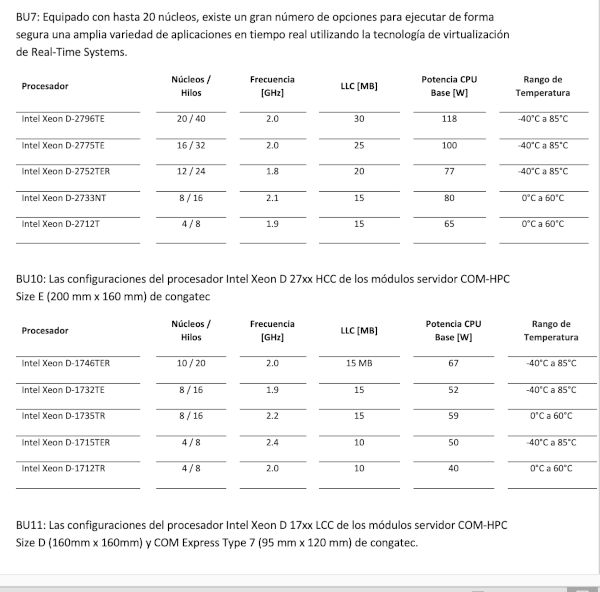
The new modules will be available in both high-core-count (HCC) and low-core-count (LCC) variants of the Intel Xeon D processor series:
• The COM-HPC Server Size E (conga-HPC/sILH) modules consist of five different Intel Xeon D 2700 HCC processors with the option to select from 4 to 20 cores and a base processor power between 65 and 118 watts. They always include eight DIMM sockets for up to 1 TB of fast 2933 MT/s DDR4 memory with ECC, 32x PCIe Gen 4 and 16x PCIe Gen 3, and 100 GbE throughput, as well as 2.5 Gbps Ethernet with real-time capability and TSN and TCC support.
The COM-HPC Server Size D modules and the COM Express Type 7 standard-based modules include five different Intel Xeon D 1700 LCC processors, with a choice of 4 to 10 cores and a base processor power ranging from 40 to 67 watts. The conga-B7Xl COM Express server modules support up to 128 GB of DDR4 2666 MT/s RAM via up to four SODIMM sockets, while the conga-HPC/SILL COM-HPC Server Size D module offers four DIMM sockets for up to 256 GB of fast DDR4 2933 MT/s RAM or 128 GB of ECC UDIMM RAM. Both modules feature 16 PCIe Gen 4 lanes and 16 PCIe Gen 3 lanes. For high-speed networking, they offer up to 50 GbE throughput and support for TSN TCC over 2.5 Gbps Ethernet.
The modules are available as application-ready evaluation samples along with robust cooling solutions matched to the processor's TDP. Solutions include high-performance active cooling with heat pipe adapters, as well as fully passive cooling solutions for optimal mechanical resistance to vibration and shock, and to mitigate thermal stress for applications that must withstand short-term, high temperature fluctuations. On the software side, the new modules come with comprehensive board support packages for Windows, Linux, and VxWorks, and RTS hypervisor technology.
Author*: Andreas Bergbauer is Senior Product Line Manager for Intel Xeon-D processors at congatec
 BU3: Edge server with three COM-HPC modules for particularly demanding real-time workloads.
COM-HPC edge server designs are not limited to single-module configurations. Prototypes also directly support multi-module setups with various COM-HPC module configurations, such as those with FPGAs or GPGPU compute accelerators. COM-HPC server and client modules can also be used together on the same board. For example, in collaboration with Bielefeld University and Christmann IT, congatec is currently developing an edge server design that integrates several different COM-HPC modules onto a single board to handle extremely demanding real-time workloads in a multi-system consolidation environment for high-dimensional AI machine learning clustering (self-organizing maps).
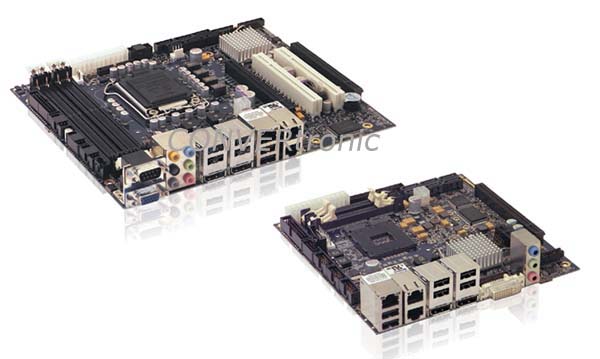
BU4: Typical motherboard designs only have standard onboard interfaces on the back of the board (rear I/O). Consequently, their suitability for industrial edge servers for the Internet of Things is limited. Furthermore, they are not designed to handle the wide temperature range of -40°C to +85°C and do not have a lifespan of 7 to 15 years. In contrast, with server modules, manufacturers can leverage the mechanics of these form factors and design the motherboard to facilitate the implementation of the necessary interfaces wherever they are needed.
BU5: The Intel Xeon D on COM-HPC Size E and Size D server has a different number of RAM sockets, which also affects the size of the modules.