




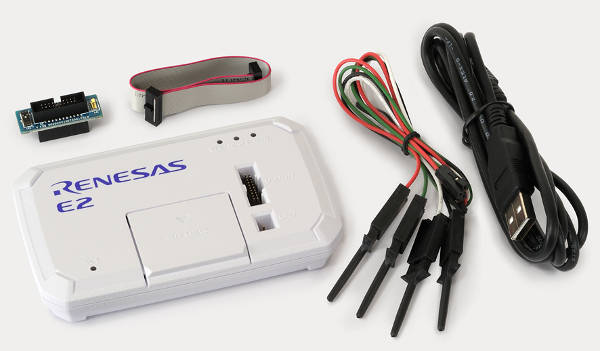
The new emulator supports the extended debugging functionality of the RH850 family and helps to shorten the time required for CAN communication debugging and current consumption debugging.
Recently, the use of electronics for automotive control has been increasing to improve fuel efficiency, safety, and vehicle comfort, and the number and variety of embedded sensors are growing. This leads to an increase in the size of the control programs for the MCUs used in electronic control units (ECUs). Since each ECU performs communication control over automotive networks such as CAN, LIN, and FlexRay®, and dozens of ECUs are installed in a single vehicle, communication control has become more complex. Furthermore, considering the number of ECUs installed in a vehicle, it has become more important to accurately understand the current consumption when each ECU operates and to optimize control programs to achieve low current consumption in automotive systems.
One challenge with developing existing ECU software is that the program must be downloaded from the emulator to the MCU. Each time debug code is added to the control program, the program size and download time increase. In the case of CAN communication, a significant contributor to this repetitive debugging cycle is the need to use a CAN analyzer in conjunction with the emulator; these devices have not traditionally operated synchronously. For low-power optimization, the emulator is typically used alongside an ammeter or current probe, making it difficult to pinpoint the peak current draw to the timing of the current draw in the running code.
To address this challenge, Renesas has integrated additional debugging functions required for software development, such as solutions, into the E2. Specifically, the new emulator reduces the time required to determine the cause of an error during CAN communication by providing a bus connection that allows message synchronization to be matched with the running code. It also facilitates determining the cause of current spikes by monitoring device drift current and correlating it with the code. This allows system developers to potentially reduce development time in these areas to as little as one-tenth (Note 1) compared to the existing method of repeated program modifications and downloads. Even when the modification/download cycle is necessary, the E2's faster download speed lessens its impact on the development cycle speed.
Main features of the new E2 Emulator:
1) Download speed is twice as fast (Note 2)
The new E2 Emulator offers faster communication speeds between the MCU and the emulator and parallelization of flash rewriting and data communication. These capabilities allow control program downloads up to twice as fast as the existing Renesas E1 Emulator (Note 2).
2) Industry-first solution (Note 3) combining instruction-level debugging with CAN communication monitoring.
As a CAN communication debugging function, the new E2 emulator can halt the program when it detects that the interrupt response time has exceeded a specified limit, and simultaneously record and display trace data related to CAN communication reception and interrupt response processing. This debugging function is provided as an industry-first solution (Note 3) for measuring CAN communication response time, enabling a clearer correlation between CAN communication and program operation.
This solution for measuring CAN communication response time can allow CAN communication trace analysis and program operation to be performed by the emulator alone, and can significantly reduce the time required to determine the cause of an error.
3) Easier Determination of the Cause of Current Consumption Peaks:
The new E2 emulator can detect current consumption peaks and stop the program when it detects that current consumption has exceeded set limits for a certain period. This allows system developers to determine the program conditions that cause it to exceed expected current consumption levels. Furthermore, the emulator can display program operation and current consumption simultaneously, making it easier to identify areas where current reduction should be targeted. This shortens the tuning time (Note 5) required to reduce current consumption.
The E2 emulator offers a native hot-plug connection on compatible devices without the need for an adapter.
The E2 Emulator supports the CS+ integrated development environment (Note 6), designed to make the inevitable edit, build, and debug cycles in software development simple, user-friendly, and secure. Support is also planned for the e2 Studio integrated development environment (Note 6) (based on the popular Eclipse), Green Hills Software's MULTI® IDE, and IAR Systems' IAR Embedded Workbench®. The board's interface is compatible with that of existing E1 Emulator boards, which can also be connected to the E2 Emulator.
Renesas also plans to provide an E2 emulator tracing solution through the RH850 debug interface and plans to offer an interrupt solution that allows breaking the program while debugging based on an external trigger signal in the future.
Availability:
The E2 Emulator is now available for the RH850 family and a selection of automotive SoCs. The new emulator will be available for the RX and RL78 families starting in July 2017. Additional debugging solutions for the E2 emulator will also be available starting in July 2017. (Availability is subject to change without notice.)
Please refer to the separate sheet for the main specifications of the new E2 Emulator.
Note 1: As of February 9, 2017, according to Renesas research. The amount of development time reduction shown is just one example, and the reduction varies by program.
Note 2: Varies depending on the device.
Note 3: As of February 9, 2017, according to Renesas' research
Note 4: This feature will be provided for the RH850 family starting in July 2017, through a free integrated development environment update. Renesas also plans to make this feature available for its RX and RL78 families of MCUs. CAN FD will be supported separately.
Note 5: This feature will be provided for the RL78 family starting in July 2017, through an
Integrated Development Environment update. Renesas is also planning to make this
available for the RH850 and RX MC8 families.
Note 6: Automotive SoCs will feature an integrated development environment from Renesas partners.




