
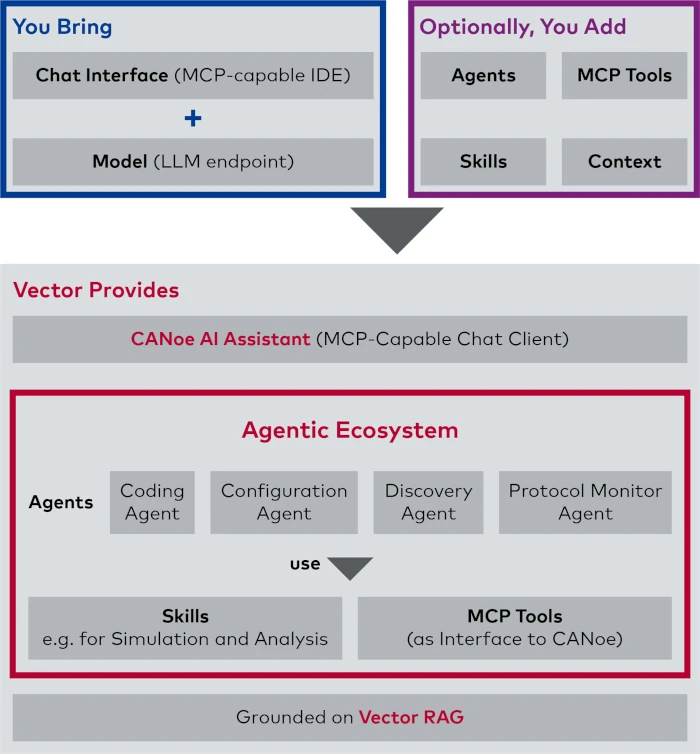
The underlying language model is provided by the users themselves, such as the LLM behind GitHub Copilot or Claude. Vector provides the open AI layer, composed of agents, skills, and MCP tools, which can be extended with custom components and domain-specific knowledge. The MCP server integrated into CANoe and the CANoe AI package are already available in version 20 SP2. From a single instruction, an AI agent creates the appropriate CAPL test based on a requirement, runs the test in CANoe, analyzes errors, corrects the CAPL code, and runs the test again. The agent then delivers the scenario to the user, who validates the results through CANoe's synchronized windows and approves them. Tasks that previously took hours or days can now be completed in minutes. Users determine the degree of autonomy with which the agents operate. Each step remains transparent and can be monitored in real time both in their usual development environment and directly in CANoe.
The CANoe AI suite is based on an open ecosystem of AI agents that utilize MCP skills and tools. Through prompts, users can read and customize configurations, control simulations, create tests, analyze communication flows, and generate and optimize CAPL, C#, and Python code. Using Vector-RAG (Retrieval Augmented Generation), agents can access a knowledge base containing relevant information from Vector documentation. As a result, responses are based on verified expertise rather than assumptions generated by the language model. New users gain quick access to CANoe, while experienced users can integrate automated workflows into their environments, from simple queries to fully orchestrated processes.
The CANoe AI package is available for free download from the Vector website. It is compatible with CANoe 20 SP2 and later versions, and requires a user-provided language model.