



RSS feed

- Details
- Category: Liabilities
KIOXIA has begun testing new Universal Flash Storage 1 ver. 4.1 embedded memory devices featuring 4-bit-per-cell quad-cell (QLC) technology. Designed for read-intensive applications and high-capacity storage needs, the new devices incorporate KIOXIA's 8th generation BiCS FLASH™ 3D flash memory technology.
- Details
- Category: Liabilities
Quad-Level Cell (QLC) NAND flash memory stores 4 bits per cell, representing 16 distinct charge levels per cell. This technique enables higher storage density at a reduced cost per bit compared to memories with fewer bits per cell, such as TLC or MLC. However, QLC presents endurance and performance challenges that require addressing with advanced controllers, strong ECC, and sophisticated thermal management/firmware.

- Details
- Category: Embedded Systems
Tria Technologies, an Avnet company specializing in the design and manufacture of embedded computer boards, systems and HMIs, has announced the OSM-LF-IMX95 module, which increases performance, security, flexibility and energy efficiency levels for next-generation edge platforms.

- Details
- Category: Power Supplies
- Details
- Category: Other Components
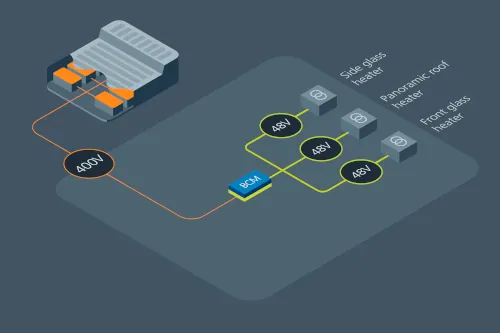
The methods commonly used to defrost ice on windshields waste heat generated by internal combustion engines, which is distributed unevenly across the glass surface. Electric vehicles (EVs), in particular, need to rethink their defrosting systems, as traditional climate control methods used to defrost windshields are inefficient because low temperatures can also freeze the windshields while the vehicle is in motion.

- Details
- Category: UPS and Rectifiers
- Details
- Category: Technology
Sulfur hexafluoride (SF₆) has been the predominant dielectric and arc-interrupting gas in medium- and high-voltage electrical switchgear for decades due to its excellent insulating properties and arc-extinguishing capabilities. However, its extraordinarily high global warming potential (GWP)—thousands of times greater than that of CO₂—has prompted a reassessment of its use within the context of the European Union's (EU) climate policy.

- Details
- Category: Integrated Circuits
Toshiba Electronics Europe GmbH (“Toshiba”) has launched the TB67S579FTG, a next-generation stepper motor driver IC featuring Advanced Microstep technology. This two-phase bipolar stepper motor driver employs a constant current control method. Thanks to its advanced features, it achieves highly efficient motor operation with low vibration and low noise. Target applications include office equipment such as printers and scanners, as well as a wide range of commercial and industrial equipment, including surveillance cameras, projectors, ATMs, 3D printers, sewing machines, and many more.
The high-efficiency stepper motor driver is Toshiba's first product to incorporate the newly developed Advanced Microstep technology, which includes three key features: second-generation active gain control (AGC2), the newly developed Automatic Waveform Generation System (AWGS), and the recently developed Continuous Microstepping. Continuous Microstepping significantly reduces vibration and noise, especially during low-speed rotation, by creating a continuous, sinusoidal waveform of the motor's drive current.
Typical microstepping control methods require increasing the input clock frequency (CLK) in proportion to the number of microsteps. The Automatic Waveform Generation System (AWGS) is a feature that allows a stepper motor to be driven in microstepping mode using a single CLK signal, just as is required for full-step rotation control. Even in applications where a stepper motor is initially driven in full-step mode to quickly generate torque and then switches to microstepping to reduce vibration and noise, a smooth transition can be achieved without adjusting the control signals. As a result, the processing load on control devices, such as microcontrollers (MCUs), can be significantly reduced.
Typically, a stepper motor operates continuously at the maximum required current under full load conditions. Active Gain Control (AGC2) detects the induced voltage during motor operation to determine the load and automatically adjusts the motor's drive current accordingly. This mechanism allows the motor to operate at the minimum required current under light load conditions, resulting in increased efficiency and, consequently, lower power consumption. AGC2 also improves the current and torque waveform by performing full-step operation.
In addition to the conventional GPIO configuration interface, the TB67S579FTG offers a flexible serial configuration interface, allowing for easy adjustment of advanced features such as microstepping, AGC2, and decay modes without increasing the pin count or system complexity.
The TB67S579FTG's output stage (covering the upper and lower transistors) has an RDS(ON) of only 0.6 Ω (typical). In standby mode, the device draws a maximum current of 1 mA. To simplify system integration, the driver operates from a single motor power supply, ranging from 4.5 V to 34 V. The product also employs Toshiba's Advanced Current Sensing System (ACDS), eliminating the need for external current-sensing resistors. The integrated charge pump circuit does not require an external capacitor. Eliminating the need for these external components results in substantial space savings in the mounting area and reduces the bill of materials (BoM) cost.
Additional features include Advanced Dynamic Mixed Decay (ADMD) technology, which can achieve up to 30% higher rotational speeds without increasing noise and vibration. The controller's integrated circuit also implements comprehensive protection functions, such as overcurrent detection, thermal shutdown, undervoltage lockout, fault indicator output, and open load and blockage detection. The integrated blockage detection function reliably identifies motor blockage conditions, improving operational safety and preventing potential damage to mechanical and electronic components.
The TB67S579FTG is housed in a small VQFN48 package, measuring only 7.0 mm x 7.0 mm. Toshiba will continue to develop products for a wide range of applications, aiming to simplify user design, reduce board footprint, and offer complete solutions.

- Details
- Category: Assets
ROHM has developed the "BD9xxN5 series" of LDO regulator integrated circuits with a 500 mA output current, incorporating its patented "Nano Cap™" ultra-stable control technology. This series includes 18 products designed for 12 V/24 V primary power supply applications used in automotive equipment, industrial equipment, and communications infrastructure.

- Details
- Category: Integrated Circuits
Microchip Technology has once again expanded its maXTouch® M1 family of touchscreen controllers to deliver reliable and secure touch detection across an even wider range of automotive displays, now encompassing widescreen formats up to 42" to small displays from 2" to 5". The ATMXT3072M1-HC and ATMXT288M1 are designed to work with a variety of screen sizes.

- Details
- Category: Test and Measurement Equipment
Teledyne SP Devices' high-speed digitization and peripheral processing enable scalable satellite signal monitoring across multiple frequency bands. Satellite monitoring allows for continuous observation of satellite communications and navigation signals to ensure link quality, detect interference, and verify compliance with spectrum regulations.
- Details
- Category: Events
The latest trends in robotics can be experienced firsthand at the Application Park of HANNOVER MESSE, where the focus will be on AI-based perception systems, autonomous mobile manipulators, and humanoid robots. Their advantage over classic industrial robots lies less in pure performance and more in their adaptability: they are designed to use tools, workstations, and infrastructure developed by people.

Spanish electronics magazine. Printed for over 25 years.
Spain - Madrid - All rights reserved © Convertronic Professional Spanish Electronics Magazine.