




Betterfrost Technology, a Vicor customer, has developed revolutionary technologies that solve the defrosting problem. Its algorithms and high-density power conversion modules generate electrical pulses that defrost car and truck windows in 60 seconds, consuming 20 times less energy than existing defrosting systems. Figure 1. Betterfrost's technology uses electrical pulses and high-density power modules to melt ice accumulated on car windows in less than 60 seconds, consuming 20 times less energy.
In electric cars and commercial vehicles, this "free" secondary heat disappears, so EVs must draw energy from the main battery for defrosting and misting, thus consuming some of the power also used for propulsion. Betterfrost's technologies completely change conventional defrosting methods. It's not necessary to completely melt the ice to remove it from the windshield; simply weakening the bond between the ice and the glass at the "interfacial layer" is enough. To do this, Betterfrost sends short, controlled electrical pulses across the glass surface, creating a thin, semi-liquid layer under the ice that instantly removes it from the windshield without heating the entire surface. Compact, high-density converter modules precisely supply 48V to the glass. A key element of Betterfrost's solution is its centralized 48V power network. For this purpose, it uses Vicor's automotive-grade BCM® bus converters, rated at 800V and 400V to 48V, characterized by their fixed ratio and high power density to deliver safe and efficient high-speed pulses to the glass surfaces. Figure 2. The Vicor BCM functions as a DC/DC transformer.
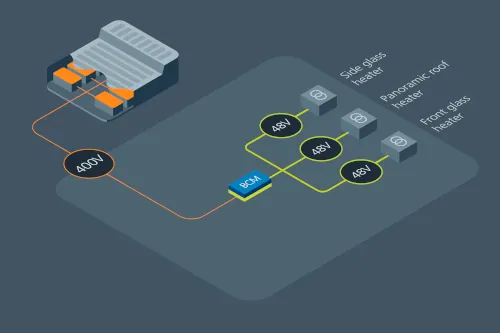
A fixed-ratio converter reacts to power variations at a rate of 80 A/s. Betterfrost uses energy pulses to melt a very thin interfacial layer of ice in less than a minute (its record is 42 seconds), compared to the 25 minutes required by traditional air conditioning systems. This technology uses a proprietary algorithm to melt ice evenly and consumes 20 times less energy.
The Vicor BCM6135 achieves the highest power density on the market at 3.4 kW/in³ and functions as a DC/DC converter, transforming the applied high-voltage input into a low-voltage output according to the module's conversion ratio, or K-factor. For example, with a K-factor of 1/16 and an 800V input, the output voltage is 50V. Vicor BCM modules meet stringent standards for air clearance and creepage distances and occupy up to 90% less space than conventional DC/DC converters. "Vicor makes it easy to connect to the 48V power grid without excessive size or weight limitations," said Derrick Redding, CEO of Betterfrost and a veteran of the automotive industry. "No one else does what they do with that level of efficiency and power density."






