
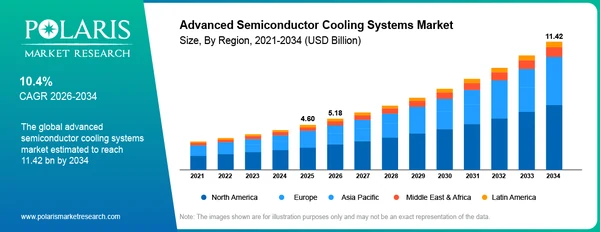
According to a report by Polaris Market Research, the advanced semiconductor cooling systems market reached a value of $4.6 billion in 2025 and is projected to reach $11.42 billion in 2034, with a compound annual growth rate (CAGR) of 10.4%.
Market evolution is driven by increased power density, the expansion of AI data centers, and the need to improve the energy efficiency of IT infrastructures.
Thermal management, a bottleneck for artificial intelligence
The increasing energy consumption of AI accelerators is pushing conventional air cooling systems to their operational limits. Liquid cooling circuits and immersion cooling systems are gaining prominence, especially in high-power-density applications. According to forecasts in the report, the segment of chips with power ratings above 1,000 W is experiencing the strongest growth, with an annual rate of 21.8%. This trend is leading to cooling systems being integrated from the earliest stages of rack design, rather than being added later.
In June 2026, NVIDIA stated that its Rubin servers can operate fanless with coolant at an inlet temperature of 45°C.
The company estimated that a 50 MW hyperscale data center could save more than four million dollars annually in energy and water costs associated with cooling. Furthermore, the International Energy Agency (IEA) projects that data center electricity demand will reach nearly 945 TWh by 2030, reinforcing the importance of thermal efficiency.
Refrigerant distribution units and heat exchangers
Refrigerant distribution units (CDUs) and heat exchangers constitute one of the main segments of the advanced refrigeration market. In 2026, these components represented a market volume of $1.386 billion, making them the highest-revenue component category, according to Polaris Market Research. Their importance lies in their role within liquid cooling circuits and their integration from the earliest stages of system design.
These systems are evolving from individual rack solutions to cooling infrastructures with capacities on the order of megawatts, intended for entire rooms in data centers.
Immersion and two-phase cooling lead the growth
Although liquid cooling is gaining ground, air cooling systems maintain a significant market position, especially in consumer electronics and servers with power ratings below 500W. The report highlights the following indicators by technology:
Air cooling: represents 36.9% of market revenue by technology.
Immersion cooling: compound annual growth of 18%.
Two-phase refrigeration: compound annual growth of 17.2%.
The last two technologies show the highest growth rates, driven by the thermal dissipation needs of high-power computing systems.
Hybrid systems will shape the evolution of refrigeration
Hybrid architectures, which combine liquid cooling for AI accelerators and air cooling for memory, storage, and networking equipment, are poised to become a dominant alternative in the coming years, according to the analysis. This trend opens up opportunities for manufacturers of thermal components, coolant distribution systems, and data center cooling infrastructure.
Thermal management is thus consolidated as a strategic element in the development of high-performance semiconductors and in the expansion of artificial intelligence infrastructures.