




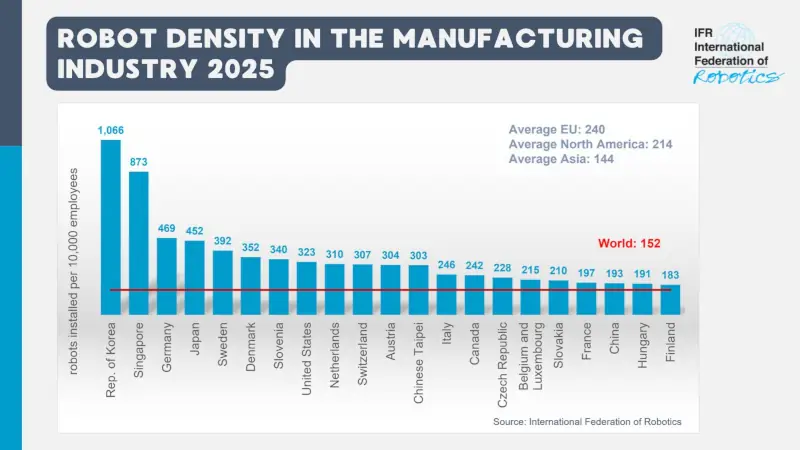
Singapore follows with 873 units, and Germany with 469, while the global average stands at 152 robots per 10,000 manufacturing workers.
Robot density allows for comparisons of automation levels between countries, taking into account the number of workers in their manufacturing industries. According to Jane Heffner, president of the IFR, this indicator facilitates international comparisons by relating the number of operational industrial robots to every 10,000 employees in the sector.
The countries that top the world rankings are:
South Korea: 1,066 robots per 10,000 employees.
Singapore: 873 robots.
Germany: 469 robots.
Japan: 452 robots.
The four countries far exceed the world average of 152 units.
The European Union increases its robot density by 35%
The European Union (EU-27) has seen an approximate 35% growth in automation between 2020 and 2025, reaching a record density of 240 industrial robots per 10,000 employees. Five of the world's ten most automated economies are in the European Union: Germany, Sweden, Denmark, Slovenia, and the Netherlands.
In North America, robot density has increased by about 24% during the same period, reaching 214 units. The United States ranks eighth globally, with 323 robots per 10,000 employees, while Canada has 242 and Mexico 64.
Asia registers 47% growth in five years
The density of industrial robots in Asia has increased by approximately 47% between 2020 and 2025, reaching 144 units per 10,000 workers. South Korea and Singapore maintain their leading positions globally, while Japan ranks fourth, with a density of 452 robots per 10,000 workers. This regional growth reflects the advancement of industrial automation in major Asian manufacturing economies.
China increases its density of industrial robots by 147%
China, considered the world's largest market for industrial robots, has reached a density of 193 robots per 10,000 employees, ranking 19th internationally. According to the IFR, the country's robot density grew by 147% between 2020 and 2025. This result is based on employment data from the National Economic Census conducted by China's National Bureau of Statistics.
Data from World Robotics 2026 shows an expansion of manufacturing automation in major industrial regions, with particularly notable increases in Asia and China over the past five years.







