

General Trends and Technology
Undoubtedly, the so-called "electrification" and the transition from fossil fuels to renewable energy is a major trend we are all familiar with. This sector will require many technological innovations to achieve the level of carbon neutrality expected by the European Commission, the US Department of Energy, and similar initiatives in Asia. Focusing on what most power supply companies are developing, I foresee four trends and one technological development influencing the power industry in 2022: reduced energy consumption; power supplies becoming part of the Machine-to-Machine ecosystem; improved energy storage solutions; and accelerated energy harvesting solutions. All of these will benefit from the deployment of broadband semiconductors.
In the pursuit of reduced energy consumption, from energy harvesting to the grid, the power electronics industry is constantly seeking new ways to improve efficiency. International and local regulations have forced power supply manufacturers to innovate, but we are seeing discussions about stricter regulations that could compel the power industry to explore new topologies, components, and materials.
I would like to illustrate this trend with an example that will both include and benefit from it: e-commerce.
 E-commerce was already growing before Covid-19, but as a result of lockdowns, working from home, and the drastic reduction in physical interaction, it has grown exponentially, placing a huge demand on fulfillment centers, IT storage, and the supply chain in general. Before even mentioning the associated data centers needed to manage the e-commerce process, fulfillment centers and warehouses have become gigantic and energy-intensive. All the major players have planned to increase the energy efficiency of their fulfillment and shipping centers, although the peak demand of 2020-2021 has been a strong signal for them to reconsider how they use and manage energy.
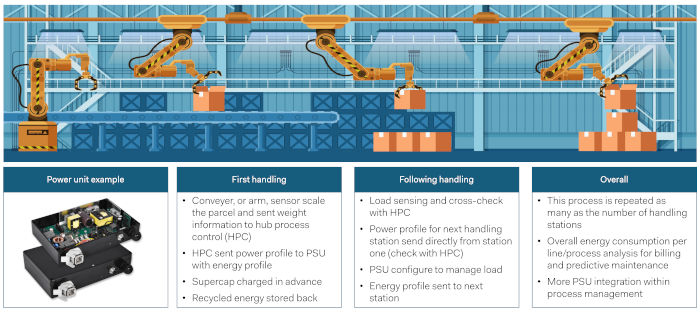
Power supplies themselves don't consume the majority of the energy, but given their strategic position in the operational chain, they become a key element in the overall process of optimizing energy use throughout the chain. In 2022, we will see the use of highly advanced power supplies in e-commerce fulfillment and shipping centers. These will not only integrate higher levels of communication but will also be capable of storing and restoring energy from supercapacitor banks, reducing grid disruptions and consumption peaks. Already tested in 2021, these power supplies have been integrated into a complete ecosystem with machine-to-machine communication (Figure 1). They not only supply power to a load, such as conveyor belt motors, but are also capable of detecting and adjusting the energy level stored in the local supercapacitor bank (Figure 2).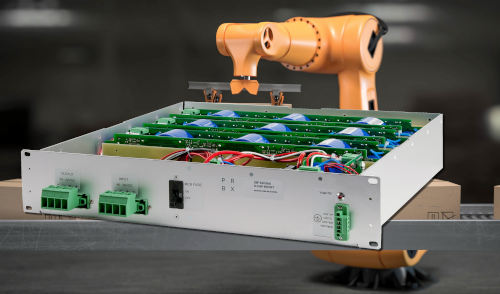
Almost invisible, from RFID tags embedded in shipping boxes that draw power from radio frequency signals, to sensors placed on motors or moving parts powered by vibration, microsystems powered by stored energy are developing very rapidly. Here too, nanotechnology, such as nanotubes, allows for the development of very small supercapacitors that store enough energy to power sensors and transmitters.
However, the level of performance will require power electronics engineers to design new power solutions using so-called "wideband" semiconductors. Depending on the application and voltage, they will select GaN or SiC types, but the advantages of wideband semiconductors will contribute to making e-commerce more energy-efficient by reducing its carbon footprint.
Critical elements!
For decades, improvements in the energy efficiency of power supplies have been made possible by technological evolution. The shift from linear to switching technology was probably the most significant, followed by other smaller leaps until digital power supplies reached the market.
Despite being on the market for several years, with emerging WBG technology and the possibilities offered by these components, digital control is becoming an absolute necessity, and I firmly believe it will be a fundamental element for power supply designers when developing new products.
Regarding components, WBG transistors are undoubtedly the ones that will prevail in 2022. That said, conventional power FETs are also making great strides, and power designers will need to reach new levels of evaluation and business acumen when selecting the most suitable technology for their applications.
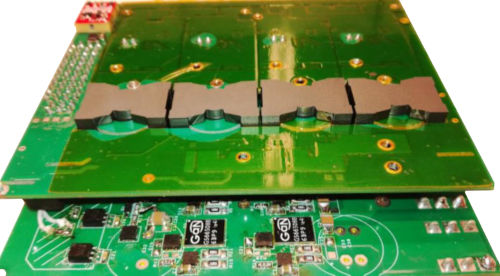 The third element I foresee as important is the advanced planar transformer with interleaved multi-core technology. Not all power supplies require megahertz switching, but given the constant pursuit of smaller, more efficient power supplies, power designers will need to consider new types of transformers and new winding techniques. In this regard, ferrite manufacturers developing new materials will be helpful, as will artificial intelligence software that shortens the design and testing time for new types of transformers (e.g., Frenetic, Simba).
A concrete example of this is the research we are conducting at PRBX, which combines digital control, GaN, and multi-core transformers with advanced wiring and self-tuning performance within the wide operating range we see in some industrial applications requiring extremely wide input voltage ranges, as well as outputs subject to repetitive peak loads. The final product is not yet ready, but it will not be possible without the combination of digital control, WBG, and advanced magnetism (Figure 03).
I believe that many of the new products we will see in 2022 and beyond will be based on these three elements, which I am sure will also include more communication to form part of a Machine-to-Machine ecosystem.
 We have faith in WBG!
What's interesting about Wide Band Gap semiconductors is that we're seeing a situation similar to when the first power MOSFETs were launched. Some immediately recognized the advantages of WBG, and although the first products weren't very user-friendly because they relied on a depletion mode that required very specific drivers, power semiconductor manufacturers didn't take long to offer "user-friendly" solutions.
Manufacturers have been promoting the advantages of this technology for over five years now, but while the Go-To-Market is ready, the Go-To-Application for mass users takes some time.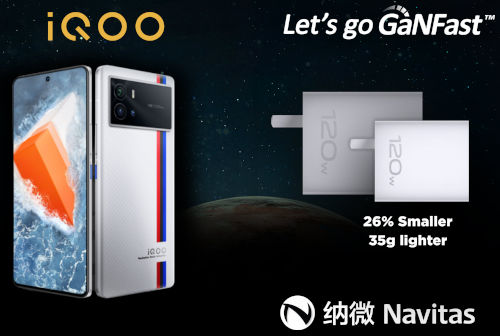
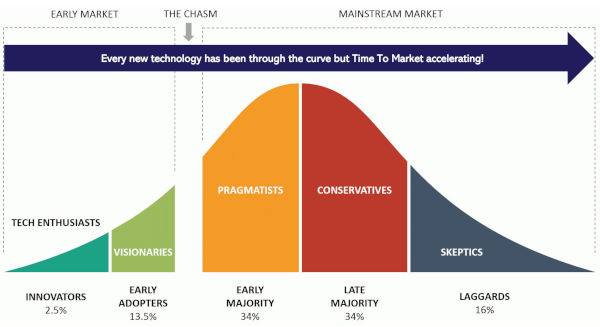
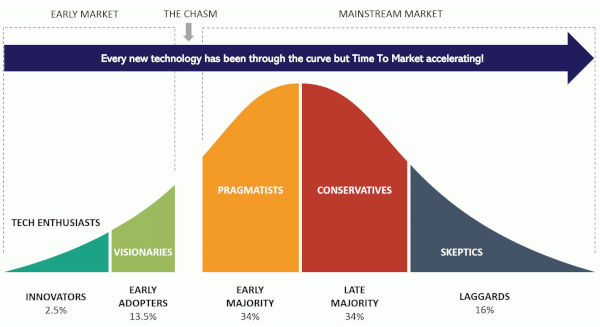
We're all familiar with the "camelback" curve that reflects the adoption of new technologies and the crossing of the chasm. Experienced power designers have crossed that technological chasm many times, the most recent being the migration from analog to digital control, which took more than 10 years to reach a significant level of implementation (Figure 4).
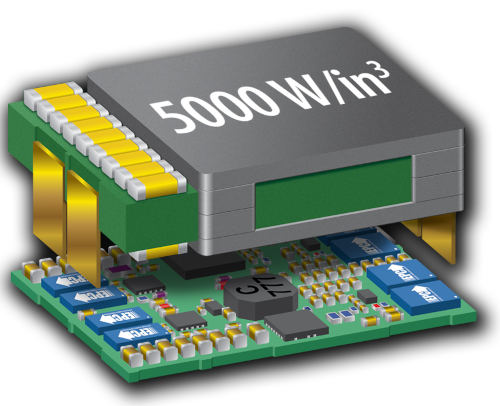 In the case of WBG—and especially gallium nitride (GaN)—early adopters entered the scene much sooner than some predicted a few years ago. It's no surprise that the computer and mobile/nomad industries were among the first to adopt it. The number of USB-C chargers using GaN semiconductors announced in 2020-2021 is very impressive. Of particular note is Navitas' next-generation GaNFast power IC, which will power the 120W ultra-fast charger included with Vivo's flagship iQOO 9 Pro mobile phone, demonstrating the rapid adoption of GaN by the nomad industry. But it's not just the electrical performance; using GaN reduces the physical size by 26%, achieving an astonishing power density of 1.3W/cc, which is quite remarkable (Figure 5).
While digital power took 10 years to become a de facto technology, WBG took only five years to reach a similar level.
What's interesting about the development of WBG semiconductors is that, due to the specific characteristics of this technology—namely, very low internal resistance and very fast switching capability—packaging is crucial, and we're seeing a great deal of innovation from manufacturers to offer optimized solutions. From a technological standpoint, the Efficient Power Conversion (EPC) approach is particularly interesting, as it minimizes interconnection losses and allows for an unprecedented reduction in the size of a power converter (Figure 06).
It's worth mentioning the astonishing number of online technical seminars offered during the COVID-19 era, not to mention the virtual APEC-2021. Many companies have taken advantage of this opportunity to have their power designers participate in online training, and as a result, some power semiconductor companies have reported shipping up to 10 times more evaluation kits than before the pandemic.
If we simplify the market into two segments: High Voltage (with SiC) and Low Voltage (with GaN), we see two different patterns. High-voltage applications, such as electric vehicles and solar power, are already familiar with SiC transistors, and for that segment, it's not a major revolution for power engineers to undergo a learning phase for the relatively new low-voltage technology.
In conclusion,
the pandemic has affected us all in very different ways, but looking back, it has contributed to accelerating the learning of new technologies and driving innovation. With all this in mind, 2022 will be a very important year for WBG, and we can expect many new power supplies (AC/DC and DC/DC) to be announced throughout the year. 2022 will be a very exciting year for everyone involved in designing power solutions.
 Author: Patrick Le Fèvre, PRBX, Director of Marketing and Communications
------------------------------------------
References:
Powerbox (PRBX)
Navitas Semiconductors
Efficient Power Conversion (EPC)
Frenetic
SIMBA
Applied Power Electronics Conferences (APEC)