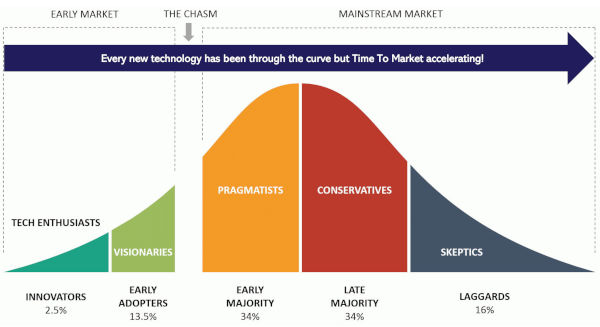
The US consulting firm Arizton estimates that the global additive manufacturing market will reach $11 billion by 2022, with an estimated annual growth rate of 16% until then. To realize this potential, experts agree on two key elements. First, a cultural shift is needed within the industrial sector, enabling it to recognize the short- and medium-term benefits. Second, the implementation of this technology must be approached strategically to deliver efficient and innovative solutions for users.
Therefore, the first intervention, by Santiago Martín (INTA/EDDM), was clear and forceful: "You can't design for additive manufacturing using machining criteria. This technology solves a clear production problem that traditional techniques can't, but to succeed, we need to understand the different technologies, materials, and design methodologies.".
Because the great revolution, according to Daniel Pyzak (Dassault Systèmes), is "that fully functional products can be manufactured anywhere in the world." In Spain, unfortunately, "few companies are implementing this technology. The industrial sector still struggles to see the medium-term benefits and is unwilling to invest until it is more widespread," states Joseba Sagarna (Addimen).
Because additive manufacturing offers many benefits: reduced stock levels, shorter delivery times, reduced prototype and tooling manufacturing, savings from small batch production, reduced material volume, and much more...
It is necessary to integrate additive manufacturing with other industrial processes because "it is not an island," commented Iñigo Bereterbide (Renishaw). According to Bereterbide, "the leap in implementation will occur when it can be used to mass-produce parts.".
Ángel Llavero (Sicnova 3D) has explained the role of open hardware, software and materials in 3D printing, which are offered by the new generation machines that are coming onto the market.
Throughout this entire process, design software plays a fundamental role. Generative functional design is another key factor in the pre-manufacturing phase; it's a new approach that starts with a design space defined by functional constraints, where parametric optimization proposes concepts to the designer that take manufacturing processes into account. With these types of solutions integrated into Dassault Systèmes' 3DExperience platform, the aerospace industry is reducing the weight of its components by minimizing volume while maximizing rigidity, resulting in significant savings across the board.
Jeroen Vermeulen (ATOS) highlighted, based on his experience, the advantages of additive manufacturing with respect to optimization. "Up to 70% mass reduction can be achieved with topological optimization, which should be followed by shape optimization and then manufacturing optimization. In this way, the savings and benefits are significant and long-lasting.".
Among the sectors with the greatest growth potential is the Health sector, says Ignacio Corrido (Comher): "Currently the market in Europe is focused on titanium at an industrial level, but it is in the health sector where the benefits in time and money are enormous and where the investment is worthwhile."
Jaume Homs (HP) spoke about HP's strategy of entering the manufacturing market rather than the 3D printing market, where the potential for providing machines for manufacturing processes is enormous. Their goal is "to increase production speed by adjusting prices while maintaining or even improving quality.".
It is also very important to have suitable tools for simulating the manufacturing process with the different existing technologies. Pauline Pfirrmann (Dassault Systèmes) explained the functionalities of the new 3DExperience “Additive Manufacturing Researcher” role, which offers an integrated environment for design and manufacturing to simulate the manufacturing process itself
Alberto Echevarría (IK4-Lortek), director of one of the leading technology centers in Spain specializing in additive manufacturing, has emphasized the need to "standardize the process to leverage the digital supply chain because it is an engineering-intensive, digital, and disruptive technology; if we don't, we will miss out on the advantages it offers." Simulation tools will streamline many processes and facilitate the implementation of this technology. Among these tools, distortions can be predicted and controlled.
Elisa Mª Ruiz Navas, a researcher at the Carlos III University of Madrid, made the attendees reflect on the little importance that is usually given to one of the fundamental actors in Additive Manufacturing, the metal powder, and reviewed the different qualities of these that are key in this type of manufacturing.
Finally, Jean-François Maizière (Dassault Systèmes) presented the Market Place proposal, a web environment that connects the ecosystems of a certified supply (engineering firms, printing companies) and demand, and closed the day by summarizing the challenges and opportunities facing Additive Manufacturing and how the Dassault Systèmes 3DExperience platform offers companies in this industrial sector the numerical continuity between the different subjects involved.