




- Details
- Category: Current Affairs
The European market for electronic components will grow by 42.7% in the third quarter of 2026
The European market for electronic component distribution is maintaining its strong recovery throughout 2026. According to the latest data from DMASS Europe, the sector reached a cumulative turnover of approximately 15 billion euros between January and September, representing a year-on-year growth of 30.2%.
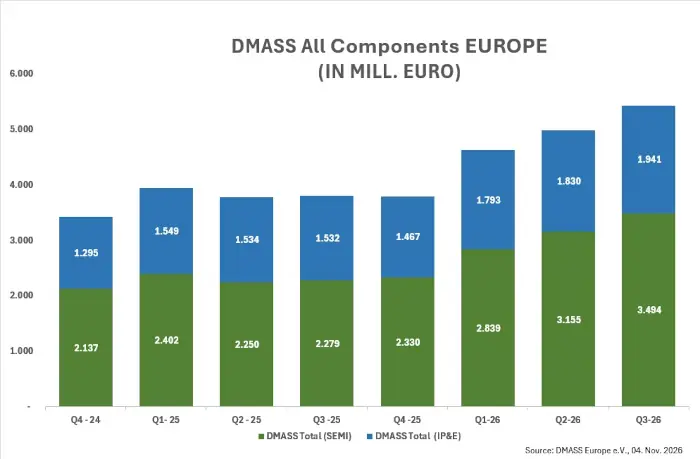
The third quarter showed particularly positive performance, with a turnover of 5.4 billion euros, 42.7% more than in the same period of 2025.
Semiconductors continue to be the main driver of growth, while interconnect, passive and electromechanical (IP&E) components show a widespread recovery, supported by industrial demand.
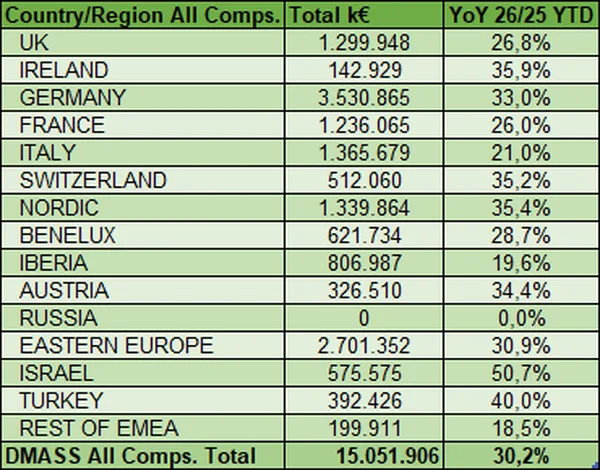
Table of all consolidated components by region
Semiconductors lead the European market recovery.
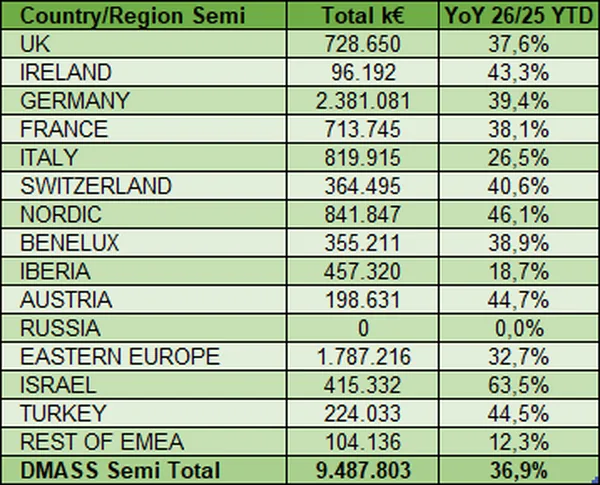
European semiconductor distribution reached €9.5 billion during the first nine months of 2026, representing a year-on-year growth of 36.9%. In the third quarter alone, this segment experienced a 53.3% increase, reaching €3.5 billion.
Israel led regional growth, with an advance of 63.5%, driven by investments in aerospace applications, defense and advanced computing.
Also noteworthy were the Nordic countries (+46.1%), Austria (+44.7%), Türkiye (+44.5%) and Ireland (+43.3%).
Germany, the largest European semiconductor market, recorded growth of 39.4%, while Switzerland (+40.6%), Benelux (+38.9%), France (+38.1%) and the United Kingdom (+37.6%) confirmed the widespread nature of the recovery.
In southern Europe, growth was more moderate, with Italy advancing by 26.5% and the Iberian Peninsula by 18.7%.
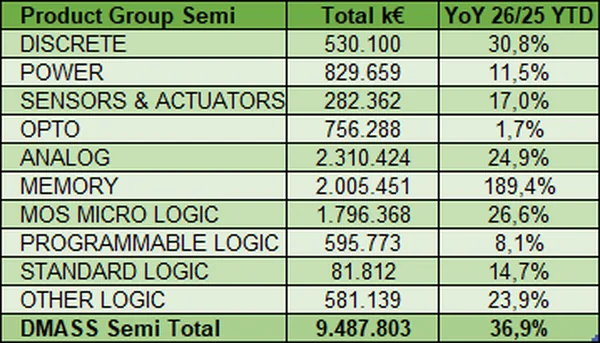
Memories experience a growth of 189.4%
By product categories, memories led the largest increase, with a year-on-year growth of 189.4%, favored by the persistent effects of prices and the recovery of demand in different application sectors.
Beyond memory, growth was also significant in other semiconductor families:
- Discrete components: +30.8%.
- MOS Micro Logic: +26.6%.
- Analog components: +24.9%.
- Other logic circuits: +23.9%.
- Sensors and actuators: +17.0%.
- Standard logic: +14.7%.
- Power components: +11.5%.
- Programmable logic: +8.1%.
- Optoelectronics: +1.7%.
These results reflect a reactivation of demand in industrial applications, automotive and infrastructure, although some segments are still going through inventory normalization processes.
Passive and electromechanical components consolidate their growth.
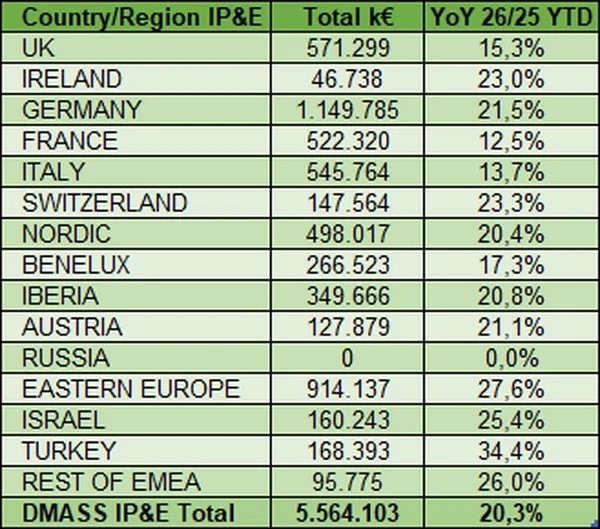
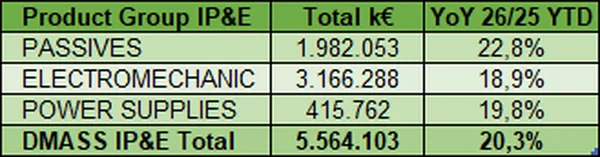
The European market for interconnection, passive and electromechanical (IP&E) components reached an accumulated turnover of 5.6 billion euros, representing a year-on-year increase of 20.3%.
During the third quarter, this segment registered a growth of 26.9%.
Turkey led the regional expansion with 34.4%, followed by Eastern Europe (+27.6%), the rest of EMEA (+26.0%) and Israel (+25.4%).
Among the main European markets, Switzerland (+23.3%), Ireland (+23.0%), Germany (+21.5%), Austria (+21.1%) and the Nordic countries (+20.4%) registered a favorable evolution.
In southern Europe, the Iberian Peninsula grew by 20.8%, ahead of Italy (+13.7%) and France (+12.5%).
By product families, passive components increased by 22.8%, driven by demand from industrial, energy, automation and transport applications.
Power supplies grew by 19.8%, boosted by investments in electrification, energy efficiency, data centers and industrial modernization.
Meanwhile, electromechanical components, which constitute the largest category by value within IP&E, with more than 3.1 billion euros, registered a growth of 18.9%.
Germany, Ireland and the Nordic countries drive the European market.
In the electronic components sector, Israel recorded the highest cumulative growth, with 50.7%, thanks to strong investments in defense, artificial intelligence, advanced technology and aerospace applications.
Ireland advanced 35.9%, possibly benefiting from its concentration of cloud-related activities, servers and data centers.
Also noteworthy were the Nordic countries (+35.4%), Switzerland (+35.2%), Austria (+34.4%) and Germany (+33.0%).
France (+26.0%), Italy (+21.0%) and the Iberian Peninsula (+19.6%) maintained positive growth, although lower than the European average.
The United Kingdom (+26.8%), Benelux (+28.7%) and Eastern Europe (+30.9%) also recorded double-digit increases.
An increasingly solid and diversified recovery
Hermann Reiter, president of DMASS Europe, highlighted that the European electronics market has entered a phase of accelerated recovery, with growth intensifying throughout 2026 and extending to both semiconductors and IP&E technologies.
According to Reiter, the scale of this expansion is particularly encouraging, as it demonstrates an improvement in the fundamentals of demand across the entire value chain.
The organization's president also stressed that Europe's competitive advantage continues to lie in its expertise in applications, its excellence in engineering, and its ability to transform innovation into industrial solutions.
Geopolitical and energy uncertainty remains a risk.
Despite the positive market performance, DMASS Europe warns that geopolitical uncertainties, trade tensions, and potential disruptions to energy markets could affect business confidence and investment decisions.
The organization considers it a priority to transform current growth into long-term competitiveness by strengthening the European innovation ecosystem, increasing the resilience of supply chains, and accelerating the adoption of advanced digital technologies and artificial intelligence-based solutions.
In this context, the combination of strong semiconductor demand, improved industrial activity, and a broader share of IP&E components points toward a more balanced and sustainable recovery for the European electronics sector.




Print Magazine

Annual subscription price:
You will receive all 10 editions that are published each year.
social networks
Popular News Electronics



Spanish electronics magazine. Printed for over 25 years.
Spain - Madrid - All rights reserved © Convertronic Professional Spanish Electronics Magazine.