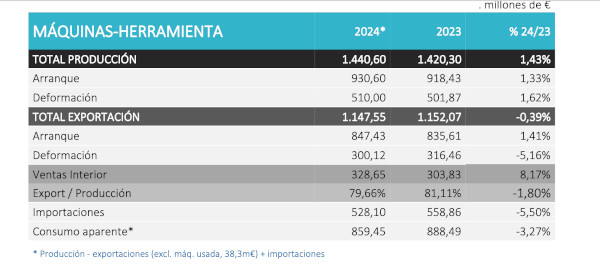
The two main subsectors, metal cutting and forming, performed similarly in terms of revenue, with increases of 1.33% for cutting and 1.62% for forming.
Exports grew by 1.73%, reaching €1,639.73 million, the best figure ever.
In this case, metal cutting showed positive growth of 1.41%, while forming fell by 5.16%.
The main destinations for our exports were Mexico, the United States, China, Germany, and Italy, followed by France, Portugal, Turkey, India, and the United Kingdom. Of particular note is Mexico's first-place ranking, which for the first time has taken the lead in exports, doubling its 2023 figure. The United States also boasts a very high figure, with 8% growth compared to 2023. China's exports have grown by 25% compared to 2023, although these figures are a mirage that does not mask the collapse in domestic orders. Germany, in fourth place, has maintained its figure practically unchanged (+1%), while Italy, in fifth position, has experienced the largest drop, losing more than half of its 2023 output. It is worth remembering that Italy has just come through years of tremendous activity thanks to government-backed programs to incentivize productive investment.
This ranking accurately reflects how North America, with Mexico and the US, has compensated for the weakness shown by both Europe and Asia for various reasons.

Orders registered in 2024 fell by 23.11% compared to those received in 2023, after two years of strong growth. In the domestic market, the drop was 45%, while in export markets they fell by 20%. Looking at the two main subsectors, the start of the year held up somewhat better, although it fell by 8.8%, with metal forming suffering the sharpest decline of 40.8%.
In terms of orders, the US leads the way, followed by Saudi Arabia with a significant figure, albeit due to a one-off transaction, Germany, Mexico, and Italy. Rounding out the top ten purchasing countries are China, Turkey, Canada, France, and the UK.
Xabier Ortueta, CEO of AFM Cluster: “The dynamics of orders over the last 12 months have led to a decrease in our order book, and this means we also anticipate a significant, though not dramatic, drop in revenue by the end of the year. The current impasse in automotive investment (closely linked to our metal forming subsector) is a cause for concern, as is the state of our main markets, which currently only foreshadows a very difficult year and a further decline in new business in 2025. The weakness of Europe (especially Germany, France, and Italy), protectionism in China, and uncertainty in the US are factors that a crisis-hardened sector like ours will have to decisively contend with.
On the positive side, the strong performance of sectors such as aerospace, rail, defense, and some branches of power generation will continue to present opportunities in a very complex and competitive environment. As always, we are confident we will be able to capitalize on them.”
The advanced manufacturing and machine tool cluster is warning of the crossroads at which Europeans find themselves and the need to change course to regain the leadership lost by our industry.
José Pérez Berdud, president of the AFM Cluster, stated: “We are undoubtedly at a critical juncture for the future of European production. The weakness of European industry, largely caused by our own decisions, is very worrying. Many years ago, we chose to relinquish control in various sectors that have proven crucial today, relocating their manufacturing or outsourcing resources, and strengthening the receiving economies (electronics, microelectronics and semiconductors, energy storage, defense, etc.). Additionally, the necessary commitment to sustainability has led us to make some decisions that have proven to be hasty, and whose consequences were not properly considered. A clear example of this is the partial loss of our prominent position in the automotive sector.”
Today we find that, given our fragility, other blocs—China, the US, and even India—have significantly strengthened their positions. The growing and fierce competition in all markets will become the norm, and we must continue investing and taking risks to innovate and offer our customers a competitive edge.
Europe must ask itself if it truly wants to lead the world. Or perhaps the time has come, at the very least, to adopt the necessary measures so that we can once again steer our own course. Many of these decisions hinge on protecting our viable industry: respecting our values, always upholding fair trade, genuine competitiveness, and sustainability, we must commit to investing in modern production equipment, incentivizing smart purchases of our excellent domestic products, and fostering robust industrial positions in critical sectors. Some have already been mentioned, and machine tools are undoubtedly one of them. In this regard, we highly value the first step taken by the Basque Government with the Action Group for Industrial Defense and urge that initiatives like this be scaled up at the national and European levels as well.
+