The initiative combines Siemens' industrial software, its Digital Twin technology, and the NVIDIA Cosmos platform to create a workflow that generates virtual representations of electronic boards and synthetic data for inspection systems. The project is being demonstrated at the Siemens Electronics Factory in Erlangen, Germany, which serves as the initial validation environment for the collaboration.
Among the established objectives are reducing by up to 85% the manual engineering effort required to generate AOI inspection programs, decreasing false detections by more than 40%, and improving first-pass yield by more than 5%.
Preparing for AOI Inspection Before Manufacturing the First Board:
In conventional electronics manufacturing processes, introducing a new product or variant typically requires a physical board before preparing and adjusting optical inspection systems. The collaboration between Siemens and NVIDIA aims to move a significant portion of these operations to the virtual environment. To achieve this, the companies are developing a procedure that uses board design and manufacturing information to prepare AOI systems before physical production begins. This approach would allow for the configuration and calibration of inspection equipment to be carried out in advance.
It also seeks to facilitate the introduction of new product variants without the need to interrupt the line to perform all the preparation tasks.

Teamcenter and Process Preparation X create the PCBA digital twin.
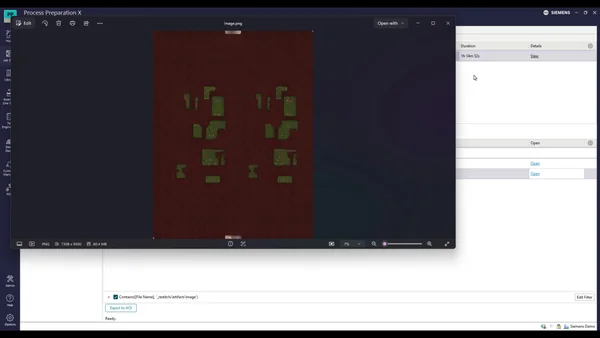
The workflow developed by both companies stems from the integration of Siemens Teamcenter and Process Preparation X. Teamcenter, Siemens' product lifecycle management (PLM) solution, provides information related to the PCB design, bill of materials, and electronic components. Process Preparation X then validates, normalizes, and assembles this data to build a digital twin of the printed circuit board assembly (PCBA).
NVIDIA Cosmos Generates Virtual Boards and Synthetic Defect Images.
One of the main elements of the collaboration is the use of NVIDIA Cosmos to generate realistic visual representations of electronic boards. The process begins with a virtual reference board, known as a golden board, which represents the correct assembly conditions.
From this digital twin, NVIDIA Cosmos allows the generation of a photorealistic representation of the reference board and synthetic samples that reproduce both correct conditions and possible manufacturing defects.
Siemens uses NVIDIA Cosmos Data Factory to generate synthetic images of defects on printed circuit boards. These images are intended to facilitate the preparation and calibration of inspection systems before the first boards are manufactured. The availability of synthetic data can reduce reliance on physical samples during the initial setup phases.
AI-powered secondary inspection to reduce false detections.
The collaboration isn't limited to the virtual preparation of AOI systems. The workflow also includes incorporating AI-assisted secondary inspection capabilities during production. When an automated optical inspection system identifies a potential defect, this second stage can help analyze the detected condition. Its purpose is to help determine whether it's a real defect or a false detection, also known as a false call.
The combination of virtual preparation, calibration with synthetic data, and secondary inspection aims to establish a connected process from the early engineering phases to factory quality control.
The Siemens factory in Erlangen serves as a demonstration environment.
The Siemens Electronics Factory in Erlangen is the chosen location to demonstrate the developed capabilities. The facility participates as Customer Zero, a designation used by Siemens to identify the first application and evaluation environment for these technologies. The factory provides the industrial use case, the production environment, and the technical expertise necessary to develop and test the workflow. It is a facility characterized by adaptable production, with a wide variety of products and processes subject to frequent changes.
Engineering Effort Reduction and Quality Improvement Objectives
The project establishes three main indicators to evaluate the planned improvements.
85%. Up to 85% less manual engineering effort in generating AOI programs
. 40%. More than a 40% planned reduction in false detections
. 5%. More than a 5% target improvement in first-time production performance.
The increase in first-pass yield refers to the improvement in the percentage of units that pass production controls on the first attempt, without requiring corrections or rework. According to Siemens, the combination of these improvements would accelerate the preparation of new part numbers and increase the quality of electronic manufacturing processes.
Siemens Connects Digital Twin with Physical Production:
Mark Hindsbo, Siemens' Executive Vice President of Operations Software, emphasized that connecting the digital twin, the production floor, and artificial intelligence allows for a unified approach to productivity and quality. According to Hindsbo, the digital representation of the reference board provides a foundation for preparing manufacturing processes using physical AI. He believes this approach can help electronics manufacturers implement production changes more quickly and reduce the need to stop lines during inspection system setup.
NVIDIA's Vice President of Physical AI Simulation, Rev Lebaredian, indicated that manufacturers shouldn't have to wait for the first physical board to arrive before beginning inspection processes. Using synthetic images of good and defective boards is one of the mechanisms planned to expedite these operations.
Towards more adaptable electronics manufacturing through industrial AI:
The collaboration between Siemens and NVIDIA represents an application of digital twins and artificial intelligence to the inspection and quality control operations of electronic boards. The proposal combines engineering data from Teamcenter, process preparation using Process Preparation X, and synthetic image generation with NVIDIA Cosmos. These capabilities are complemented by an AI-assisted secondary inspection stage designed to analyze potential defects during production.
The project aims to connect the virtual and physical manufacturing phases to reduce dependence on prototypes, expedite the configuration of AOI systems, and facilitate the introduction of new references.