"The service robotics sector is on the move: more and more robots are providing services in factory plants, shopping centers, or helping with deliveries on the street," says Marina Bill, President of the International Federation of Robotics.
Main applications of professional service robots by units sold
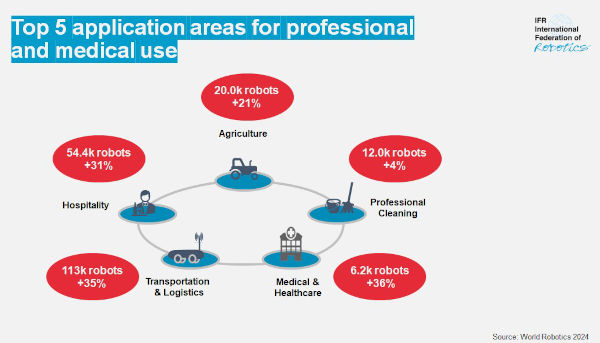
More than one in two professional service robots sold in 2023 were built for the Transportation and Logistics application class. Sales grew by 35%, with nearly 113,000 units sold in 2023. Given the significant labor shortage in the sector, there is strong demand for technological support. For example, one of the most time-consuming tasks for truck drivers is loading and unloading, where robotic applications offer targeted automation solutions. Making the application easy for non-technical personnel to use and understand is key to its adoption.
The shortage of skilled workers is also driving demand for automation in outdoor environments without public traffic. Robot types in this class range from conventional automated vehicles, such as forklifts or tractors, to customized solutions, often with a weatherproof enclosure for the goods being transported.
Hospitality robots are becoming increasingly popular: Over 54,000 units are expected to be sold in 2023 (+31%). Robots for mobile guidance, information, and telepresence account for the majority of these robots. As the sector evolves rapidly, some key applications have emerged, such as food and beverage preparation, as well as wayfinding and information points in public spaces.
Sales of agricultural robots are registering strong growth (+21%), with almost 20,000 units sold in 2023. The shortage of human labor in times of serious demographic changes and the demand for more sustainable precision agriculture make service robots a key player in this market.
The market for professional cleaning robots grew by 4% to almost 12,000 units sold. The main application is floor cleaning, representing approximately 70% of units sold in this application group.
According to the ISO standard, the World Robotics 2024 yearbook considers medical robots as a third category alongside service robots and industrial robots: Sales of medical robots increased by 36% to reach approximately 6,100 units in 2023. Sales of rehabilitation and non-invasive therapy robots increased by 128%. Demand for surgical robots increased by 14%, and sales of diagnostic robots increased by 25%.
The top 3 countries supplying medical robots and services
The United States is home to the largest number of medical and service robot manufacturers in the world, with 199 companies headquartered there. Sixty-six percent of these manufacturers produce professional service robots, 27 percent consumer service robots, and 12 percent medical robots.
China ranks second with a total of 107 manufacturers of medical and service robots. The proportion of companies offering professional service robots is even higher than in the United States, at 80%. 34% offer consumer robots, and only 5% offer medical robots.
Germany ranks third, with 83 companies. Like China, it has a very high proportion of manufacturers of professional service robots, with a 79% share. 17% offer consumer applications and 12% medical robots.
From a regional perspective, most manufacturers of medical and service robots are based in Europe, with a global market share of 44%, followed by Asia with 29% and America with 25%.