Sensor technology is ubiquitous in modern electronic equipment and devices. The ability to detect and convert physical information into an electrical signal for processing makes sensors commonly used in communications, transportation, industry, healthcare, energy, consumer goods, and agriculture.
Although sensors represent only a small portion of the annual revenue of large electronics companies, sensor technology represents a multi-billion dollar global market. By 2025, commoditized sensor technologies, such as semiconductor, optical, and conventional (electromechanical, electrochemical) transducers, will capture the majority of the market share by revenue.

Ten-Year Global Sensor Market Forecast (2025-2035), Segmented by Sensor Technology. Source: IDTechEx - “Sensor Market 2025-2035: Technologies, Trends, Players, Forecasts.”
In these established sensor markets, design trends focus on improving integration and performance in products and applications. New sensor technologies must compete in size and power, offer the ability to measure more parameters for longer periods with greater sensitivity and accuracy, and integrate into new form factors.
Beyond established sensor markets, emerging global technology megatrends are reshaping sensor technology requirements and offering new growth opportunities for original equipment manufacturers (OEMs). The future of mobility (autonomy, electrification, and driver control), the expansion of the Internet of Things (IoT), the increasing integration of AI, the adoption of wearable technology, and the commercialization of 6G demand unique sensing requirements.
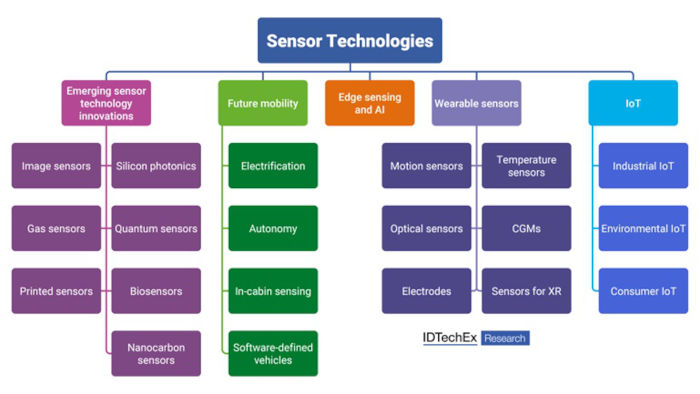
The main sensor markets and technologies covered in the IDTechEx report “Sensor Market 2025-2035: Technologies, Trends, Players, Forecasts.” Source: IDTechEx.
A Bright Future for Sensors in the Mobility of the Future.
Trends in electrification, automation, in-cabin monitoring, and software-defined vehicles are dramatically changing sensor needs in the automotive sector. For example, temperature, current, voltage, and gas sensors are needed to monitor electric vehicle batteries, while LiDAR, radar, infrared imaging, and camera technologies are essential for autonomous vehicles.
The increasing autonomy of vehicles will transform passenger-vehicle interactions, and automotive sensor technology is poised to play a key role in ensuring safety and delivering personalized passenger experiences. Infrared, time-of-flight (ToF), and radar sensors can be used for in-cabin monitoring in advanced driver assistance systems (ADAS) to check if the driver is focused on the road. In the future, enhanced passenger-vehicle interaction and biometric authentication will enable the emergence of software-defined, connected vehicle (CV) business models based on functions as a service.
The future of mobility will rely on sensor technology to drive the next evolution of transportation and passenger-vehicle experiences.
The wearable sensor technology landscape encompasses a wide range of sensor types, which can be integrated into a variety of wearable form factors. Motion sensors, optical and image sensors, wearable electrodes, and force, strain, temperature, and chemical sensors are used in medical, consumer, AR/XR, and industrial applications.
The past decade has been marked by the success of smartwatches and fitness trackers, as well as the disruption of continuous glucose monitors (CGMs) from glucose test strips to other devices. Following this disruption, large-scale opportunities in the wearables sector are more difficult to find. Looking ahead, there are still many exciting innovations in the wearable sensor sector, which could now seek to penetrate more specialized markets as demand grows for refining them for smaller, more specific vertical applications.
Demand for IoT sensors persists, but their adoption and deployment remain slow.
IoT continues to be a key high-volume target market for sensors, with solutions promising smart devices that are “more than the sum of their parts.” Although IoT sensors are widely used in logistics, agriculture, industry, and building automation, the rate of adoption has consistently been disappointing. Despite this, sensor manufacturers continue to develop industrial, environmental, and consumer IoT applications at a good pace.
The Industrial IoT (IIoT) uses sensor networks to collect, monitor, and analyze data from industrial operations. Key emerging applications of IIoT sensor technology include industrial robotics and automation, machine condition monitoring and predictive maintenance, worker safety, inventory management, and logistics. Data obtained from IIoT solutions allows for optimized efficiency, improved safety and productivity, and reduced operating costs.
Gas sensors are key components within environmental IoT solutions, where indoor air quality and outdoor pollution monitoring are of primary interest. Stricter regulations and recommendations regarding outdoor air quality are increasing the need for sensitive gas sensors. Key gas sensor technologies in the environmental and consumer IoT include optical particle counters, metal oxide sensors, electrochemical sensors, infrared sensors, photoionization detectors, and photoacoustic sensors.
The long return on investment (ROI) period for IoT solutions remains a key challenge. High initial capital investment, operational downtime, and the integration of legacy infrastructure represent barriers to IoT adoption. These challenges are largely independent of the underlying IoT sensor technology, but they nonetheless affect the growth rate of the sensor market.
Edge sensors combine edge computing and AI.
Over the past decade, the commercialization and advancement of high-performance, low-power CPUs have been driving edge computing. Integrating edge computing into sensors enables lower-latency, intelligent functionality, reduced overall power consumption, and fewer data privacy concerns.
Edge sensors are increasingly being developed with AI capabilities to bring greater intelligence to devices. The emergence of neural processing units (NPUs) is enabling the integration of AI into end devices (e.g., by locally using small and medium language models). Integrating AI into sensors promises predictive and prescriptive functions for greater device automation in most application markets.
Edge sensor technology is compelling in time-critical applications that generate large volumes of data. Key applications in the edge sensor market include occupancy detection in smart buildings, predictive maintenance in industrial IoT, and activity and vital sign monitoring in medical wearables.
Innovations in sensor hardware continue to expand the possibilities of the sensor market.
While global technology trends are reshaping many established sensor markets, innovation in sensor hardware will play a key role in enabling future applications.
New material platforms with maturing sensor applications offer new form factors and cost savings compared to current solutions. Printed and flexible sensors, including advanced carbon sensors, can be fabricated on large surfaces for capacitive touch, force, temperature, and photosensing applications.
Following the successful commercialization of quantum dots in the display industry, quantum dot image sensors are now appearing on the market and are poised for significant disruption. QD-on-CMOS short-wave infrared sensors are at least an order of magnitude cheaper than current InGaAs sensors, unlocking high-volume applications such as ADAS systems for vehicles.
Looking ahead, the sensor market is venturing into uncharted territory as the commercial development of quantum sensor technology accelerates. Major players, such as Intel, Philips, and STMicroelectronics, are capitalizing on the growing interest in quantum technology, which is receiving significant investment. Quantum sensors, such as atomic clocks and inertial navigation sensors, are initially seeking applications in the aerospace and defense sector, where high sensitivity and cutting-edge sensor performance are paramount.
Market Outlook:
IDTechEx’s latest report on the topic, “Sensor Market 2025–2035: Technologies, Trends, Players, Forecasts,” provides a comprehensive overview of the global sensor technology market, with critical insights and analysis drawn from 14 related IDTechEx reports covering sensor technology.
Author: Dr. Jack Howley, Technology Analyst at IDTechEx