As long as at least one node is powered, time synchronization is maintained relatively accurately. However, certain applications, especially outdoor lighting or installations with frequent power outages, present an additional challenge: what happens when all devices on the network lose power completely for hours or even days?
In these situations, the loss of the network's time reference causes all functions that inherently depend on it, such as time-based scheduling events, to malfunction. Traditionally, manufacturers have attempted to solve this problem by creating dedicated devices that are powered by batteries or supercapacitors for a limited time. However, this solution has significant limitations, which have been addressed by the innovative GPS-Timer function developed by Olfer Electronics and will be implemented in one of their upcoming releases.
Global Positioning System (GPS): A Precise, Permanent, and Global Time Reference.
The Global Positioning System (GPS) is primarily known for its navigation and geolocation applications. However, one of its most valuable and lesser-known features is its extraordinary ability to provide an extremely precise time reference.
The GPS constellation consists of dozens of satellites orbiting the Earth, continuously transmitting positioning and time information. Each satellite incorporates highly stable atomic clocks, capable of maintaining errors on the order of nanoseconds. The entire GPS infrastructure is synchronized with respect to a common time scale which, through appropriate corrections, allows for references aligned with Coordinated Universal Time (UTC) for any area of the planet.
The operating principle of the GPS system is based on trilateration. A ground receiver calculates its position by measuring the time it takes for signals emitted by multiple satellites to arrive. Since electromagnetic waves travel at the speed of light, even a minimal time deviation would result in significant positioning errors. For this reason, time accuracy is one of the system's fundamental pillars. This capability makes GPS technology an ideal solution for maintaining an accurate and reliable time reference, even when an installation is without power for extended periods.
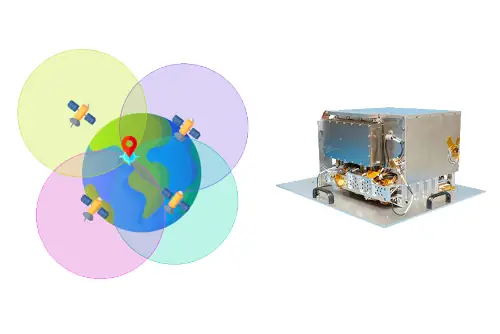
Figure 1. Trilateration method of the GPS system (left) and high-precision atomic clock (right)
A Disruptive Solution for Casambi Lighting Systems
. Building on these advantages, Electrónica Olfer has developed an innovative feature called GPS-Timer, integrated into one of the devices that will make up its new generation of Casambi nodes, to be launched in the coming months.
The concept is simple, yet extremely effective: the device incorporates a GPS receiver capable of directly obtaining the UTC time reference provided by satellites. In this way, the node can assume the role of Master Timer within the Casambi network, continuously providing the necessary time information for the execution of scheduling events and other functions that depend directly on this condition.
The main difference compared to conventional solutions is that maintaining the time reference no longer depends on energy storage elements such as batteries or supercapacitors.
While other devices on the market typically offer autonomy of between 24 and 72 hours to maintain the time during a power outage, the GPS-Timer solution eliminates this practical limitation. Upon power restoration, the device immediately receives the time reference from GPS satellites, achieving precise synchronization without needing to conserve energy during the power outage.
Therefore, it can be said that, by using this new solution, the system provides "infinite time autonomy," since the time reference does not depend on a local energy reserve that could be depleted.
Furthermore, by using a GPS receiver, the device is able to receive the exact geographic coordinates and transmit them to the Casambi network so that certain functions requiring this information operate correctly after a power outage. A clear example of this is the scheduling of sunrise/sunset events, which depend on this location to function properly based on the location of our Casambi network.
Main technical advantages of a GPS-Timer device
The incorporation of the innovative GPS-Timer functionality as the primary time source brings multiple technical benefits to a Casambi lighting system:
• Energy independence for maintaining the time reference. Infinite autonomy.
• Greater long-term reliability, avoiding the degradation associated with the use of batteries/supercapacitors.
• Greater robustness in outdoor lighting installations, where complete system shutdowns are frequent.
• It does not require any type of SIM card or internet connection.
• Direct synchronization with UTC, guaranteeing a global and extremely precise reference. We avoid the typical time drift in Casambi networks that occurs due to the use of quartz oscillators (2.5s/day).
• Automatic transmission of geographic coordinates to the Casambi network to ensure the correct functioning of sunrise/sunset-based time scheduling events.
• Compatible with installations located anywhere in the world. Automatic adaptation to the 38 time zones present in the world and all day time zone changes (DST) in any territory.

Figure 2. Graphical representation of the different time zones present in theworld
New range of Casambi nodes
The GPS-Timer functionality mentioned in this article will be implemented in one of the devices that will be part of the new family of Casambi nodes that Electrónica Olfer is developing to meet the most demanding needs of the market.
The aim of this new product range is to provide solutions capable of simplifying the integration of the Casambi control system in outdoor lighting applications, increasing the reliability of installations and significantly reducing operating and maintenance costs.
The revolutionary GPS-Timer device combines Casambi connectivity, DALI control output, and advanced time synchronization and location capabilities in a compact form factor compatible with Zhaga Book 18 sockets. It also features other unique functions and tools that will be unveiled soon.

Figure 3. Casambi node with GPS-Timer functionality and DALI control output (currently under development)
With the addition of the GPS-Timer node, Electrónica Olfer introduces a completely different approach within the Casambi product ecosystem and solves one of the historical challenges present in this type of system: maintaining an extremely precise time reference even when the entire Casambi network has remained completely disconnected for an unlimited period of time.
This innovation reinforces Electrónica Olfer's commitment to developing advanced products and technologies for smart lighting systems, expanding its already extensive range of nodes that aim to offer better performance, greater robustness, and new automation possibilities for manufacturers, integrators, and managers of Casambi lighting infrastructures, reinforcing the company's role as a benchmark in the design and manufacture of a wide variety of devices within the Casambi product ecosystem.