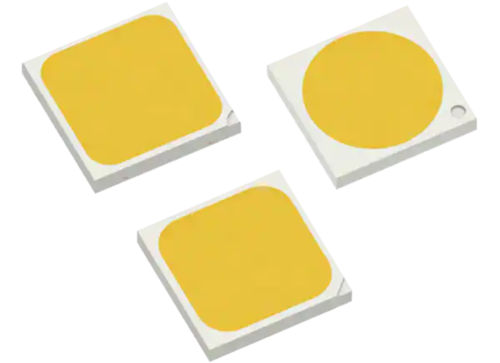
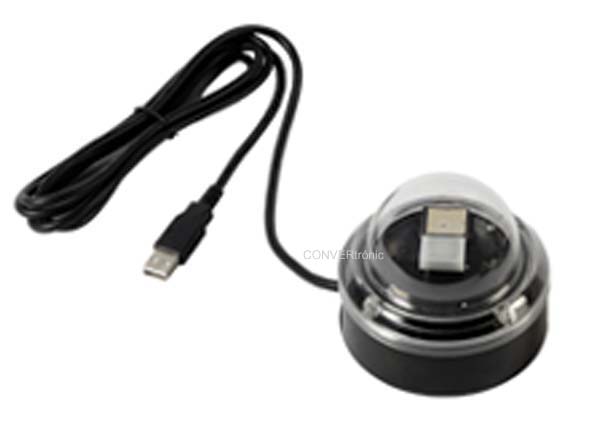
 This article describes the various options available to designers for integrating an LED driver solution. ROHM has expanded its range of highly integrated LED driver ICs to offer a variety of design options with integrated or external switched outputs, parallel/series control, and numerous protection and fault detection features in compact surface-mount packages.
Applications of LEDs in automobiles include interior lighting (such as ceiling, instrument panel and legroom lighting), indicator and warning lights, infotainment backlighting, as well as exterior functions (signaling) such as taillights, turn signals, brake lights (including top center mounted brake lights), parking lights, side marker lights, fog lights and daytime running lights.
More recently, some car manufacturers have introduced high-brightness LED-based headlights in production models. In some cases, the capacity of an LED driver can allow the same LEDs to be used in more than one application. Major automotive headlight manufacturers have supplied prototypes with high-brightness LEDs, and almost all car manufacturers have also showcased prototype vehicles incorporating this type of lighting; it is anticipated that some standard vehicles will incorporate LED-based headlights in 2012. As LEDs continue to improve in efficiency and decrease in cost (the light output of encapsulated LED devices doubles approximately every 18 months), vehicles will use an increasing number of LEDs and LED drivers. Thanks to the low energy consumption of LEDs compared to conventional lighting, an estimated 0.2 liters of fuel consumption per 100 km and approximately 4 grams less CO2 emissions per km represent a definite advantage of replacing incandescent lighting with LEDs for daytime running lights alone. In electric and hybrid vehicles, an 85% reduction in energy consumption thanks to the use of LEDs instead of incandescent bulbs translates into greater range. As a result, there are several compelling reasons for implementing LEDs in automotive applications. A key factor is the power management provided by the integrated circuit drivers.
 LED Driver Requirements:
LEDs require a constant current to produce consistent illumination. Therefore, this is the primary requirement for the operation of an LED driver. The accuracy of the current source determines its appeal to the customer. Current fluctuations caused by variations in the vehicle's voltage supply must be avoided. Linear regulators offer simple control and do not require electromagnetic interference (EMI) filters. However, their power dissipation can be excessive in high-power applications. Buck DC/DC converters are often used as the next step. When the driver manages multiple LEDs in series, a boost converter is used. In some cases, a buck-boost topology offers the possibility of meeting various application requirements, including the ability to handle a variable supply voltage.
LED drivers can be designed to offer a combination of series and parallel LED control. Devices with this capability provide circuit designers with the flexibility to control LEDs in different applications with a single driver, rather than requiring multiple devices that increase development work and homologation testing. Dimming is a common requirement for interior lighting. However, exterior lighting applications require supplying different brightness levels with the same LED. For example, brake/tail lights, low beam/daytime running lights, and high/low beam headlights are referred to as dual-level light points. In some cases, the lighting design can cover both situations with the same LED by using the appropriate LED driver. For harsh automotive environments, various protection circuits are needed to prevent device failure under fault conditions.
 Design considerations for the automotive sector:
Unlike other market segments, automotive applications have more demanding requirements than those reflected in industry standards and purchasing specifications, including temperature and humidity ranges, supply voltage range, the ability to withstand aggressive chemicals, electromagnetic interference and electromagnetic compatibility (EMC), as well as reliability requirements set by homologation tests.
The voltage range for automotive applications extends beyond the normal operating range of 9 to 16V (nominally 14V) for charging a 12.6V battery at ambient temperature. It encompasses extreme operating conditions such as reverse battery charging (-12V), jump-starting by connecting to another battery with double the voltage (+24V), and fault conditions like the sudden discharge that occurs when the battery is disconnected from the alternator, as well as other voltage transients. A sudden, uncontrolled discharge can last for several hundred milliseconds and easily exceed 80V, but many manufacturers have now centralized the surge protection circuitry and therefore require such components to withstand transients down to approximately 40 to 60V. In addition to these high voltage requirements, starting conditions can result in lower voltages, necessitating the availability of countermeasures for adverse conditions.
The high reliability of automotive applications is indicated by the need for protective circuitry against overvoltages, undervoltages, reverse polarity, overcurrents, short circuits, and overtemperature in numerous integrated circuits. The component's operational life must also be verified through a wide range of tests. The vehicle manufacturer's target for operational life might be a 10-year/150,000 km warranty.
 Discrete or Integrated LED Outputs:
Depending on the power requirements of the LEDs, it may be useful to implement LED drivers with integrated or external transistors. However, there are advantages and disadvantages to integrating MOSFETs into the LED driver IC. Integrated LED switches reduce the number of components by saving board space and simplifying the component list, as they also ensure perfect coordination between the transistor and driver. If the power level increases, such as when the LED driver manages high-brightness LEDs or when LED matrices need to be controlled, it is much better to consider the external option, as this facilitates heat dissipation.
ROHM LED drivers are divided into three main segments:
a) Single-channel and multi-channel controllers for backlighting.
b) Controllers for switches and single LEDs in parallel.
c) Complex controllers for outdoor lighting.
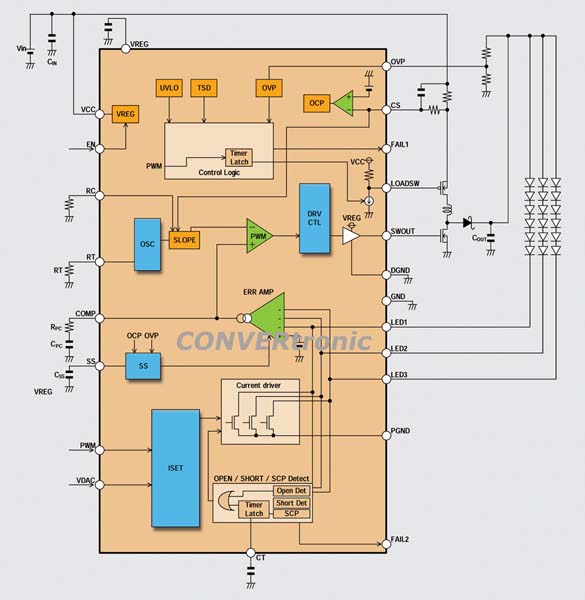
Backlighting is especially important for displays (of medium and large size) in radio navigation systems and central information displays. ROHM offers LED drivers with one, two, three, or four channels to meet the different requirements and display sizes. A step-up/step-down system is used as the topology, allowing for adjustment of the display's brightness and readability across a wide range of ambient light levels and sources, from full sunlight to complete darkness. The three-channel BD81A33 requires only a few external components and is supplied in a high-temperature SSOP28 package (see Figure 1).
The switching frequency of the drivers for the backlight LEDs can be up to 2.2 MHz to reduce the size of external components (e.g., the inductor) and eliminate the influence of EMI in the AM band. The supply voltage is 4.5 V up to approximately 2.2 MHz. The 40V output and maximum current range of 120 to 400 mA per channel (depending on the driver) are used. The maximum number of LEDs in series in each matrix depends on the forward bias of the diodes and the preset value of the protection mechanisms. Typically, six or seven LEDs can be controlled in series. Therefore, with a three-channel matrix, 20 LEDs are available to illuminate a display. To avoid EMI issues—especially important for car radio applications—external synchronization is available.
The integrated LED malfunction detection function has two output channels: Output 1 for undervoltage lockout, thermal shutdown, and overvoltage and overcurrent protection, and Output 2, which indicates the detection of live wires or open LEDs in one or more LED matrices. If necessary, the corresponding channel can be disconnected to prevent damage to other parts of the system.
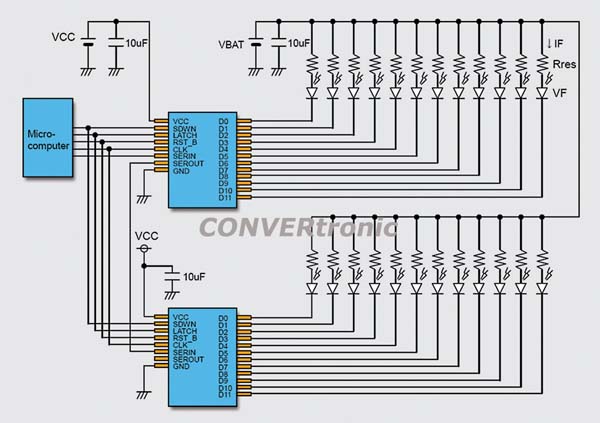 Fully integrated controllers with serial input and parallel output are shift registers used to control individual LEDs mounted in parallel. To achieve consistent brightness of nearby LEDs, each channel can be dimmed individually or together with the entire system. ROHM offers 8- and 12-channel controllers, such as the BD8105, BD8115, and BD8377. Based on the BD8377, a device with integrated diagnostics has been designed to meet the needs of the European market. All controllers are ideal for instrument panel displays, warning indicators, and especially center-panel controls such as those for climate control. The integrated circuits require only a few external components, resulting in a space-saving design. The BD8377 and BD8105 have 12 parallel outputs (Figure 2), while the BD8115 has eight channels. The maximum output current is 50mA (DC) and switched up to 150mA for each channel.
The driver ICs can be cascaded, allowing two or more devices to be controlled in series (Figure 3) when controlling more than eight or twelve LEDs, without increasing the number of I/O pins on the microprocessor. The driver, supplied in a B20W SSOP package and incorporating transistors, provides standard protection circuitry against overheating, overcurrent, and overvoltage. Additional diagnostic functions allow for the detection of open or short-circuited LEDs, enabling the disconnection of each channel until the malfunction is cleared. The respective channel is then reactivated by the microcontroller.
ROHM's latest LED driver series comprises drivers for exterior lighting, such as taillights and low beam headlights, as well as daytime running lights. The BD8372 in an HTSSOP28 package is designed for controlling multiple high-brightness LEDs in headlights. The BD8372 in an HTSOP8 package is designed for taillights. Both devices tolerate a maximum input voltage of 50V to allow direct battery control. They incorporate the same protection circuitry and diagnostic functions described earlier, which are particularly important for the automotive market.
 The application diagram (Figure 4) illustrates the use of external MOSFETs by the BD8381. The transistor phase is externally accessible so that designers can select the type of switch required for each application when multiple brightness levels are needed. It supports both multi-chip and single-chip LEDs. The integrated PWM generator would even allow operation without a microcontroller.
The trend in exterior lighting is moving towards increased functionality integrated into LED drivers and multiple channels for all types of functions: turn signals, low and high beams, daytime running lights (front) as well as flashing lights, taillights, fog lights, and brake lights (rear). With its LED drivers for white LEDs aimed at automotive applications, ROHM Semiconductor has further expanded its portfolio of highly integrated LED driver ICs, offering a range of devices for virtually every type of LED-based vehicle lighting. ROHM's own LEDs are also available.
Author: Finn Lange, Product Manager, ROHM Semiconductor Europe).