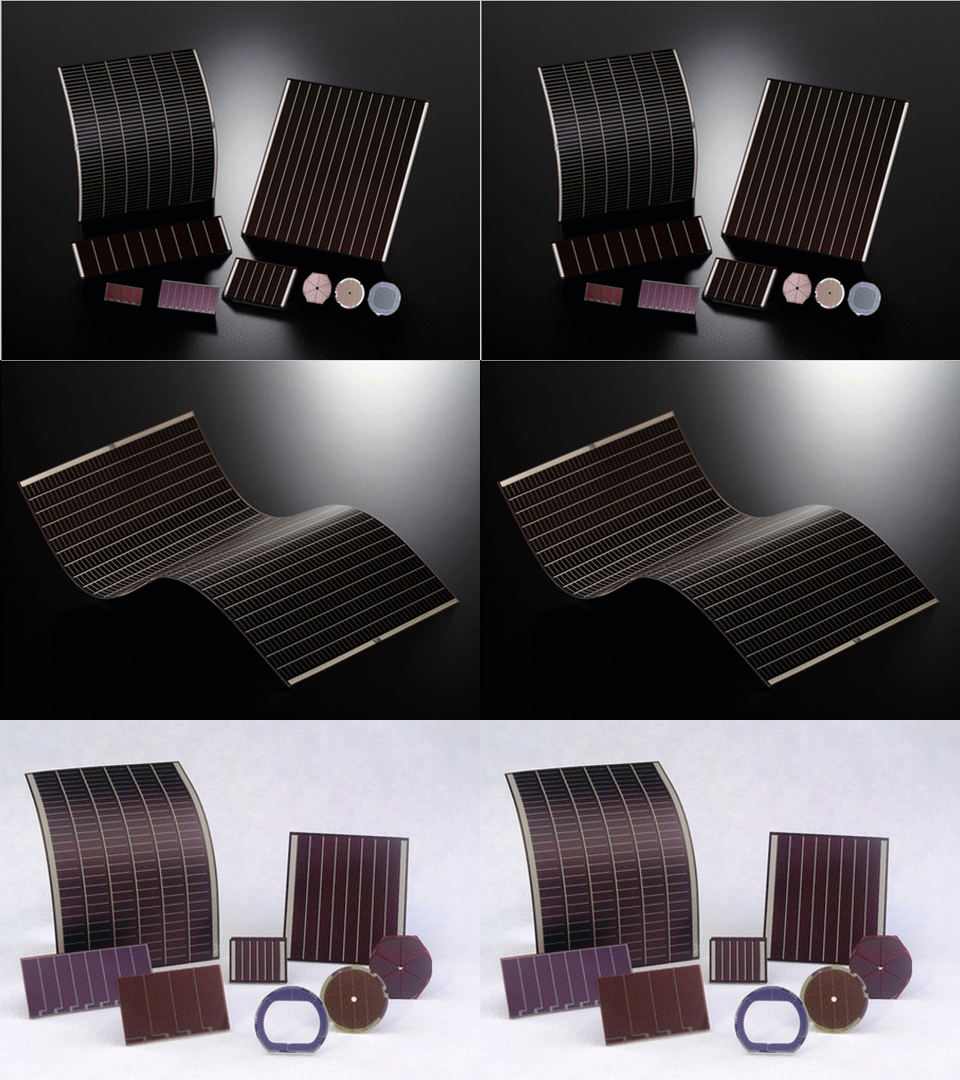
Consequently, for the same thickness, a layer of amorphous silicon absorbs more light than a layer of crystalline silicon. Therefore, sheets less than 1 μm thick can be used to manufacture efficient amorphous solar cells, while the sheet thickness for crystalline silicon is on the order of μm. Flexible, thin, durable solar cells in complex shapes can be produced.
The human eye is sensitive to light in a range of wavelengths between approximately 380 and 780 nm, and since amorphous silicon photovoltaic cells absorb light in virtually the same range, they can also be used as visible light sensors (brightness sensors).
The main applications in the industry are:
- Displays (e.g., e-paper displays).
- Battery chargers / battery life extension.
- General energy harvesting.
- Standalone and wireless sensors.
- RFID tags.
- Remote controls.
- Automotive accessories.
- Garden lights, motion-activated lights, LED lighting.