
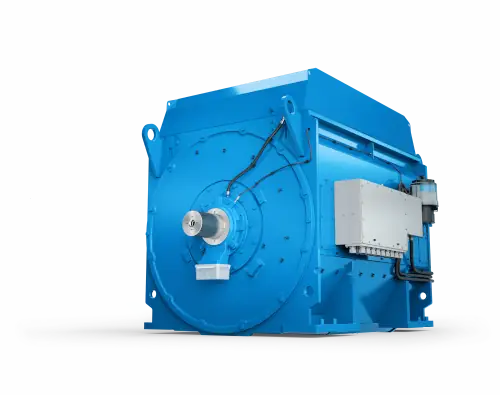
The system, called GENERA, is based on a doubly fed induction generator (DFIG) and offers improvements in power density, dimensions, noise emissions, and material consumption. One of its main features is that it does not use permanent magnets or rare-earth materials, even in the highest power classes.
Power Density Up to 700 W/kg:
The design achieves power densities of up to 700 W/kg, approximately 10% higher than its predecessor. At the same time, the generator's length has been reduced by around 25%.
This reduction facilitates its integration into the nacelle and can simplify the logistics of equipment intended for turbines with capacities exceeding 10 MW, allowing the use of standard trucks and containers in certain projects.
The system also eliminates the need for external cooling fans, thus avoiding the auxiliary power consumption associated with these components. This allows a greater proportion of the generated electricity to be allocated to the turbine's net output.
Another improvement is in acoustic performance. Noise emissions are reduced by 6 dB(A) compared to the previous generation, a particularly relevant feature for installations located in areas with noise restrictions.
A rare-earth-free generator,
GENERA, utilizes a DFIG architecture and can be employed in various power classes without relying on rare-earth materials.
This feature is particularly important in high-power turbines, where other generation architectures may use permanent magnets incorporating these materials.
Rare-earth mining and processing are geographically concentrated in a limited number of countries, which can introduce risks related to pricing and supply. Eliminating these materials reduces this dependence within the wind turbine's drive train.
Furthermore, the generator windings can be manufactured from aluminum or copper, depending on the project requirements. This flexibility allows for consideration of factors such as cost, raw material availability, and the required technical characteristics.
Gearbox Integration:
The generator is designed to operate with various gearboxes, although it can also be integrated with architectures specifically optimized for high-power wind turbines.
One such architecture is REVO, a transmission concept that achieves a torque density of 300 Nm/kg. The aim of these solutions is to achieve more compact drive trains or increase power output without proportionally increasing the overall dimensions.
Coordination between the generator and gearbox optimizes the transmission ratio and the overall system efficiency. It also facilitates reactive power management, grid compatibility, and the integration of the wind turbine within wind farms.
Customized configuration for each project.
The generator's characteristics can be configured according to the specific needs of each installation. Variables include the winding material, noise restrictions, and transportation and installation requirements.
This modularity is particularly relevant in a sector where turbine characteristics can vary considerably depending on whether they are intended for onshore or offshore installations, their power output, and the specific site conditions.
Powertrain Monitoring:
The evolution of these systems is also linked to the digitalization of maintenance. Vibration sensors and monitoring systems allow for the supervision of various powertrain components, from the main bearing to the gearbox, coupling, and generator.
The collected data can be centralized to analyze both individual wind turbines and complete assemblies within a wind farm. Analyzing this data enables the detection of anomalies and the planning of maintenance interventions before certain failures occur.
This approach aims to reduce unplanned downtime, optimize maintenance intervals, and increase turbine availability throughout their lifespan.
Less Mass for Future Wind Turbines:
Reducing the weight and dimensions of drive train components is becoming increasingly important as wind turbine power increases.
Lower mass can reduce structural demands on towers and foundations, as well as facilitate equipment transport and installation. More compact designs can also simplify access to sites with greater logistical constraints.
The combination of higher power density, less dependence on certain critical materials, and digital monitoring systems reflects one of the key trends in the wind energy industry: increasing turbine power without proportionally increasing the size, mass, and complexity of its components.